
High-engagement nail posts repeatedly focus on the same experience: a full-cover tip can look elegant and feel fast when the size and curvature fit, but a poor match creates sidewall gaps, pressure points or an unnatural profile. For wholesale buyers, “many sizes” is not a complete specification.
This full cover soft gel nail tips wholesale guide explains how brands, salons and distributors should evaluate size matrices, curvature, shape, material behavior, sample fit, packaging and private-label options. “Gel-X” is associated with a particular branded system; this guide uses the brand-neutral term full-cover soft gel nail tips.
Fit is a three-dimensional specification
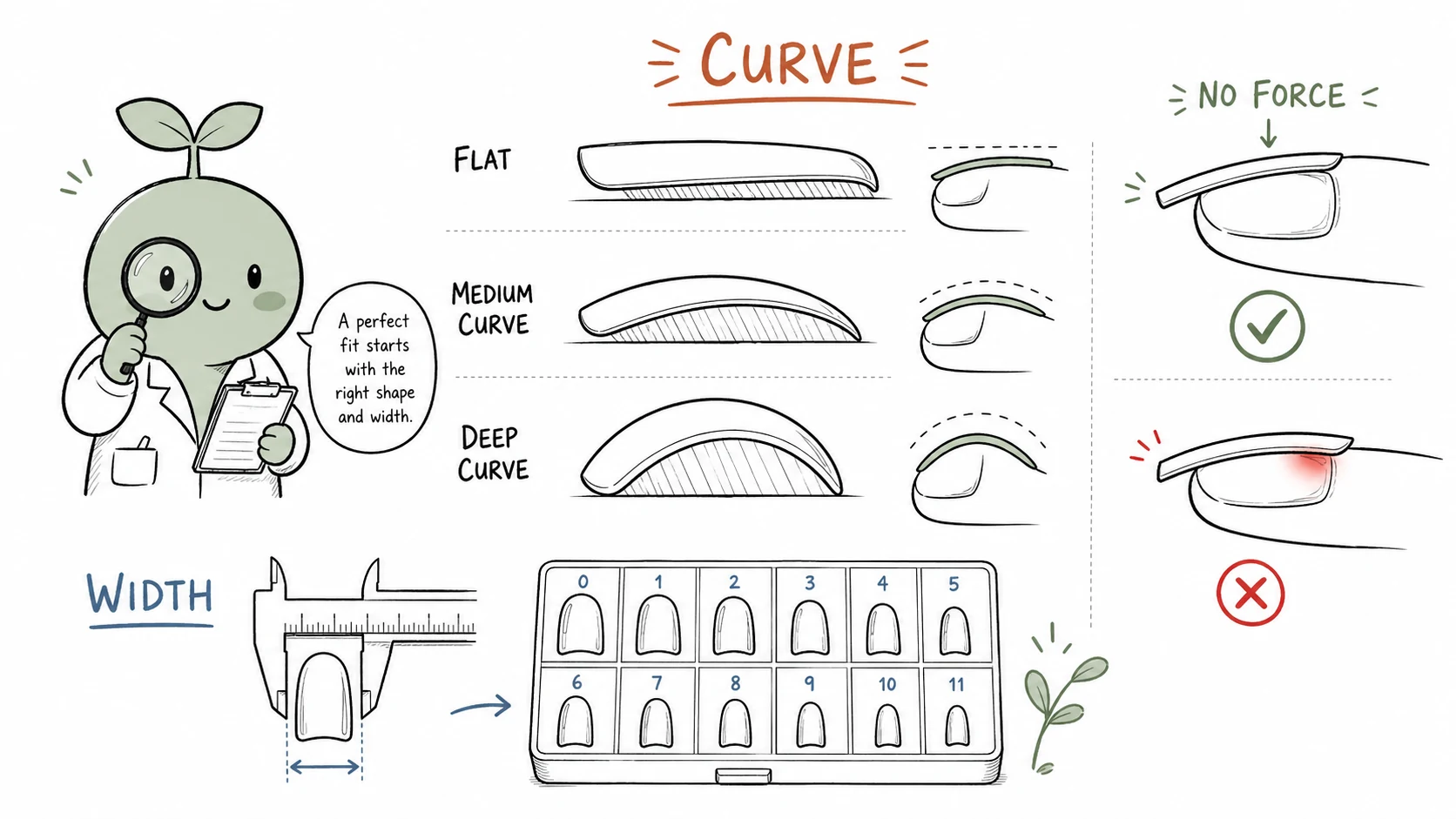
Tip width is only one variable. A size may span the sidewalls and still fit badly if its C-curve is too deep or too flat. Apex position, cuticle shape, sidewall taper and free-edge direction also influence contact.
Define the target fit with:
- width by size at a stated measuring point;
- internal curvature or C-curve family;
- cuticle-end contour and thickness;
- apex position and profile;
- sidewall shape and free-edge angle;
- overall length and finished shape;
- contact-area or pre-etched design if included.
Request a dimension table and physical size kit. Do not rely only on nominal labels such as 0–9 because numbering can differ between suppliers and collections.
Build a size matrix around real users
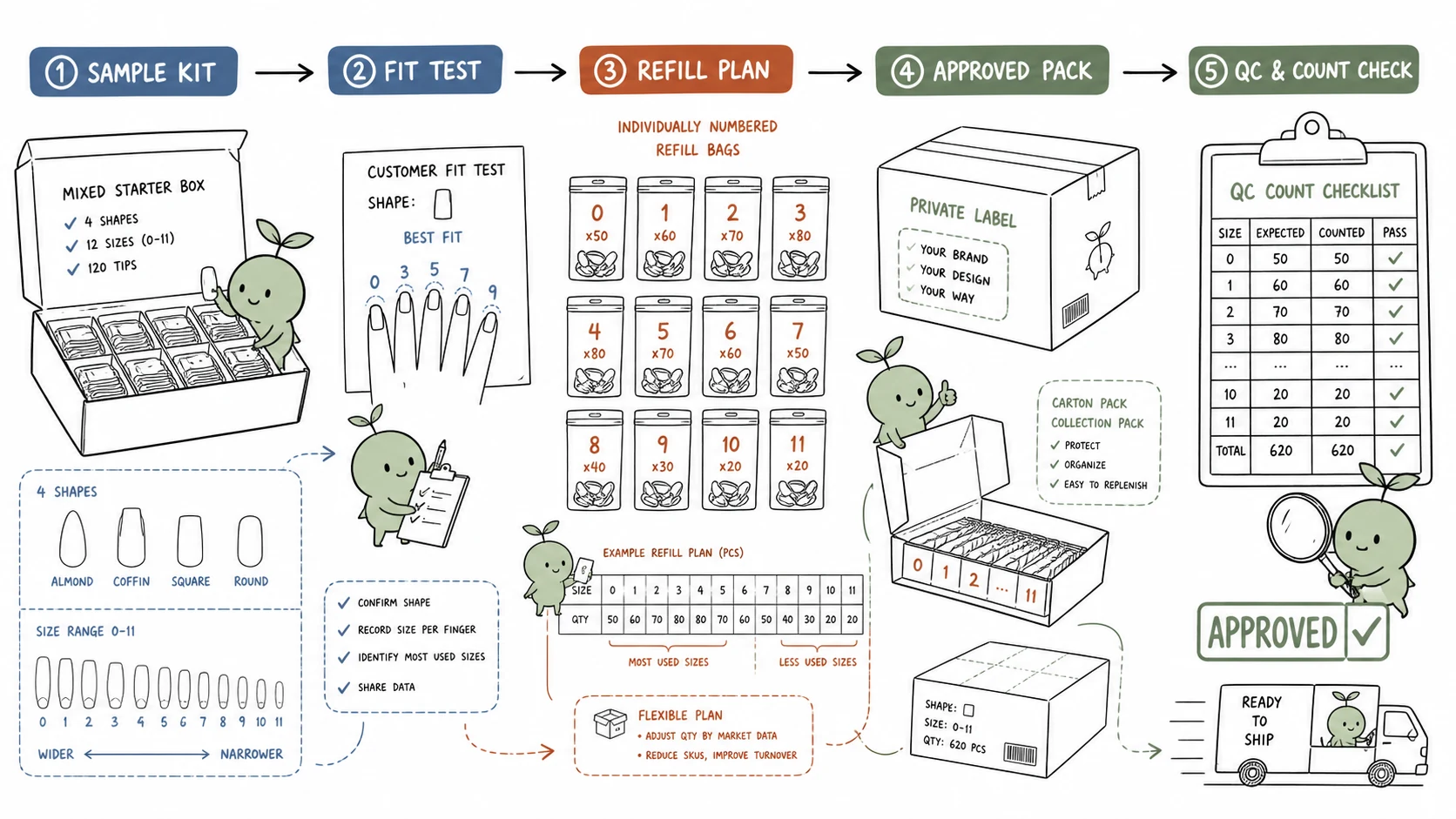
A 10-size kit can serve many users, but a wider matrix or half sizes may reduce forced fitting for salon professionals. More sizes also increase mold, inventory and packing complexity. The correct choice depends on the channel and price position.
| Program type | Size strategy | Main trade-off |
|---|---|---|
| Salon professional | Broad refillable matrix, possibly multiple curvature families | More SKUs and replenishment planning |
| Starter kit | Balanced assortment in a compartment box | Unused sizes in mixed kits |
| Consumer pre-sized set | Curated sizes with clear measurement guide | Higher risk of fit complaints |
| Distributor refill | Individual size bags or boxes | Forecasting by size is required |
During sampling, recruit users with narrow, wide, flat and pronounced-curvature nail beds. Record the chosen size, sidewall coverage, cuticle fit and whether pressure is needed to hold contact. A tip that requires force to fit is not a neutral match.
Material and geometry affect service behavior
“Soft gel” can be used broadly in product descriptions. Ask the supplier for the material definition, intended application system and relevant product documentation. Evaluate flexibility, clarity, thickness distribution and consistency across sizes.
A useful sample comparison checks:
- flex without whitening, cracking or permanent distortion;
- uniform wall thickness and smooth molded edges;
- clarity or color consistency;
- apex and free-edge profile across the size range;
- surface preparation at the contact area;
- compatibility with the brand’s validated adhesive and cure process;
- removal behavior under the system instructions.
Do not make universal wear-time or removal claims from the tip alone. Preparation, adhesive, lamp, cure, application and client behavior influence system performance. Claims should match the tested complete system and destination-market requirements.
Approve more than one hero size
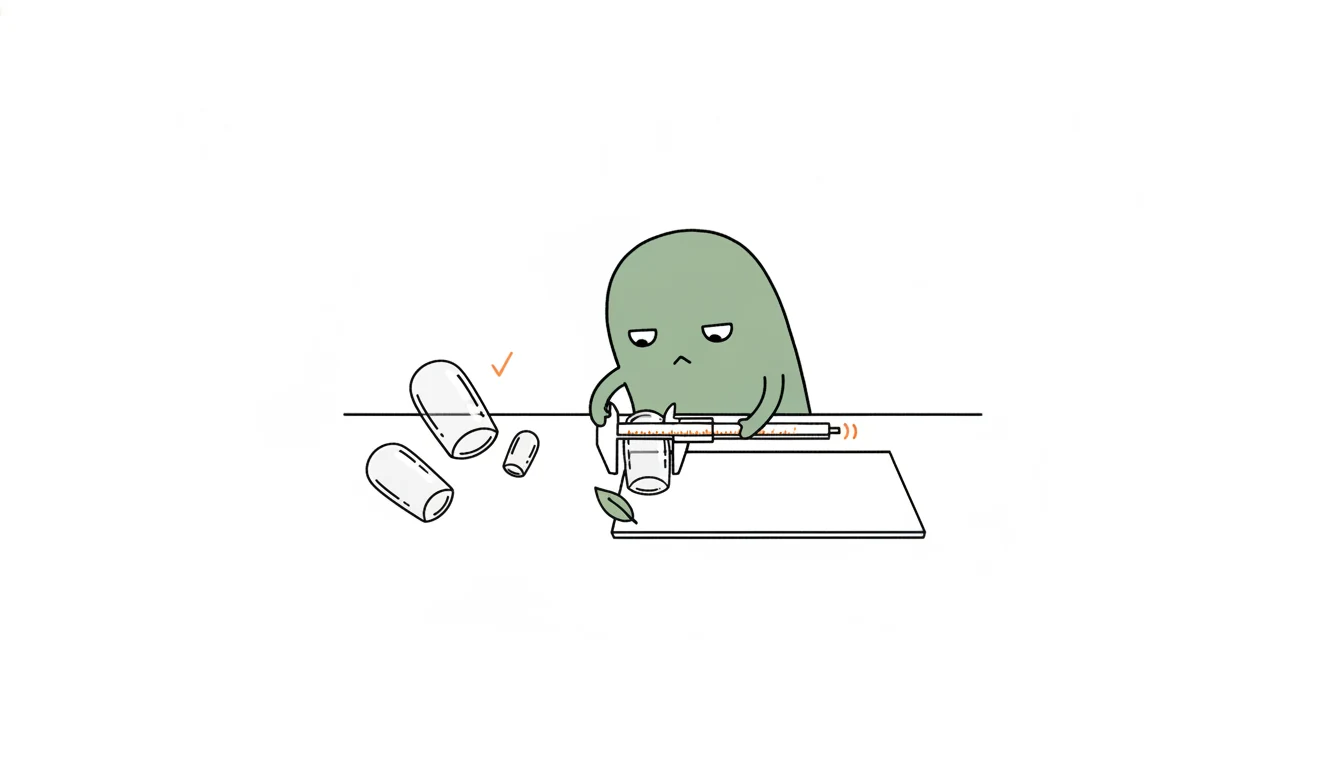
Suppliers often present a visually appealing medium tip, while the smallest and largest molds expose variation. Inspect at least the largest, smallest and several middle sizes for symmetry, flash, edge smoothness, numbering, thickness and curvature progression.
Run a pack-count audit and verify that each compartment or refill bag contains the stated size. Mixed or missing sizes are a frequent operational complaint because the product becomes unusable even when the tips themselves are good.
Create golden samples for each shape and curvature family. Production inspection can then compare dimensions, appearance, fit-box packing, labels, lot code and carton configuration. Use retain samples for traceability.
Choose shapes by channel, not trend alone
Almond, square, coffin, round and stiletto styles serve different customers, and each may come in several lengths. A first wholesale collection should balance demand with manageable inventory. A salon distributor might begin with short almond, medium almond, short square and medium coffin before adding long or extreme shapes.
Review sales and refill consumption by size and shape. The best-selling mixed kit does not always reveal which refill sizes are creating repeat orders. A refill strategy can improve professional loyalty and reduce waste.
MOQ, lead time, packaging and customization
Stock molds and shapes usually support a lower MOQ than custom geometry. A new mold family can require tooling cost, engineering samples and a longer validation cycle. Ask whether MOQ applies per shape, length, curvature, color, pack format or artwork.
Common packaging options include compartment boxes, numbered bags, refill boxes, salon bulk bags and starter kits with accessories. Confirm pieces per size, total piece count, spare compartments, label space, barcode, instructions and master-carton pack.
Customization may include:
- shape, length and curvature selection from stock molds;
- custom size matrix or new mold development;
- clear, natural or tinted material appearance;
- pre-etched contact area where available;
- logo box, label, instruction card and QR tutorial;
- mixed starter kit or individual-size refill program.
Lead time should separate size-kit sampling, fit validation, custom tooling if any, packaging proof, bulk molding, packing, inspection and freight. Build sample approval into the launch calendar.
Create a quote-ready tip program
Send the target customer, shape, length, curvature preference, size count, quantity per pack, refill plan, application system, packaging, branding, required documents, destination market and delivery target. If possible, include measurements or approved reference tips instead of only social-media images.
Use our Private Label vs OEM vs ODM guide, MOQ guide, nail quality-control checklist and OEM capabilities to prepare the project. Then contact us to request a quote for MOQ, lead time, packaging and customization options.
Frequently Asked Questions
Are all full-cover soft gel tip size numbers interchangeable?
No. Numbering, width and curvature can differ by supplier and shape. Use a physical size kit and dimension table.
How many sizes should a professional kit include?
The answer depends on the customer population and refill strategy. A broader matrix can improve fit but increases packing and inventory complexity.
Why can a tip fit in width but still feel tight?
The internal curvature may be deeper or flatter than the natural nail. Pressure should not be used to force an unsuitable curvature into contact.
What should be checked in a wholesale sample?
Check dimensions, curvature, symmetry, thickness, flexibility, molded edges, numbering, fit across diverse nail beds, pack counts and compatibility with the validated application system.
Can a supplier create a custom tip mold?
Often yes, but custom geometry can add tooling cost, higher MOQ, engineering samples and longer lead time. Compare it with stock-mold customization first.



Leave A Comment