
You can’t out-design or out-price a hepatitis lawsuit. If a single client walks out with a bloodstream infection traced back to your salon, the resulting state inspection, license suspension, online review storm, and possible civil suit will erase ten years of word-of-mouth in one quarter. Yet the 2024 Reddit threads on r/Nails make one thing painfully clear: most working nail technicians still don’t have a written sterilization SOP, and many salon owners are still buying disinfectants by smell instead of by EPA registration number.
This is the no-fluff B2B compliance guide we wish someone had handed us when we started supplying salon equipment. It is built around the three-tier workflow that every state board in North America implicitly enforces (cleaning → disinfection → sterilization), the actual tool-by-tool decision matrix you can post on your back-room wall, the equipment investment tiers from $50 jars to $2,000 autoclaves, and the disposable-vs-reusable economics nobody runs honestly. We’ll close with eight FAQs based on the questions that come up most in salon owner forums.
Why nail salon sterilization is the #1 inspection citation
Across the major US state boards that publish citation data, improper tool sterilization is consistently in the top three citations issued during routine salon inspections. The reasons are mundane, not exotic: jars of disinfectant left out for days past their effective dilution, files and buffers being reused without a proper barrier method, and metal implements being “wiped down” between clients with a paper towel and rubbing alcohol.
The real blast radius is rarely the inspector’s fine itself. It’s the chain reaction:
- License suspension for repeat citations (the second inspection in a 12-month window in most states triggers a probationary period).
- Insurance premium hikes after a written citation lands on your liability profile.
- Negative reviews if a client picks up a fungal or bacterial infection — the public review will tag your shop name forever.
- Civil exposure if a client can show your salon as the likely vector. Hepatitis B and HPV transmission via shared nail tools is documented in the dermatology literature; lawsuits in this space have settled in the five and six figures.
None of this requires advanced compliance theater. It requires a written SOP that everyone on the floor follows the same way.
US state rules: NY, CA, TX side-by-side
State cosmetology and barbering boards run the show in the United States. Federal-level OSHA bloodborne pathogen rules apply in any salon where blood exposure is possible (nipper-related cuts, etc.), but the operational rules — what disinfectant, how long, in what container — are state law. Three of the largest markets give you the spread:
- New York State (NYS Department of State, Division of Licensing Services) — Implements through the Appearance Enhancement License rules. Required: an EPA-registered hospital-grade disinfectant, immersion bath with full submersion of the tool, contact time per the manufacturer’s label (typically 10 minutes minimum). Visible debris must be removed first via cleaning. UV light alone is not recognized as a primary disinfection method.
- California (Board of Barbering and Cosmetology, Title 16 §979) — Distinguishes between non-electric tools (must be cleaned, then disinfected with an EPA-registered disinfectant labeled bactericidal, fungicidal, and virucidal) and electric tools (must be cleaned, then disinfected with an EPA-registered disinfectant intended for that purpose). Porous tools that come in contact with broken skin must be discarded after a single use. UV light is allowed only as a supplementary measure, not a substitute.
- Texas (Texas Department of Licensing and Regulation, 16 TAC §83.103) — Aligns with the EPA-registered hospital disinfectant requirement; explicitly references autoclave sterilization (steam under pressure, typically 121 °C for 15–20 minutes) as the preferred method for tools that have come in contact with blood or non-intact skin. Single-use porous items (emery boards, buffers, orangewood sticks) may not be reused on a different client.
What about the rest of the US? The pattern is consistent: an EPA-registered hospital-grade disinfectant, full immersion for the labeled contact time, and either single-use disposal or autoclave sterilization for any tool that contacts non-intact skin. Florida, Washington, and Illinois are stricter on inspection cadence; rural states are looser on inspection but the legal floor is the same.
What about Canada and the UK? Provincial public health units in Canada follow comparable EPA-equivalent registration (Health Canada DIN). UK practice is governed by the local environmental health department under the Health and Safety at Work Act 1974; HTM 01-05 is the dental decontamination standard most upmarket salons borrow from voluntarily.
The three-tier sterilization workflow (every salon’s baseline SOP)
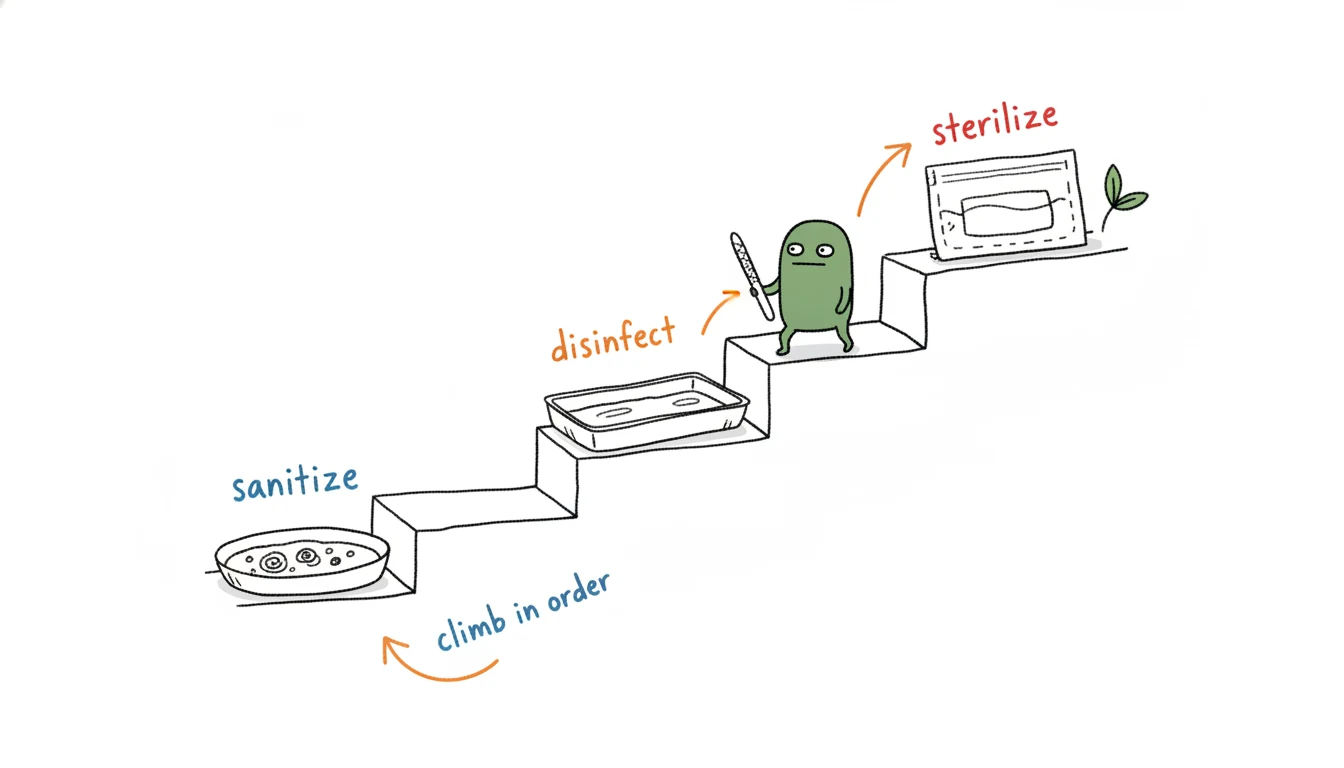
This is the SOP shape that every state board’s rulebook implicitly assumes. Print it. Laminate it. Tape it above the sink.
Tier 1 — Cleaning
Mechanical removal of visible debris (hair, skin, oil, polish residue) with warm water plus a neutral surfactant (dish soap is acceptable). Brush, rinse, dry with a single-use paper towel. This step is non-negotiable — disinfectants and sterilizers are deactivated by organic load, and “skipped cleaning” is the silent reason most disinfection fails.
- Time: 30–60 seconds per tool
- Tools used: nail brush, dish soap, running water, single-use paper towel
- Outcome: tool is visibly clean, free of debris, dry
Tier 2 — Disinfection
Chemical kill of bacteria, fungi, and most viruses. The product must be an EPA-registered hospital-grade disinfectant (look up the EPA registration number on the EPA’s List E for tuberculocidal claims, or List N for COVID-era virucidal claims). Full submersion in the labeled dilution for the labeled contact time — most products specify 10 minutes minimum.
- Time: 10 minutes minimum (longer is fine, never shorter)
- Tools used: covered immersion container with strainer basket, EPA-registered disinfectant solution at correct dilution, timer
- Outcome: tool is disinfected to bactericidal/fungicidal/virucidal levels claimed on the label
- Common failure: leaving the bath open (evaporation changes concentration), reusing solution past its expiration, partial submersion
Tier 3 — Sterilization
Total kill of all microbial life including bacterial spores. Required for any tool that contacts non-intact skin or blood. Two practical methods for a salon:
- Autoclave (steam under pressure): 121 °C for 15–20 minutes at 15 psi. Medical-grade option, ~$800–$2,000 capital cost. Highest assurance, fastest cycle.
- UV cabinet with a properly rated UV-C bulb: 30 minutes minimum, tools must lie in a single layer with surfaces fully exposed (UV-C is line-of-sight). UV cabinets are commonly accepted as a secondary step after Tier 2 disinfection, but most state boards do not recognize UV alone as primary sterilization. Confirm your state’s exact wording.
Tool-by-tool decision matrix
The single most-asked question in salon owner forums: “Which workflow does this tool actually need?” The honest answer is determined by two variables: the tool’s material (porous vs non-porous) and whether it contacts non-intact skin.
| Tool | Material | Contact with non-intact skin? | Workflow |
|---|---|---|---|
| Cuticle nipper | Stainless steel | Yes (frequent) | Tier 1 + 2 + 3 |
| Cuticle pusher | Stainless steel | Possible | Tier 1 + 2 + 3 |
| Nail file (emery board) | Porous paper / foam | No | Single-use only — discard after one client |
| Buffer block | Porous foam | No | Single-use only |
| Orangewood stick | Porous wood | Possible | Single-use only |
| Drill bit (carbide / diamond) | Non-porous metal | Possible | Tier 1 + 2 + 3 |
| Drill bit (mandrel for sanding band) | Non-porous metal | No (band is single-use) | Tier 1 + 2; sanding band single-use |
| Manicure bowl | Plastic / glass | No | Tier 1 + 2 between clients |
| Pedicure tub liner | Disposable polyethylene | No | Single-use disposable |
| Wax stick / spatula | Wood | Yes | Single-use only — never double-dip |
If you take only one rule from this section: porous tools cannot be sterilized. They absorb organic material faster than any chemical or UV process can kill it. The cost of stocking single-use files and buffers in bulk is far lower than the liability of a fungal infection traced to a reused buffer block.
Equipment investment tiers ($50 to $2,000)
Most salons over-spend at startup on the wrong tier and under-spend ongoing on the right one. Here’s a realistic breakdown.
Entry tier — UV bulb in a jar (~$50–$150)
A small UV chamber the size of a tissue box, holds 6–10 tools, single bulb. Use case: very small home-based studios as a supplementary step after Tier 2 disinfection. Limits: no air circulation, single-bulb shadow zones, bulb degrades within 9–12 months and most operators never replace them. Will not satisfy a state inspector as a sole sterilization method.
Standard tier — UV cabinet 8L–15L (~$200–$600)
The workhorse for a typical 2–4-chair salon. Capacity for two simultaneous tool trays, internal mirror surfaces to bounce UV-C light around shadow zones, timer with auto-off. Best paired with: Tier 1 + Tier 2 in front of it. Watch for: bulb wattage (15W minimum for 8L capacity), warranty length (12 months is the floor; 24 months is achievable from a serious factory), and replacement bulb availability. Nail Legend is currently expanding our UV sterilizer cabinet line — talk to us at the quote stage if you want early-access wholesale pricing on this category.
Premium tier — Autoclave (~$800–$2,000)
Medical-grade steam under pressure, the gold standard for tools that contact non-intact skin. Use case: high-end salons, medspas, podiatry-adjacent practices. Cycle time 30–45 minutes including drying. Watch for: chamber size (4L minimum for a salon, 8L preferred), automatic cycle logging (some states require sterilization logs on inspection), and consumables cost (sterilization pouches at ~$0.05 each).
Most salons should run a UV cabinet for routine tool sterilization plus single-use disposal for porous items. Autoclaves make sense once your service mix includes services where blood exposure is a routine possibility (callus removal, ingrown corrections, advanced pedicure procedures). For category sourcing, our salon equipment range covers both UV cabinets and adjacent capital tools, with private-label and custom-voltage options at the quote stage.
Disposable vs reusable: the cost analysis nobody runs honestly
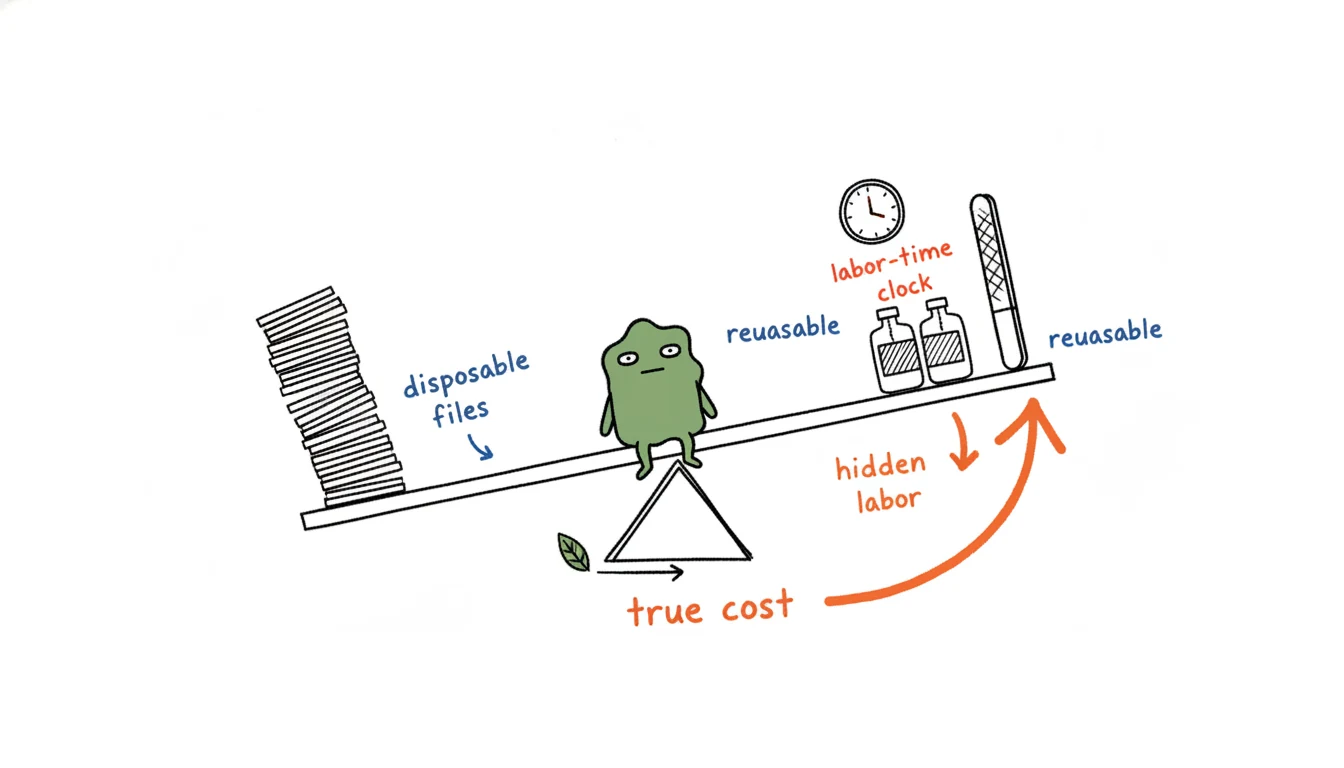
The “disposables are wasteful and expensive” objection is mostly a feeling, not a number. Here’s a worked example for a typical 3-chair salon doing 200 manicures per month.
Reusable scenario (files / buffers reprocessed):
- Initial outlay: 50 metal-core files at $1.20 each = $60
- Disinfectant solution + sterilization pouches: ~$30/month
- Hidden cost: 5–7 minutes per tool per cycle × 200 cycles = ~20 hours/month of staff time at $20/hour fully loaded = $400/month labor
- Compliance risk: porous file cores cannot be fully sterilized — if a state inspector challenges the workflow, the citation cost dwarfs the savings
Disposable scenario (single-use files / buffers):
- Wholesale cost of a 100-pack of emery boards at private-label B2B pricing: ~$8–$12
- 200 clients × 1 file each = 2 packs/month = $16–$24/month
- Buffer blocks at similar wholesale pricing: ~$15/month
- Total disposable spend: ~$30–$40/month
- Labor saved: ~20 hours/month redirected to revenue services (booking 2 extra clients per week pays for the disposables 4× over)
The math overwhelmingly favors disposables for porous tools — they’re cheaper, faster, and remove a compliance attack surface entirely. Reusables remain the right answer for non-porous metal implements (nippers, pushers, drill bits), where Tier 3 sterilization is genuinely effective.
If you’re sourcing in volume, disposable nail supplies (single-use files, buffers, orangewood sticks) and non-woven products (gauze, wipes, lint-free pads) both ship at private-label-ready B2B pricing. Discuss your monthly volume at the quote stage and we’ll match you to the right pack size and packaging format.
Building your written SOP in 30 minutes
Most state inspectors want to see a written SOP, posted, and a sterilization log book. The SOP doesn’t need to be a 40-page binder. A single laminated sheet covers the legal floor:
- Tool category list with the workflow tier for each (use the matrix above)
- EPA registration number(s) of the disinfectant(s) you use, with the exact dilution and contact time
- Daily disinfectant change schedule (most products require fresh dilution daily; some allow 30 days if covered)
- Sterilization equipment make, model, cycle settings, and bulb-replacement schedule
- Single-use tool list (files, buffers, orangewood sticks, wax spatulas, pedicure tub liners)
- Staff acknowledgment: every technician signs and dates that they’ve read and will follow the SOP
Pair this with a sterilization log book — even a simple notebook works — recording which tools were processed, by whom, on what date, with what cycle. Inspectors love seeing this. Customers who notice it become long-term clients.
Stocking your sterilization workflow
Whether you’re opening a new salon or upgrading an existing operation to pre-empt your next inspection, the supply side of compliance has a few moving parts:
- UV sterilizer cabinets (8L–15L) for routine non-porous tool processing
- Disposable files, buffers, orangewood sticks for single-use porous workflow
- Non-woven gauze, wipes, lint-free pads for cleaning and disinfectant application
- Pedicure tub liners for spa-chair single-use protection
Nail Legend manufactures all four categories under direct factory ownership in China and supplies B2B distributors, salon chains, and private-label brand owners across 40+ countries. Discuss your monthly volume, packaging requirements, and any state-specific labeling needs at the quote stage. Request a wholesale quote →
Related reading
- Cuticle Oil Private Label Manufacturing: The Complete 2026 Guide
- Depilatory Wax Heater Wholesale: The 2026 B2B Buyer Guide
- Pedicure Kit Wholesale: The 2026 B2B Buyer Guide
Choosing the hardware
For the equipment side of this — UVC boxes vs cabinets, lamp vs LED, drying cycles, capacity sizing, and bulk/OEM sourcing — see our UV sterilizer cabinet buying guide for salons, or browse the UV tool sterilizer range.
Companion SOP: Daily Cleaning Protocol
For the wall-poster version of the four-step protocol — clean, disinfect, dry, store — plus tool-by-tool sub-protocols for nippers, files, brushes, e-file bits, and pedicure tubs, see our step-by-step salon SOP for cleaning and disinfecting nail tools.


Leave A Comment