
A common question from estheticians and spa managers is simple: “Where do I find the safety data sheets for the products we use?” For a wholesale buyer, distributor or private label brand, the better question is what documentation a body care supplier should hand over with every product, and why. A safety data sheet (SDS) is only one part of that answer. Bath salts, sugar scrubs, massage oils, lotions and multi-step spa kits are usually regulated as cosmetics, and cosmetics follow different documentation rules from industrial chemicals.
This guide explains when an SDS is actually expected, what else a spa or distributor should request, and how to build a document pack into your purchase process so the binder in the treatment room never depends on a last-minute email. Regulatory points below link to primary sources; always confirm the rules for your own market and use case.
Why spa buyers ask for an SDS in the first place
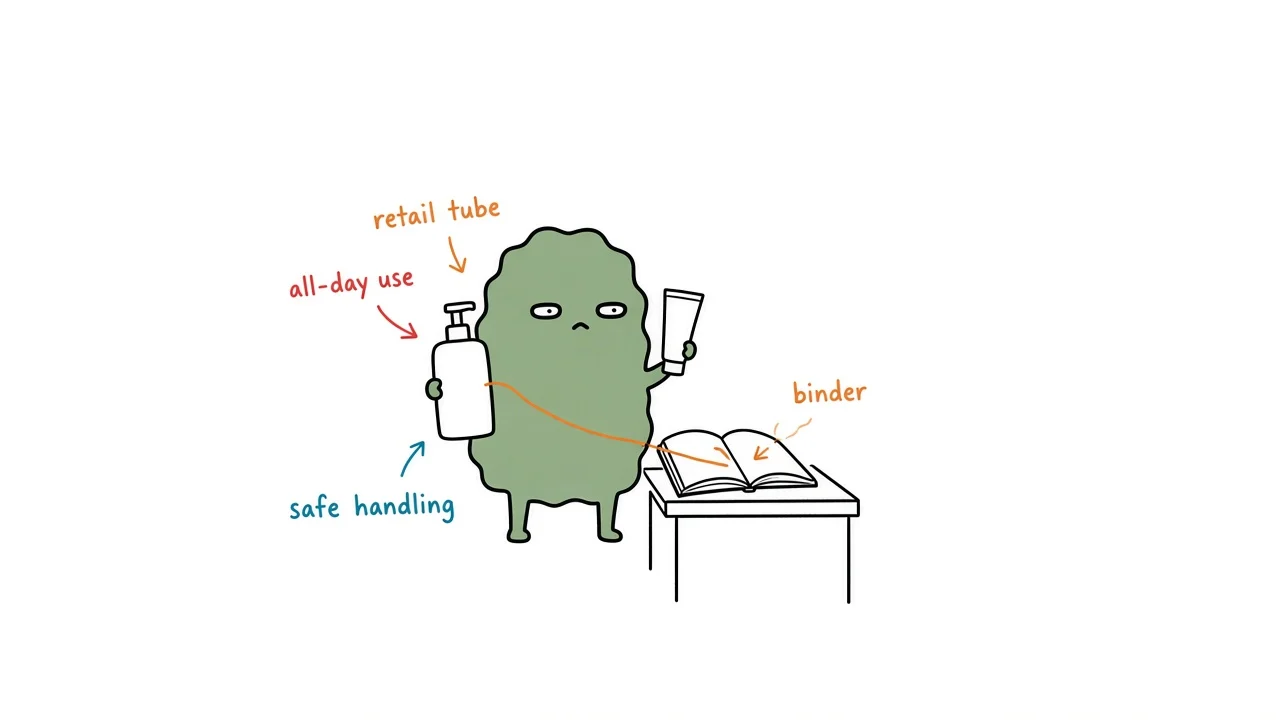
In the United States, the OSHA Hazard Communication Standard (29 CFR 1910.1200) requires employers to keep a safety data sheet in the workplace for each hazardous chemical employees use. The standard has two exclusions that matter in a spa. Paragraph (b)(6)(viii) excludes cosmetics packaged for sale to consumers in a retail establishment, and cosmetics employees use for their own personal consumption at work. Paragraph (b)(6)(ix) excludes consumer products only where the employer can show they are used as intended and with a duration and frequency of exposure no greater than a consumer would experience.
That second condition is the reason many spas ask for SDSs. A therapist who opens a gallon of massage lotion and uses it on clients all day is not using it the way a consumer would. OSHA has explained in a standard interpretation letter that it is the employer’s responsibility to assess whether workplace use goes beyond normal consumer frequency and duration. So the request is reasonable even when the product itself is mild: the spa needs either an SDS or a clear basis for deciding none is required.
In the EU, the picture is different. REACH Article 31 requires SDSs for hazardous substances and mixtures, but Article 2(6)(b) of Regulation (EC) No 1907/2006 excludes cosmetic products in the finished state, intended for the final user, from the supply-chain information title. The UK applies the same exemption under UK REACH. Instead, the safety of a finished cosmetic is documented through the safety assessment and Product Information File required by Regulation (EC) No 1223/2009 (Articles 10 and 11) and, in Great Britain, through the Responsible Person system described in UK government guidance. Employers in the UK still have workplace duties to assess substances hazardous to health, so a spa may reasonably ask for safe-handling information even where a formal SDS is not legally owed.
Two practical consequences follow. First, a supplier that says “cosmetics don’t need an SDS” may be partly right in the EU and UK, but the buyer still needs safe-handling information. Second, bulk product supplied to another business for filling is not a finished product for the final user, so a mixture classified as hazardous can trigger SDS duties at that stage.
Which spa products deserve the closest documentation review
Not every SKU carries the same risk. Grouping products by formula family helps a buyer decide where to push for detail:
- Anhydrous oils and butters (massage oil, cuticle oil, body butter): low water activity, but essential oils and fragrance can bring allergen and skin-sensitisation information that belongs on an SDS or safety summary. See our notes on massage oil manufacturing.
- Emulsions (massage lotion, cream masks): contain water and preservatives, so the preservative system and challenge-test evidence matter more than physical hazards.
- Salt and effervescent products (soak salts, foot soak tablets, bath bombs): citric acid and sodium bicarbonate dust, eye irritation from powders and moisture sensitivity in storage.
- Keratolytic products (callus removers, cuticle softeners): high-pH or acid systems, where professional-use labelling, contact-time warnings and PPE guidance are central.
- Multi-component kits: each component in a Deluxe Spa Kit needs its own record, because a kit combines several formula families in one carton.
The document pack to request from a body care supplier
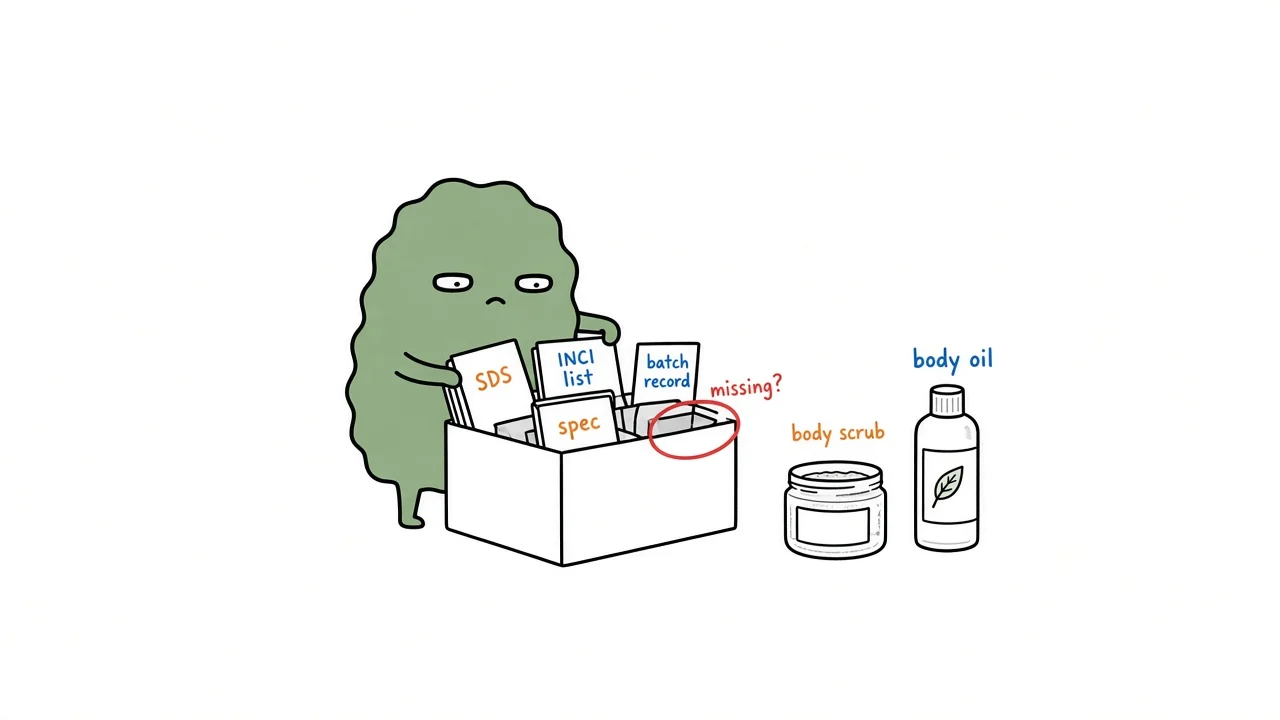
A useful document pack is specific to the exact formula, fragrance and pack size you are buying, not a generic file for a product family. When you request a quote, ask the supplier to confirm which of the following it can provide, for which markets, and who prepares each item:
- SDS or safety summary in the 16-section format where an SDS is required or requested, dated and identifying the responsible party who prepared it.
- Full ingredient list in INCI names, matching the label artwork, with fragrance and colorant identities stated as they will appear on the label.
- Specification sheet: appearance, odour, pH where relevant, viscosity or particle size, net content tolerance and pack format.
- Stability and compatibility evidence for the actual packaging, or a written statement of what testing is planned and who pays for it.
- Microbiological evidence for water-containing products, such as preservative efficacy results for the formula.
- Batch documentation: a certificate of analysis or batch release record linked to the lot code printed on the unit.
- Label and use instructions, including any professional-use statement and warnings.
- Market-specific files: support for an EU or UK Responsible Person’s Product Information File, or for a US responsible person’s safety substantiation records.
At NailLegend, certification and testing claims are confirmed by factory, product, market and document scope during quotation; we do not treat a document template as proof of a certificate. Our compliance documents page explains what can be prepared for an order, and our guide to body care testing quote scope shows how to agree which tests are in the price.
Build SDS control into the purchase order, not the treatment room
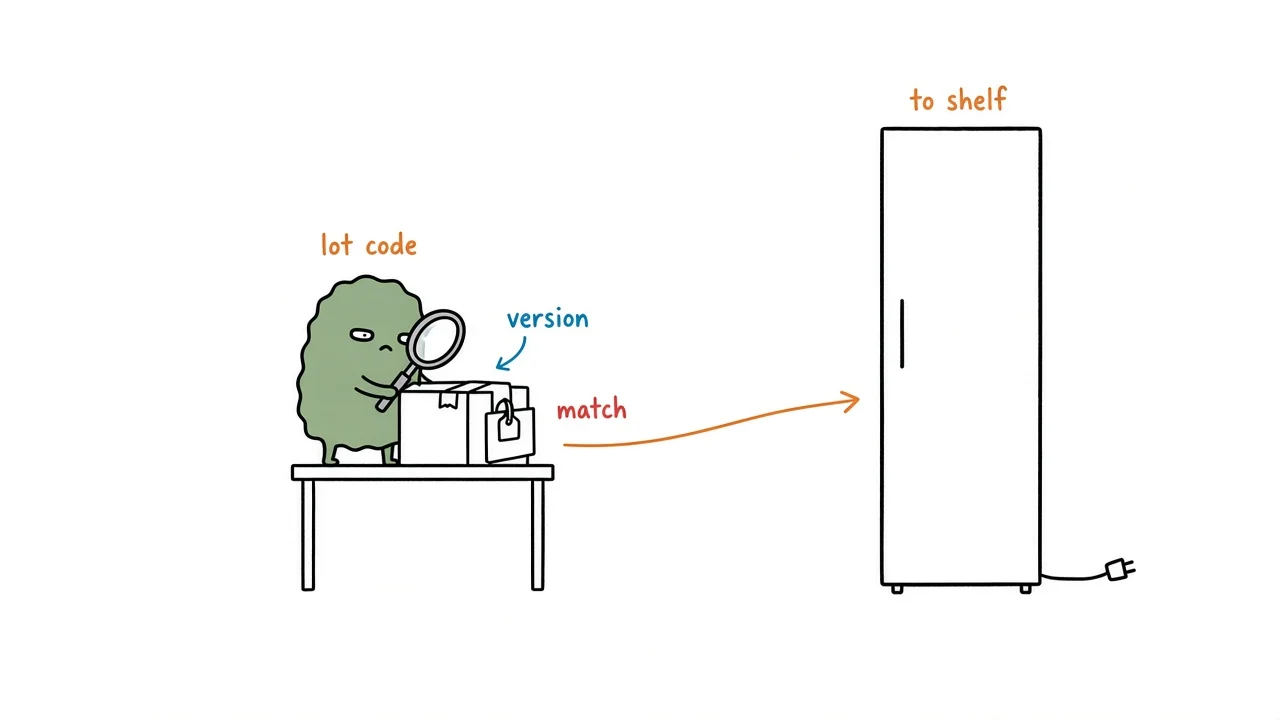
Most documentation gaps appear after a reformulation, a fragrance change or a new pack size. The spa binder still holds the old SDS while the shelf holds a new product. Prevent that with three purchasing controls:
- Tie documents to a version. Each SDS, ingredient list and specification should carry a formula version or revision date. Put that version on the purchase order and the carton label.
- Make change notification a contract term. Require written notice before any change to formula, fragrance, raw material supplier or packaging, with updated documents supplied before shipment, not after.
- Check documents at receiving. Goods-in staff compare the lot code, label and document version before stock moves to the treatment room, the same way they check quantity and damage.
Distributors have one more duty: pass documents downstream. If you resell to salons and spas, keep the supplier’s SDS or safety summary in a shared folder indexed by SKU and version, so customers can download the current file. That service is often what separates a wholesale partner from a price list.
Questions to ask before you approve a new body care supplier
Before you add a new backbar or retail body care line, use these questions in your supplier review. They complement the checks in our beauty supplier due diligence guide:
- Who prepares the SDS or safety summary, and when was it last revised?
- Does the document cover the exact fragrance and colour variant we are buying?
- Which markets is the documentation intended to support, and who acts as Responsible Person or responsible person there?
- How will we be notified of formula or packaging changes, and how far in advance?
- Can documents be supplied in English with each shipment and stored by lot?
- For bulk product we fill ourselves, has the mixture been classified for hazards, and will an SDS travel with it?
A supplier that answers these clearly in writing is easier to work with when an inspector, a spa chain’s procurement team or a marketplace asks for evidence. A supplier that cannot answer them is a risk to your service continuity, whatever the unit price.
How NailLegend supports documentation for OEM and wholesale orders
NailLegend is a B2B wholesale, white label, private label and OEM supplier of spa and body care products, with more than 10 years of manufacturing experience and customers in over 40 countries. Our factory is in Guangzhou, and our range covers soak salts, sugar scrubs, massage oils and lotions, body butters, masks and multi-step spa kits. Documentation is agreed product by product: we confirm the formula, fragrance, packaging and target market first, then state which files and tests are included in the quotation. MOQ depends on product, formula, packaging, fragrance and quantity per SKU, and regular production usually takes 25–35 days after samples, design, order and payment terms are confirmed.
If you are building a backbar range or a private label line and need a clear document pack from day one, explore our spa product line and OEM capabilities, then send us your product list and target markets.
Ready to plan your next order? Request a Quote with the products and markets you need documented, Contact Us to discuss SDS and safety summary scope, or ask our team to Download Catalog files for our spa range.



Leave A Comment