
Soap makers and brand owners sometimes find that one batch, or even one variant in a group made from the same base, develops a rancid odour while others stored nearby do not. Consumer and craft discussions of that problem are a useful demand signal: private-label soap, cleansing bars and soap flowers can oxidise in storage, and a fragrance can fade or change as the lipids deteriorate. Those posts are not a diagnosis. A buyer should not guess that a clay, an essential oil or a cupboard was “the cause” without a structured review of the formula, the incoming oils, the pack and the storage history.
This checklist is about oxidative rancidity and shelf stability. It is not a colour-defect investigation, and it is not a fragrance-substitution pilot. Those are separate buying tasks, with their own records and sample decisions.
Separate rancidity from colour defects and fragrance changes
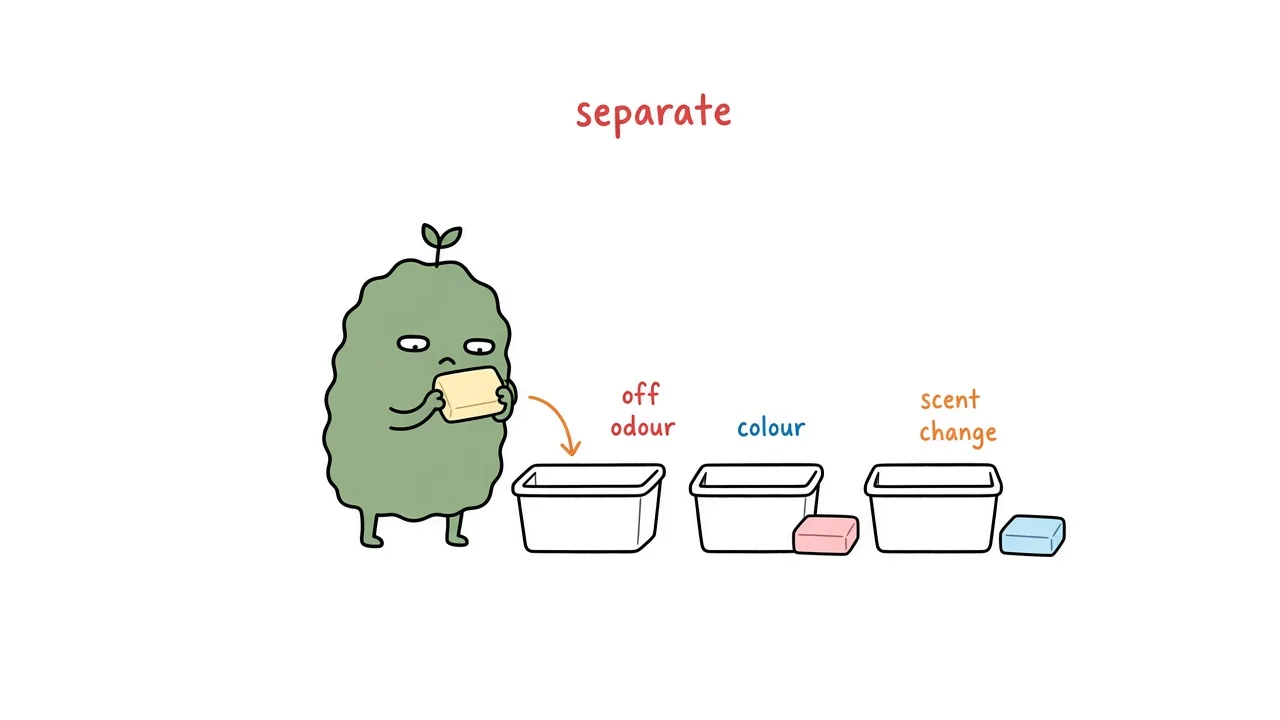
Rancidity, in practical buying language, is a deterioration of the lipid portion of the soap that shows up as an off odour, often with a change in surface feel or colour. It is not the same as a batch that is simply the wrong shade, and it is not the same as a planned fragrance switch. If the complaint is mainly colour, use a discoloration investigation. If you intend to change the scent of an approved soap, use a fragrance-change pilot. If the complaint is a stale, painty, oily or “off” smell, treat it as a stability issue and keep retained samples, lot records and storage conditions in the file.
Our private-label soap discoloration batch investigation and OEM soap fragrance-change pilot approval checklists cover those other paths. Do not merge them into one informal email, or you will lose the evidence trail.
Understand lipid oxidation and unsaponified oils, without inventing a cause
Soap made from fats and oils can contain unsaponified material. In a study of cold-saponified herbal soaps, Prieto Vidal and colleagues reported that the majority (86–99%) of the polyunsaturated fatty acids remained unsaponified after manufacture, which is one reason leftover lipids in a bar can still oxidise during cure and storage (Prieto Vidal et al., Molecules, 2018). Related work on herbal soaps found that a majority of polyunsaturated di- and triacylglycerols can also remain unsaponified, and examined whether plant antioxidants can influence quality during storage, without turning any one extract into a universal shelf-life claim (Adigun et al., Antioxidants, 2019).
The underlying chemistry is the same lipid autoxidation described for oils: a radical chain reaction that forms hydroperoxides, which later break down into odorous secondary products. Heat, light, oxygen and traces of metals can accelerate the process; more unsaturated oils are generally more sensitive than more saturated ones (Choe and Min, 2006). That is a tendency, not a verdict on your SKU. A bar can begin to oxidise before a defect is obvious, and a surface mark is not automatically proof of rancidity. Ask the manufacturer to explain, for your formula family:
- which oils, butters and unsaponified or superfatted portions are in the formula;
- how incoming oil freshness is checked;
- what antioxidant or chelation approach, if any, is used and why;
- what stability or ageing work has been done, in which pack, at which storage conditions;
- what evidence supports any shelf-life or storage statement on the specification or label.
Do not write a shelf-life number into the brief unless the supplier can show what it is based on. Do not assume that a natural or essential-oil story makes the bar more stable; some additives can help, and some can add their own odour or oxidation load.
Include essential oils, botanicals and storage in the same review
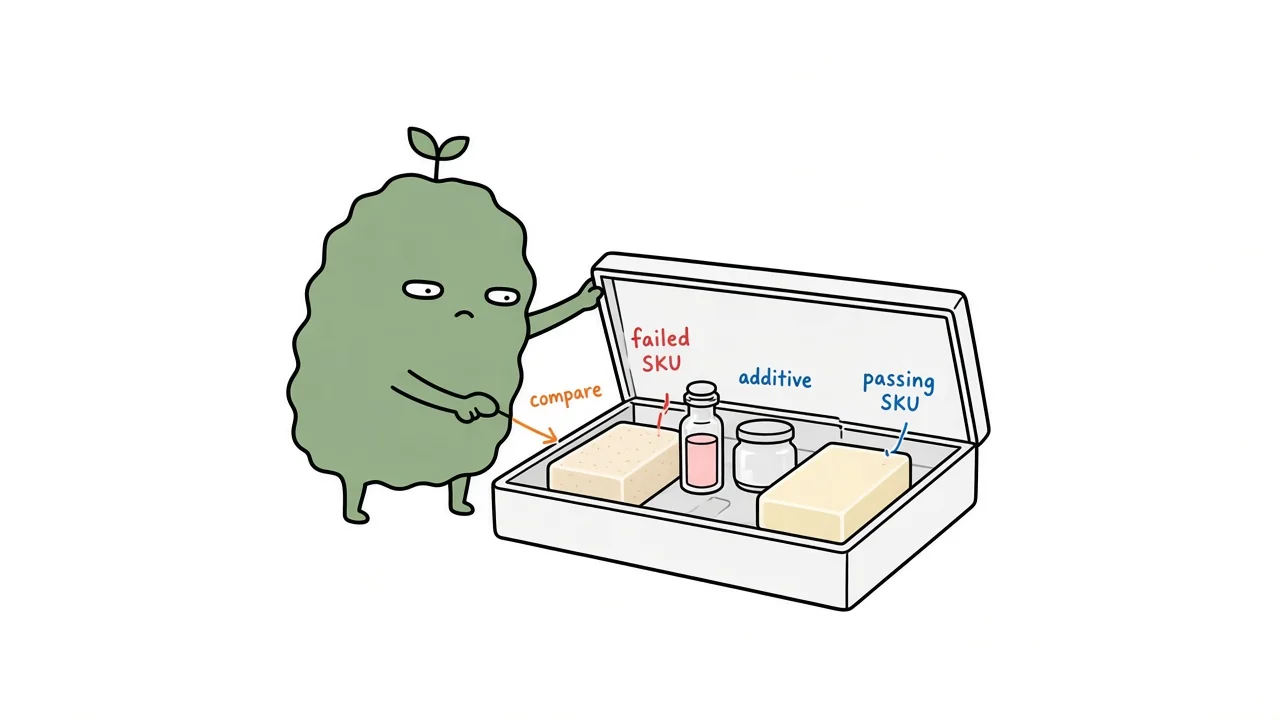
When only one scented or coloured variant fails, the difference may lie in the fragrance, essential oil, botanical or colour additive, in a small process difference, or in how that SKU was packed and stored. The correct buying response is to compare those variables, not to declare a single ingredient guilty from a forum story.
Ask for a line-by-line comparison of the failed SKU against a passing SKU from the same period: formula, fragrance and essential-oil identity and lot, botanical or clay additions, cure or drying time, pack, and storage. Then agree whether a new sample, a retained-sample odour check, or a short aged-sample study is needed before the next bulk order. If the fragrance itself will change, switch to a formal pilot rather than treating the change as a stability patch.
Storage instructions should be written, not implied. Specify expected warehouse and shop conditions, and ask the manufacturer for handling guidance (for example protection from heat, light, moisture and strong ambient odours). A paper wrap, carton or display box is part of the stability system for a bar or a soap flower, because it affects light, air and crushing. If you already have a packing standard for bars, keep it with this checklist; our body cleansing bar sample-to-bulk QC article covers appearance, firmness, packaging and traceability, which you will need again if a rancid lot is compared with the approved sample.
Build sample-to-bulk stability checks into the order
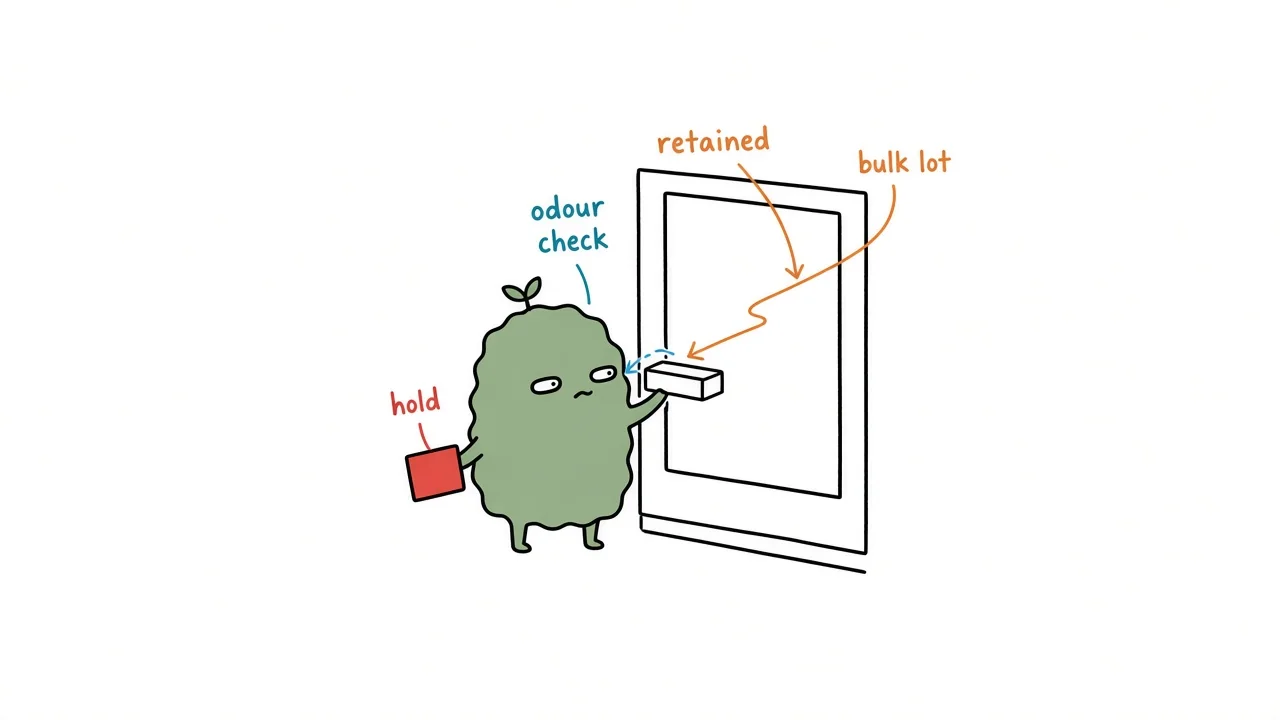
A soap that smelled clean on the sampling table can still deteriorate after shipping or after several months in a warehouse. Make the following part of the purchase file:
- Retained samples. Keep approved reference bars or soap flowers from the signed sample, stored as agreed, and keep a retained unit from each bulk lot.
- Incoming oil and additive records. Ask what lot documents travel with the fats, butters, fragrance and essential oils, and how an out-of-date or off-odour oil is rejected.
- Odour and appearance at goods-in. Compare a bulk unit with the retained sample in the same room, using a short written scale for odour, surface and colour. If they do not match, hold the lot and investigate; do not guess.
- Aged checks when the risk is high. For formulas with more unsaturated oils, added butters, or a long intended shelf life, agree whether a later check of retained units is required before a reorder is released.
- Traceability. Lot codes on inner and outer packs should lead back to the formula version, the fragrance lot and the production date.
Testing scope should be written into the quote. Microbiological work, where relevant, is not a substitute for an oxidative-stability discussion, and the reverse is also true. Our guide to body care testing quote scope helps you see which assessments are included.
If the product is sold in the United States, confirm whether it is the narrow FDA category of “soap,” a cosmetic, a drug, or more than one of these. The FDA applies the soap exemption only when the bulk of the nonvolatile matter consists of alkali salts of fatty acids, the detergent effect comes from those compounds, and the product is labelled, sold and represented solely as soap (FDA: Is It a Cosmetic, a Drug, or Both? (Or Is It Soap?)). A scented, moisturising or decorative soap flower or bar is often treated as a cosmetic. Classification does not by itself prevent rancidity, but it does change the labelling and document pack you should request.
What your soap stability brief should contain
Before you approve a sample or a reorder, send a short brief covering:
- product type (cleansing bar, decorative soap flower or another soap format), target markets and intended shelf life as a question, not as a number you have invented;
- oils, butters, fragrance or essential oils, and botanicals that must be included or avoided;
- packaging and storage conditions in your warehouse, shop or amenity programme;
- how incoming oils and finished lots will be checked, including retained samples;
- documents you need (INCI, allergen listing, SDS and any stability or oil-quality records the supplier can support);
- forecast quantities per SKU. MOQ is confirmed per product, formula, pack, scent and SKU; see MOQ for private label beauty products.
Working with NailLegend on soap and soap flowers
NailLegend is a B2B wholesale, white label, private label and OEM supplier for spa and personal care, with more than 10 years of manufacturing experience and customers in over 40 countries. Our soap-related range includes soap flowers and related gift or amenity formats, and we can discuss cleansing-bar quality criteria against a written sample. For a stability question, we review the formula family, pack, storage assumptions and available records before quoting, and we do not invent a cause or a shelf-life number. Regular production usually takes 25–35 days after samples, design, order and payment terms are confirmed; custom development and shipping are additional.
Browse our soap flower private label manufacturing page and the soap flower range, then send us your brief.
Next step: Request a Quote with your soap stability brief, Contact Us to discuss sample and storage checks, or ask to Download Catalog information for our soap flower and body care range.


Leave A Comment