
Consumer discussions often start with a question about oil ratios: how to combine jojoba, oat or soybean oil, sometimes with tocopherol, to get a light, sprayable body oil. Other requests ask for a special-occasion body oil that smells pleasant without being heavy. For a brand owner or spa buyer, those comments are a demand signal for a spray or mist-format body oil. They are not a formula, not a ratio to copy, and not a licence to use informal terms such as “low-tox” as a product claim.
This brief covers how to specify skin feel, how to discuss base oils and antioxidants, and how to test the spray pack before you approve bulk. It is not a labelling checklist, and it is not a general massage-oil manufacturing overview.
Decide what the spray oil must do before you discuss ratios
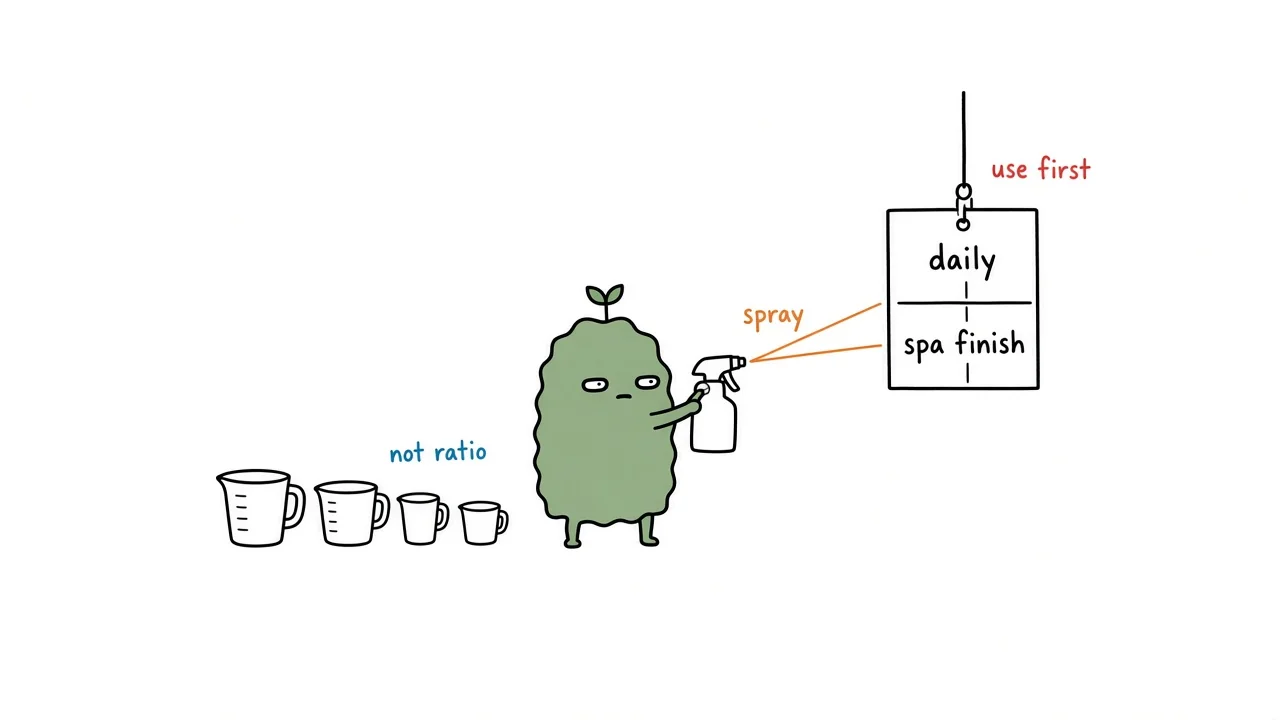
A spray body oil is still an anhydrous oil blend. The spray format changes dosing, first-contact feel, and how the pack and formula must work together. Start the brief with use, not with a percentage table:
- Use occasion. Daily after-shower oil, spa or massage finish, travel mist, or a special-occasion body oil will need different slip, dry-down and scent strength.
- Application method. A fine mist, a wetter spray or a pump that delivers a short stream are different products. Describe the spray pattern you want, and whether the oil will be sprayed onto skin, into the hands, or both.
- Target markets. Ingredient restrictions, labelling and packaging rules differ between the US, the EU, the UK and other markets, and they can change which oils and fragrance materials you may use.
- Channel and size. A retail spray, a spa backbar bottle and a kit mini have different fill volumes, closure types and transit risks.
If you are still choosing between oil, lotion and cream, our comparison of massage lotion vs oil vs cream explains the format differences. A spray body oil should then be briefed as its own SKU, including the pack.
Specify feel without inventing oil ratios
Buyers sometimes arrive with a three-oil blend and a request for “the right ratio.” Ratios belong to the manufacturer once you have described the result you need. A beaker ratio may not spray, may feel greasy, or may be unstable in the chosen bottle. Give observable targets instead:
- viscosity or sprayability in the intended pack (does it atomise, or does it spit and stream?);
- after-feel at set times after application, on the same skin area, with a measured dose;
- whether a light dry-down or a longer slip is required;
- clarity, colour and any sediment;
- scent character and strength, or a fragrance-free requirement;
- a reference product for feel only, with a request for an original formula rather than a copy.
Do not put unverified “low-tox” or similar phrases in the claims list. Those terms are not a substitute for a market-specific ingredient review. List ingredients to include or avoid, and ask the manufacturer to confirm feasibility for each target market.
Choose base oils with oxidation in mind
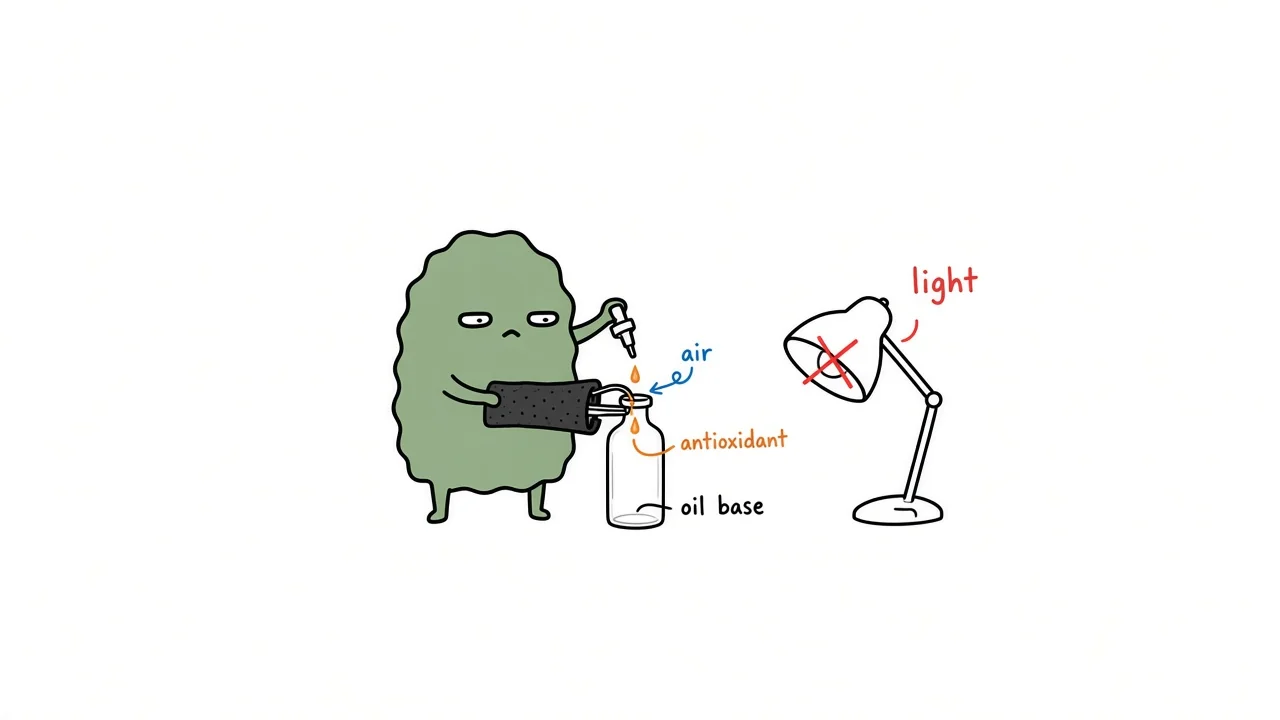
Spray body oils are typically blends of carrier oils, with or without esters, plus an antioxidant and, if wanted, a fragrance. The base affects feel and stability. As a general chemical tendency, oils richer in polyunsaturated fatty acids oxidise more readily than more saturated oils, and oxidation is accelerated by heat, light, oxygen and traces of metals. Choe and Min describe autoxidation as a free-radical chain reaction that forms hydroperoxides, which later break down into off-odour compounds (Choe and Min, Comprehensive Reviews in Food Science and Food Safety, 2006). That mechanism is relevant to cosmetic oils, but it does not give you a shelf-life number or a ranking of any commercial oil as “safe for 12 months.”
In briefing language, this usually means:
- tell the manufacturer which feel you want (light and fast-spreading, or richer and slower);
- ask them to propose a base-oil combination and to explain why it is suitable for a spray pack and for your storage conditions;
- ask how freshness of incoming oils will be checked (for example peroxide value or another stated method) and how old oil is prevented from entering production;
- treat jojoba (a wax ester rather than a typical triglyceride) and more saturated oils as possible stability tools, not as a guarantee. Highly unsaturated oils can still be used if the stability plan supports them.
Do not send a DIY ratio as a production formula. Ask for a documented proposal, then approve a sample. Our massage oil private label manufacturing page and the massage oil range describe oil formats we already supply; a spray SKU still needs its own pack and stability review.
Treat antioxidants and packaging as part of the formula
Anhydrous oils do not need a water-phase preservative in the same way as a lotion, but they do need a plan against rancidity. Tocopherol and other antioxidants can slow oxidation; they are not a preservative if water later enters the pack, and they do not make an already oxidised oil fresh again. Your brief should ask:
- which antioxidant system is proposed and why it fits the oil blend;
- whether stability work will be done in the actual spray bottle, with the actual pump or sprayer, not only in a glass lab jar;
- how light, headspace oxygen and storage temperature will be handled (for example opaque or amber packs, fill level, and storage instructions);
- what evidence will support the proposed period after opening or shelf-life statement.
Agree which tests are included in the quote. Oxidative-stability work, pack compatibility and any additional claims support are common sources of quote differences. Our guide to body care testing quote scope gives a template for that conversation.
Test spray-pack compatibility before you lock the component
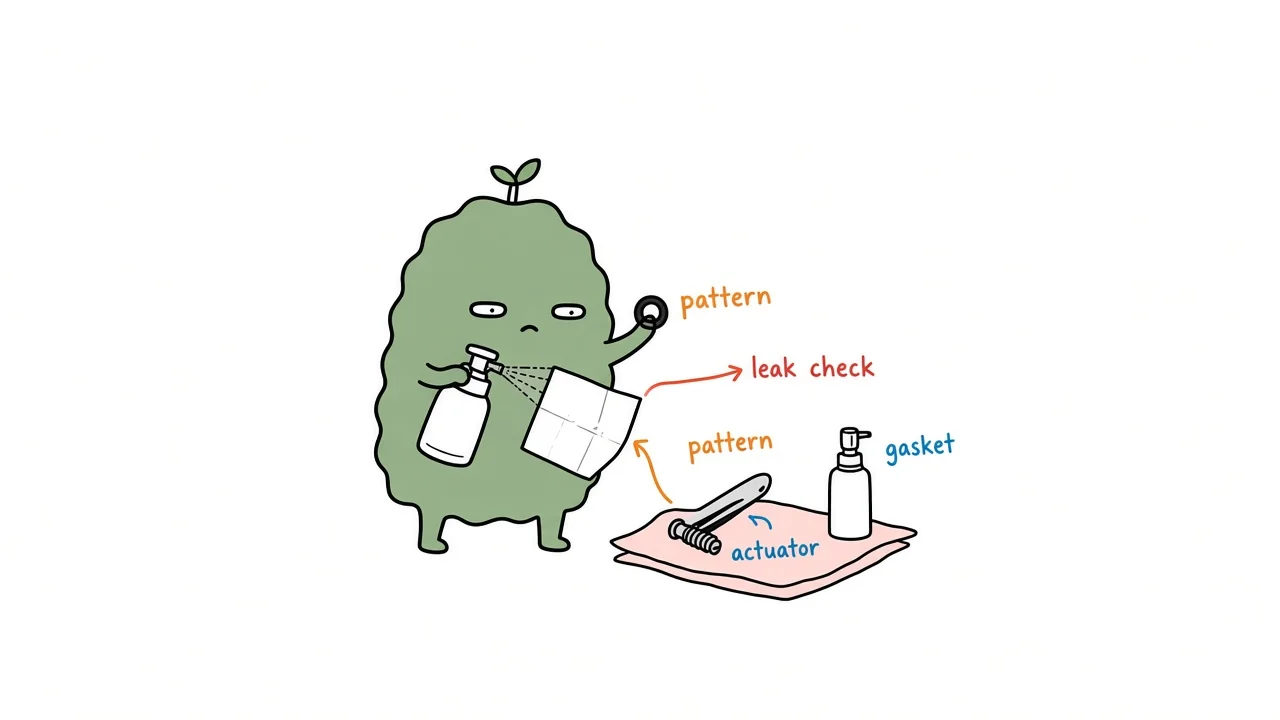
A formula that feels right in a dish can still fail as a spray. Oil can affect pump components, change the spray pattern, leak, or oxidise in the actuator between uses. Specify and test the pack as carefully as the oil:
- Spray performance. Check prime, pattern, droplet size and dose over a stated number of actuations, including after the pack has been stored on its side or upside down if that is realistic for shipping or a bathroom shelf.
- Component compatibility. Ask whether the oil, fragrance and antioxidant have been checked against the actual bottle, dip tube, spring, gasket and actuator you will buy.
- Leak and transit. Agree a leak test, cap-secure check and carton pack-out. Heat in transport can thin some oils and raise leak risk.
- Residue on the nozzle. Look for clogging, sticky film or a change in odour at the actuator after storage.
- Label and claims space. Spray bottles often have a small label. Plan ingredient, language and responsible-person information early. Our private-label body scrub and body oil label checklist covers the labelling work separately from this pack-and-feel brief.
In the EU, the cosmetic product safety assessment must consider the packaging material as part of the information needed to assess safety (see Annex I to Regulation (EC) No 1223/2009). Do not treat a pack drawing as a substitute for that review. In the US, keep claims in cosmetic territory: a body oil intended to lubricate or soften the skin and impart fragrance is generally a cosmetic, but therapeutic claims can cause the product to be treated as a drug (FDA: Is It a Cosmetic, a Drug, or Both?).
What your spray body oil OEM brief should contain
Before you ask for samples, send a brief covering:
- product concept, use occasion, spray pattern and target markets;
- skin-feel and appearance targets, with a reference for feel if you have one;
- ingredients to include or avoid, without imposing an untested ratio or an undefined “low-tox” claim;
- fragrance direction or a fragrance-free requirement;
- pack format, fill size, sprayer type and decoration;
- stability, spray-function and compatibility tests you expect, plus the documents needed for each market;
- forecast quantities per SKU and launch timing. MOQ depends on product, formula, packaging, fragrance and quantity per SKU; see MOQ for private label beauty products.
Working with NailLegend on body oils
NailLegend is a B2B wholesale, white label, private label and OEM supplier for spa and personal care, with more than 10 years of manufacturing experience and customers in over 40 countries. Our range includes massage oils as well as lotions and butters. For a spray body oil, we review feel targets, the proposed base, the sprayer and the testing scope before quoting, and we do not invent ratios, shelf-life numbers or unsupported claims. Regular production usually takes 25–35 days after samples, design, order and payment terms are confirmed; custom development and shipping are additional.
Browse our OEM capabilities and spa product line, then send us your brief.
Next step: Request a Quote with your spray body oil brief, Contact Us to discuss feel, base oils and spray packaging, or ask to Download Catalog information for our oil and spa range.




Leave A Comment