
A microscope image of shimmer polish can make a social post fascinating. For a private-label buyer, the deeper lesson is that an “effect” is a physical system: pigment particles, base viscosity, dispersion, brush pickup, film thickness, magnet response and lighting all influence what the customer sees.
Effective effect pigment nail polish quality control therefore needs more than a color name and one digital photo. This guide shows brands and distributors how to specify shimmer, metallic, pearlescent and magnetic effects, approve a master sample and control batch variation.
Translate the mood board into observable attributes
Creative terms such as “icy,” “velvet,” “galaxy” or “liquid metal” are useful direction, but two teams can interpret them differently. Convert the direction into attributes that can be compared:
- base color and opacity at a stated coat count;
- effect type: fine shimmer, flake, pearl, metallic or magnetic;
- visible particle scale and density;
- color travel or shift under different angles;
- surface smoothness after curing or drying;
- brush pickup and distribution across the nail;
- for magnetic products, line sharpness, movement and hold time under a defined magnet.
Ask the laboratory to record the substrate, coat count, cure or dry method and top coat used for every swatch. Otherwise, two swatches may look different for reasons unrelated to the bulk formula.
Particle size is one input, not the whole specification
Finer particles can create a smoother, more uniform glow. Larger flakes may create more visible sparkle or color shift. But the visual result also depends on shape, coating, concentration, refractive behavior and how particles orient in the film.
Microscopy can support development and failure analysis by showing agglomeration, contamination or a changed particle distribution. It should not replace the application test. The customer experiences a finished layer on a nail, not a microscope slide.
| Failure signal | Possible causes to investigate | Buyer-side check |
|---|---|---|
| Patchy shimmer | Poor dispersion, low pickup, settling | Swatch at defined strokes after standard mixing |
| Rough surface | Large particles, agglomerates, film too thin | Visual and tactile check with stated top coat |
| Weak magnetic line | Particle response, viscosity, magnet or technique | Use the approved magnet, distance and timing |
| Batch looks dull | Concentration, orientation or base-color shift | Side-by-side retain-sample panel |
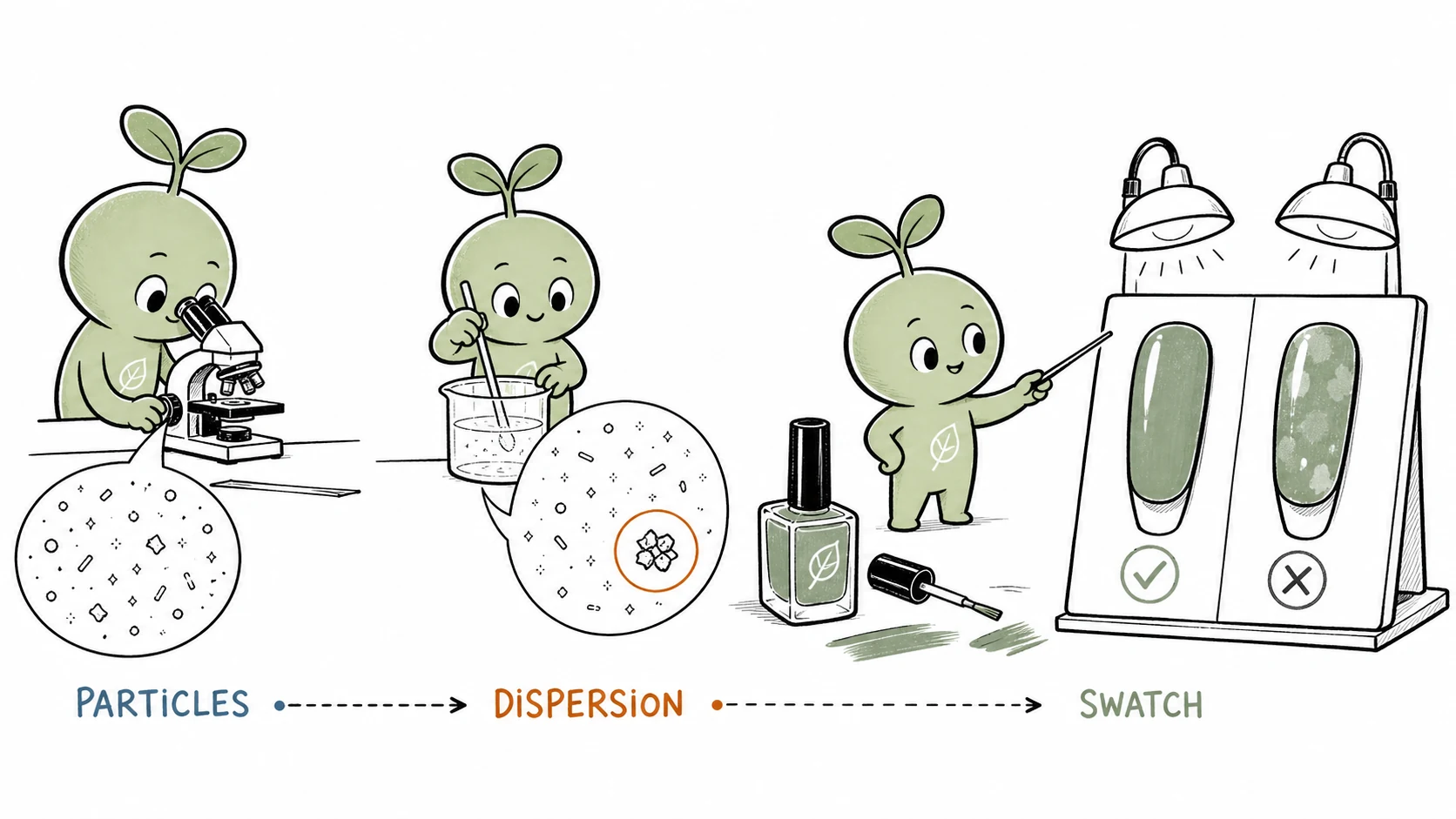
Create a controlled swatch protocol
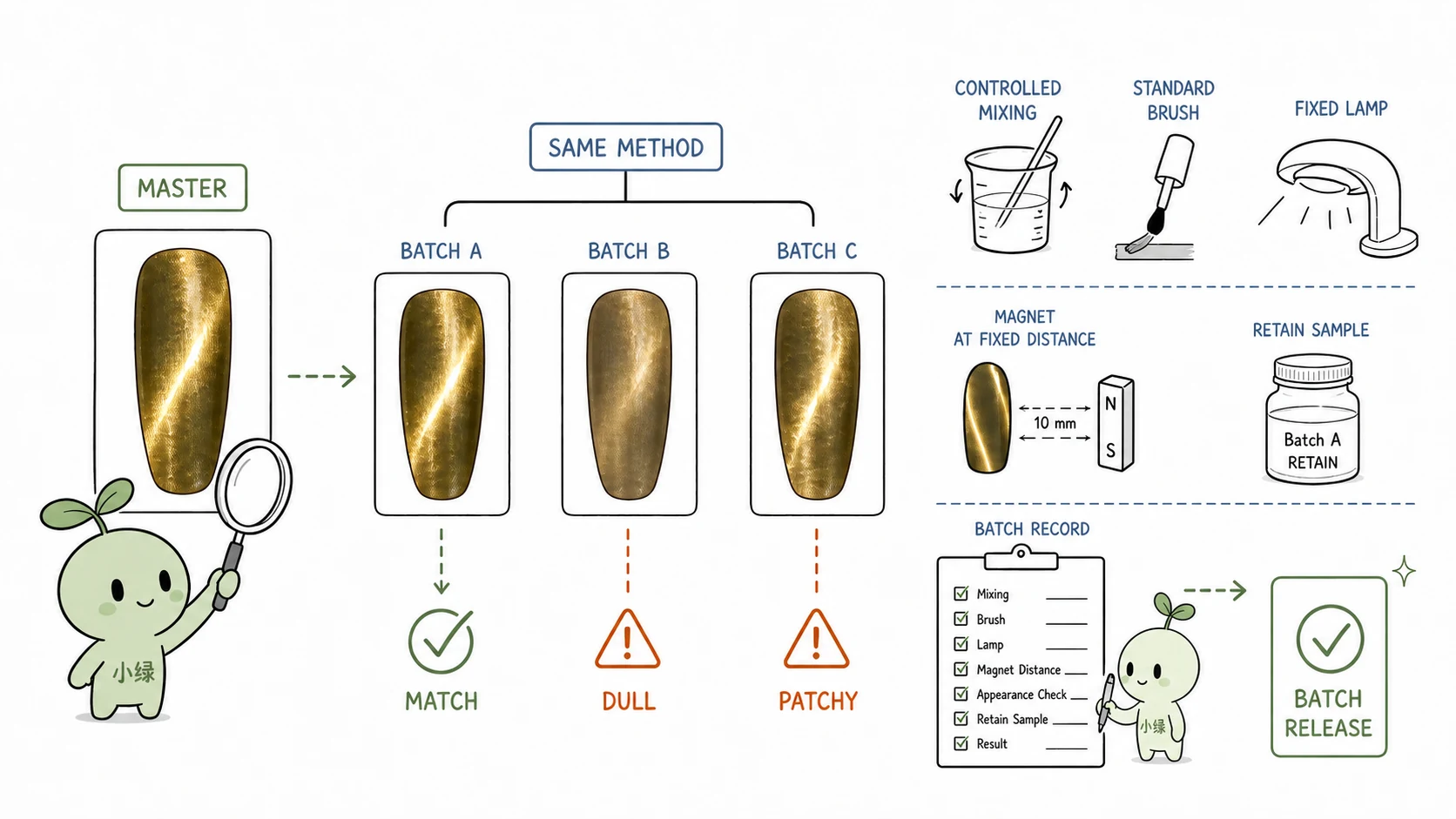
A master standard is only useful when the comparison method is stable. Write the swatch protocol into the product specification:
- condition samples at the agreed temperature;
- mix using the agreed number of rolls or inversions;
- use the specified tip color and surface;
- apply the stated number and approximate thickness of coats;
- use the approved lamp and cure time for gel systems;
- use the approved magnet geometry, distance and exposure time where relevant;
- evaluate before and after the specified top coat;
- photograph under defined daylight-equivalent and salon lighting.
Approve a physical master sample and sealed retain. Digital color values help documentation, but screens, cameras and lighting can distort reflective effects. Set tolerances around an approved range rather than promising impossible visual identity under every light.
Control settling and redispersion

Effect particles may settle over time. The commercial question is whether the product returns to a uniform state under the labeled mixing method and remains practical during use. Test after relevant storage intervals and temperatures, following a program appropriate to the formula and destination market.
Record separation, hard settling, redispersion time, viscosity, brush pickup and swatch uniformity. A product that looks acceptable immediately after production can fail later if dense particles form a compact layer that ordinary mixing cannot restore.
Packaging is part of the system. Bottle geometry, neck finish, brush length, wiper, ball bearings and fill volume influence mixing and application. Check packaging compatibility rather than assuming a bottle used for a cream color will work identically with a heavy effect pigment.
Batch release checks for effect products
A B2B release record may include appearance of bulk, fill weight, viscosity or other agreed physical tests, application swatch, cure or dry performance, effect response, packaging function, label verification and batch-code traceability. The exact plan should reflect the formula and applicable market requirements.
For every approved shade, keep:
- signed color/effect master;
- formula and raw-material version;
- approved packaging specification;
- swatch protocol and image conditions;
- retain samples from commercial batches;
- change-control and deviation records.
MOQ, lead time and customization choices
MOQ can be driven by the bulk batch, pigment purchase, bottle decoration, carton printing or per-shade filling minimum. Ask for total collection MOQ and per-color MOQ separately. A 12-shade collection may be commercially different from three hero effects even when the total unit count matches.
Lead time should separate laboratory matching, sample approval, stability or compatibility work where required, component production, bulk manufacturing, filling, release and freight. Customization can include base color, pigment blend, magnetic response, bottle, brush, cap, printing, label, carton and set configuration.
For magnetic systems, also review our private-label cat-eye gel guide. Use the Private Label vs OEM vs ODM guide to choose the right development route and the MOQ guide to plan a multi-shade launch.
Send a quote-ready effect brief
Include destination market, product system, target effect, reference swatches, coat count, shade count, quantity per shade, bottle and brush preferences, packaging, claims, required documents and delivery target. State which variables may change if the initial MOQ is not feasible.
Review Nail Legend’s OEM capabilities and contact us to request a quote. We will confirm the sample route, MOQ, lead time, packaging and customization options for the project.
Frequently Asked Questions
Can a microscope prove an effect polish is high quality?
No. Microscopy can reveal useful particle and dispersion information, but quality also depends on application, film formation, packaging, stability and batch consistency.
Why do effect swatches look different in photos?
Reflective particles change with light source, camera angle, exposure, background and top coat. Use controlled lighting plus physical approved samples.
How should magnetic nail effects be compared?
Use the same base, coat thickness, magnet geometry, distance, exposure time, cure sequence and top coat. Record line sharpness, movement and persistence.
What causes shimmer polish to apply unevenly?
Possible causes include settling, incomplete redispersion, agglomeration, viscosity, brush pickup, film thickness or application technique. Investigate against the approved protocol.
Can each shade have a different MOQ?
Yes. Bulk batching and filling normally create per-shade minimums, while bottles and cartons may have separate total or per-design minimums.




Leave A Comment