
Here is how that MOQ ladder actually shows up on your margin, worked through a real example:
Take a typical private label cuticle oil with a $2.50 factory cost at 500-piece MOQ. Add $0.60 per unit for freight and import duty, and $0.40 per unit for destination warehouse handling. Landed cost: $3.50. Selling wholesale to distributors at $7.00 gives you 50% gross margin. Selling DTC at $18.00 — after ad spend, platform fees, and fulfillment of $6.50 — leaves you $8.00 contribution margin per bottle.
Now run the same model at 3,000-piece MOQ. Factory cost drops to ~$1.80. Landed cost ~$2.80. Wholesale margin at $7.00 wholesale: ~60%. DTC contribution margin at $18.00 retail: ~$8.70. The delta per unit is ~$0.70 — meaningful, but only if you actually sell through the 3,000 units inside 12–18 months.
The decision rule: pick the MOQ tier where your expected 90-day sell-through volume is at least 50% of the run. If you cannot ship half the inventory in a quarter, you are over-ordering — take the smaller tier and pay the higher unit cost until demand is proven.
Cost Breakdown: From FOB to Landed Cost
Beyond the factory quote, landed cost is what actually hits your P&L. Here is a worked model for 1,000 units of a stock 10ml private label cuticle oil:
Stacking the two sections above, the full landed-cost model for 1,000 units of 10ml private label cuticle oil in a stock glass dropper, sweet-almond/jojoba base, 2-color label, US-bound looks like this:
| Stage | Per-unit | Notes |
|---|---|---|
| Ex-works (factory) | $1.40–$1.90 | Stock formula + stock packaging |
| + Ocean freight (LCL) | $0.18–$0.35 | South China → US West Coast |
| + Section 301 tariff (7.5%) | $0.11–$0.15 | On FOB value |
| + 3PL inbound | $0.10–$0.20 | Receive, palletize, put-away |
| + Insurance / brokerage | $0.02–$0.05 | Marine + customs |
| Landed cost | $1.81–$2.65 | Ready to pick & pack from 3PL |
For most pilots we model, $2.20–$2.80 landed per unit is the working assumption. Anything below $1.80 means you’ve either skipped a real cost (almost always 3PL inbound or duty) or you have a sub-spec component you’ll regret. Anything above $3.20 at 1,000 MOQ means you’re either over-spec’d on packaging, over-spec’d on formula, or paying a premium-tier supplier markup that you could trim at the same quality with a second-round supplier vetting pass.
The same model run on 5,000 units drops landed cost to roughly $1.60–$2.10 — not because the formula gets cheaper, but because ocean freight drops to FCL rates and 3PL per-unit handling halves. Step-up math like this is exactly what the MOQ ladder is built around.
Regulatory Considerations by Market

Cuticle oil is regulated as a cosmetic in most jurisdictions. The exact paperwork varies by where you plan to sell, and understanding the framework up front prevents costly delays when you are ready to ship:
- United States — FDA regulates cosmetics under the FD&C Act, but there is no pre-market approval requirement. Your label must comply with the FDA cosmetic labeling rules (INCI ingredient list, net content, responsible party). MoCRA (Modernization of Cosmetics Regulation Act) added facility registration and product listing requirements for brands marketed in the US — you will want your supply chain partners to be aware of those obligations.
- European Union — Every cosmetic product requires CPNP (Cosmetic Products Notification Portal) registration and a designated Responsible Person in the EU. A Cosmetic Product Safety Report (CPSR) is mandatory. Many private label brands work with a third-party RP service to handle notification rather than building the compliance stack in-house.
- United Kingdom — Post-Brexit, the UK runs its own SCPN portal with similar but separate notification requirements. A UK-based Responsible Person is required for products marketed in GB.
- Canada — Cosmetics must be notified via the Cosmetic Notification Form within 10 days of first sale. Simpler than EU/UK but still mandatory.
- Australia — NICNAS/AICIS ingredient assessments may apply for novel ingredients, but most standard cuticle oil formulations run on already-listed ingredients with no pre-market approval.
For most first-time brands, the practical sequence is: start with the home market, get your labeling and notification paperwork sorted, validate the product commercially, and only then expand into additional jurisdictions. Trying to launch simultaneously in the US, EU, and UK triples your compliance workload on day one.
How to Vet a Cuticle Oil Manufacturer
Most beauty brands start the search by Googling “cuticle oil supplier” or “cuticle oil manufacturer” interchangeably, but the two roles differ: a cuticle oil supplier resells bulk stock, while a manufacturer owns the formulation and filling line. The checklist below assumes you want a manufacturer, not a re-packer.
The single decision that shapes your brand’s future is which factory you pick. A manufacturer that cannot hold a scent profile across runs will kill your customer retention. One that ghosts on artwork rounds will miss your Q4 window. One that quotes low but upcharges on every revision will eat your margin.
We built a practical framework for this — 8 quality signals to evaluate before you commit, covering sample turnaround, formulation IP ownership, customization depth, documentation discipline, and the red flags that should end the conversation before you sign a PO.
Red Flags That Should End the Sourcing Conversation
- Refusal to show the production line on video or in person
- Evasive answers to INCI ingredient list requests (under NDA is fine; refusal entirely is not)
- Pricing significantly below cuticle oil raw material floor — jojoba and vitamin E have market prices, bottles have market prices; “$0.40 all-in for a 10ml bottle” is fiction
- Disclaimers like “we work with many factories, we pick the best one for your order” — means they will switch factories mid-relationship
- Claims to hold certifications (GMP, ISO 22716, CPNP) without producing the certificate within one business day
- Named account manager who does not exist on follow-up emails — sales handoff in the middle of a relationship is an operational warning sign
Launch Roadmap: From Concept to First Restock
A realistic launch timeline for private label cuticle oil, starting from zero:
- Weeks 1–2: Scope lock — target market, channel, retail price, scent lineup, packaging format
- Weeks 2–4: Manufacturer sampling round (request 2–3 base-oil options with your target scent)
- Weeks 4–6: Artwork development and final sample approval
- Weeks 6–10: Production run (25–35 days after artwork lock)
- Weeks 10–12: Quality inspection, shipping documentation, export logistics
- Weeks 12–14: Ocean freight to destination; allow 4–7 days for air freight
- Week 14+: Warehouse intake, listing activation, first sales
If you are building a full brand rather than just sourcing a single SKU, our step-by-step private label skincare brand guide walks through the parallel brand-build workstream — positioning, channel strategy, and first-year sales planning — that runs alongside the manufacturing timeline.
Related B2B ranges
Putting together a multi-SKU order? Two ranges our distributors and private-label clients pair most often:
- Pedicure kits & spa sets — retail-ready 5-in-1 / 6-in-1 / 7-in-1 kits, private label and OEM.
- Wholesale gold handle nail brush sets — Kolinsky and nylon brushes with custom-color handles.
Pedicure kit wholesale buyer guide · Request a quote →
Frequently Asked Questions
What is the minimum order quantity for private label cuticle oil?
For standard retail containers (12 oz), MOQ starts at 500 pieces per SKU per scent. Smaller pilot volumes are possible on 5-gallon bulk (MOQ 10 pieces) for in-house decanting or early market testing. For bulk formulation without packaging, the baseline is 200 kg / 52 gallons.
How long does it take from concept to first delivery?
Plan on 12–14 weeks from scope lock to inventory in your warehouse. That breaks down roughly as 2–4 weeks of sampling and artwork, 25–35 days of production, plus quality inspection, export logistics, and transit time. Air freight shaves 2–3 weeks off the back end if your unit economics support it.
Do I need to own my formula, or can the manufacturer provide one?
For private label, the manufacturer provides the formula — that is what makes it private label. You keep the brand, packaging, and go-to-market; they keep the formulation IP. If owning the recipe matters for your positioning or defensibility, you want OEM or ODM instead. Most first-time brands start with private label and move hero SKUs to OEM after commercial validation.
Can we match a specific scent or signature blend?
Yes. Beyond our eight stock scents (Lavender, Rose, Honey, Orange, Mint, Jasmine, Green Tea, Cherry), custom fragrance development typically takes 2–3 sampling rounds (3–4 weeks). Once locked, the scent becomes a reserved profile for your account — the exact same fragrance oil blend on every subsequent run.
Start Your Cuticle Oil Private Label Project
If you are scoping a private label cuticle oil launch, we can help you pressure-test the fundamentals — MOQ vs. your cash flow, scent lineup vs. your target channel, packaging format vs. retail shelf. Send us your scope and we will come back within 24 hours with a structured quote.
Request a cuticle oil private label quote or request our wholesale catalog for the full cuticle and nail care range.
Where can I find a low-MOQ cuticle oil OEM supplier in 2026?
Boutique cuticle oil specialists start at 100–250 units; mainstream private label houses start at 2,500. Nail Legend runs 100-unit pilot tier with custom formulation and stock-formula rebrand options. For deeper MOQ math by tier, see our cuticle oil MOQ guide.
Who are the best private label cuticle oil manufacturers for indie beauty brands in 2026?
Indie brands typically pair best with boutique specialists rather than enterprise CDMOs. Top options include nail-native specialists (Nail Legend, MissGel), US-domiciled boutiques (Pravada Private Label, LuxeFormula Labs), and natural-positioning houses (Beauty Private Labels). Compare them side-by-side in our 2026 listicle.
How does Nail Legend compare to Bo International or Onoxa for cuticle oil sourcing?
Bo International is India-based with strong English content marketing presence; Onoxa is US-based with MOQ=1 dropship model for indie brands testing first SKUs; Nail Legend is Shenzhen-based with nail-native formulation depth, 100-unit MOQ pilots, and shipments to 40+ countries. Choose based on geography, MOQ tier, and formulation depth needed.
Are Chinese cuticle oil manufacturers cheaper than US suppliers?
Per-unit cost is typically 20–40% lower at China-based manufacturers versus US equivalents at comparable formulation depth. The gap narrows above 5,000 units. Total landed cost (per-unit + freight + customs + lead-time working capital) is the real comparison metric, not per-unit pricing alone.
What ingredients are typically used in private label cuticle oil?
Standard private-label base: jojoba oil, sweet almond oil, vitamin E (tocopheryl acetate), and a fragrance carrier. Premium formulations add argan, rosehip, biotin, or essential oil blends. Vegan formulations replace beeswax derivatives with plant-based alternatives. Custom hero-ingredient blends are offered at 500+ unit commitments.
Can I customize bottle, applicator, and label design for my cuticle oil brand?
Yes. Standard customization: bottle size (5–15 ml), applicator type (brush, dropper, pen-applicator), bottle color tinting, and full label artwork. Custom mold development for unique bottle shapes requires 5,000+ unit commitments due to tooling cost. Pilot runs use stock packaging with custom labels for fastest time-to-market.
Which cuticle oil manufacturer offers the lowest MOQ for pilot runs?
Nail Legend offers 100-unit pilot tier with stepwise scaling to 500–1,000 units for custom formulations. Onoxa offers MOQ=1 with stock formulas for true zero-inventory testing. LuxeFormula Labs starts at 100 bottles with FDA-registered facility. Compare full pilot-tier options in our 2026 cuticle oil manufacturer listicle.
What is the difference between OEM, private label, and white label cuticle oil?
Private label = your brand on a stock or modified-stock formula owned by the manufacturer. OEM (Original Equipment Manufacturer) = manufacturer produces a custom formula to your specifications, with you owning the IP. White label = generic stock formula sold under any reseller brand. Most indie brands start with private label and graduate to OEM at 5,000+ unit annual scale.
Sister cosmetic kit category: distributors carrying private-label cuticle oil often pair it with a private label bath bomb SKU lineup — same retail channels, similar packaging, complementary basket size.
Adjacent category: distributors carrying private-label cuticle oil typically run pedicure kits as the recurring service-attached SKU. The category framework parallels this guide — see the pedicure kit wholesale buyer guide for the multi-step kit equivalent.
Sourcing bath bombs at scale?
If you’re evaluating bath bomb wholesale and private label manufacturing for a retail line, gift set, or spa chain, our B2B Bath Bomb wholesale program covers 8 base scents, custom shapes and silk-screen printing, and MOQ from 100 jars at the quote stage. Request a Bath Bomb wholesale quote →
Deep-Dive: Choosing the Base Oil
Base oils are 85–95% of every cuticle oil and the single decision that constrains packaging, claim language, retail price point, and shelf life. For the side-by-side comparison of jojoba vs sweet almond vs argan vs squalane — cost ratios, viscosity, absorption, brand-story strength, common blends, and which base fits which buyer profile — see our cuticle oil base oils comparison for private label brands.
Wholesale Cuticle Oil Pricing: Tier-by-Tier Quote Reality

Buyers searching wholesale cuticle oil on a B2B comparison rarely land on a single per-unit number. The actual cuticle oil wholesale price ladder we quote across pilot, standard, and scale tiers compresses sharply — 5K–10K–25K–50K bottle MOQ each shave 8–18% off per-unit cost depending on bottle shape, cap closure, and whether the order ships bulk cuticle oil in jerricans (private blenders) or fully filled-and-labelled retail SKUs.
Three line items dominate every wholesale cuticle oil quote: (1) carrier oil base spec (jojoba-only premium runs ~30% above 70/30 jojoba/sweet-almond blends), (2) bottle + brush-applicator hardware (TPR pen applicator vs. dropper bottle vs. roller-ball each carries a different cap-and-collar SKU), and (3) labelling + secondary box. A bulk cuticle oil tote shipment for an in-house blender skips items 2 and 3 entirely — useful for brands with internal filling lines or a domestic co-packer relationship.
Cuticle Oil Suppliers vs. Distributors: When to Use Which
A cuticle oil supplier — what we are — manufactures the base oil, fills it, labels it, and ships it on your PO. A cuticle oil distributor buys finished SKUs from a manufacturer and re-sells with markup, usually carrying inventory for sub-MOQ buyers in a single country. The trade-off is straightforward: cuticle oil suppliers win on per-unit cost and customisation depth but require MOQ commitment; distributors win on speed-to-stock at small quantity but cap your formulation, label, and shape options to whatever the distributor already imported.
Brand buyers usually start with a distributor for the first 6–12 months while validating retail sell-through, then move to a direct cuticle oil supplier relationship once the SKU stabilises. That migration is what most of our private label cuticle oil RFQs look like in the first call. Two questions surface every time: minimum order quantity at the first run, and how quickly the supplier can match the distributor SKU buyers already shelf-tested. See the private label vs. stock comparison for the gating decision and our cost breakdown for the margin math against distributor pricing.
TL;DR — Who We Are
Nail Legend is a Shenzhen, China–based B2B private label & OEM manufacturer specializing in nail care and spa care, serving customers in 40+ countries with full-service formulation, packaging, and logistics. Our cuticle oil program runs at 100-unit pilot MOQ with custom formulation, brush/dropper/pen applicator options, and 25-day lead time.
10+ years · 40+ countries served · MOQ from 100 units (pilot tier) · 5 core product lines · 24-hour response
Cuticle oil has quietly become one of the highest-margin, lowest-complexity categories in the private label nail care space. A 10–15 ml bottle sells for $12–$28 at retail, uses commodity base oils, and ships without temperature control — which is why experienced brand operators keep adding it to their lineup. This guide walks you through every decision that sits between “I want to launch a cuticle oil brand” and your first 5,000 branded bottles landing in a warehouse.
Whether you are building a nail aftercare collection for salon distribution, adding a hero SKU to an Amazon brand, or sourcing a signature amenity for a spa chain, the manufacturing fundamentals are the same. We will cover formulation options, packaging formats, MOQ realities, lead times, regulatory considerations by market, and the vetting framework that separates credible factories from brochure-ware operations.
Why Cuticle Oil Is a Winning Private Label Category in 2026
Three structural advantages make cuticle oil a standout entry point for a private label nail brand:
- High gross margin. A 10 ml fill of a jojoba + vitamin E base costs the factory roughly $0.70–$1.20 all-in (raw + container + label + cap). Retail pricing sits at $12–$28, and wholesale to distributors lands at $3.50–$6.00. Margins stay healthy at every tier.
- Low production complexity. Cuticle oil does not emulsify, does not need preservative systems as aggressive as water-phase skincare, and runs on standard liquid-filling lines. That means faster sampling rounds, shorter lead times, and fewer failure points.
- Clear buyer intent. Shoppers searching “cuticle oil” know what they want and compare on brand, scent, and format — not abstract feature claims. For a private label launch, that translates to faster conversion and less brand-education spend.
The typical buyers we see for private label cuticle oil fall into four camps: nail salon chains building a take-home retail line, Amazon sellers adding a high-repeat SKU to a nail or self-care brand, spa supply distributors bundling it into professional kits, and established beauty brands extending an existing nail or hand-care collection. Each of them optimizes for slightly different things — salon chains care most about consistency and scent library, Amazon sellers obsess over packaging shelf appeal, spa distributors want bulk economics, and established brands need airtight documentation to meet existing vendor standards.
What “Private Label Cuticle Oil” Actually Means
Private label cuticle oil means the manufacturer produces the product using a stock or lightly adjusted formula, and you sell it under your own brand name and packaging. You get speed and lower cost; the factory owns the formulation IP. If you want to own the recipe, that is the OEM or ODM path — a different tradeoff we break down in our complete comparison of private label, OEM, and ODM models.
For most first-time nail brand launches, private label is the right call. It lets you test the market, validate scent preferences and packaging design, and build initial distribution before committing capital to exclusive formulation work. Many brands operate on a private label foundation for years before moving a hero product to full OEM.
White Label vs Private Label vs OEM: Three Distinct Sourcing Models
The three terms get used interchangeably in casual industry conversation, but they describe meaningfully different sourcing models — and choosing the wrong one wastes time and money. A white label cuticle oil is a generic stock formula that any reseller can rebrand and sell under their own name; the manufacturer owns the formula IP and sells the same base to multiple buyers in the same market. A private label cuticle oil is a stock or modified-stock formula sold under your brand only — the manufacturer may still own the underlying IP, but the SKU is contractually tied to your brand within your defined channel. OEM (Original Equipment Manufacturing) means a fully custom formulation built to your specifications, with you owning the resulting IP and the manufacturer producing exclusively to your brief.
For most early-stage indie brands launching a cuticle oil line, white label cuticle oil is the fastest path to market: lowest MOQ, lowest unit cost, fewest decisions to make. The downside is that your formula is shared with competitors and the differentiator becomes purely brand identity, packaging, and channel positioning. Private label cuticle oil is the dominant model once you want even modest formula differentiation (a custom scent, a hero ingredient swap, a tweak to viscosity) without paying full custom-development costs. OEM becomes economical only at 5,000+ unit annual scale where amortizing the $1,500–$5,000 development fee makes sense. Most operators we work with start with a white label cuticle oil SKU to validate channel demand within 60 days, then graduate to private label as monthly volume crosses 1,000 units. See our 2026 cuticle oil manufacturer comparison for which suppliers handle which model best.
In RFQs we receive, the same model is often phrased three different ways — “OEM cuticle oil”, “custom-formula cuticle oil”, or “ODM nail oil” — but the commercial structure is identical: you own the IP, the factory produces to your brief.
Worked Example: Launching a White Label Cuticle Oil SKU in 60 Days
To make the abstract sourcing-model decision concrete, here is the actual 60-day path most first-time buyers take when they choose white label cuticle oil as their entry SKU. Day 0–7: shortlist three to five white label cuticle oil manufacturers, request samples of each supplier’s stock formula, and confirm which carrier oil base (sweet almond, jojoba, grapeseed, fractionated coconut) is offered without custom blending fees. Day 8–14: receive samples, evaluate scent throw, viscosity, absorption rate, and stability across 5–10 testers; pick one stock formula to commit to. Day 15–28: lock the brand identity (logo, label artwork, brand color), choose stock packaging (10ml glass dropper is the volume default; brush-cap 8ml is the boutique-margin default), submit print-ready label artwork, and place a 500–1,000-unit deposit order. Day 29–55: production runs (typically 18–25 days for white label cuticle oil with stock packaging — no formula development means no chemistry lead time), QC inspection, and freight booking. Day 56–60: receive inventory at your 3PL, list on Amazon/Faire/Shopify, and start channel testing.
Cost-per-unit math at 1,000-unit MOQ on a typical white label cuticle oil program: stock formula in 10ml glass dropper lands at roughly $1.40–$1.90 ex-works depending on carrier oil and supplier tier; add $0.35–$0.60 for label printing and application; add $0.45–$0.70 for ocean freight + duty + 3PL inbound to a US/EU warehouse. Total landed cost per unit settles around $2.20–$3.20 — meaning a $14.99 retail SRP yields a 75–85% gross margin before channel fees. The same SKU built as private label cuticle oil (with a custom scent or hero-ingredient swap) typically adds $0.15–$0.40 per unit and 7–14 days to lead time. The same SKU as full OEM (custom formula development) adds a one-time $1,500–$5,000 dev fee plus 4–8 weeks of formulation work. For our complete bulk pricing tiers and MOQ breakdown, including 5,000-unit and 10,000-unit step-downs, see the dedicated MOQ guide. To compare which manufacturers handle white label cuticle oil stock-label programs versus full-custom OEM, see our 2026 cuticle oil manufacturer comparison.
Formulation Decisions: Base Oils and Active Ingredients
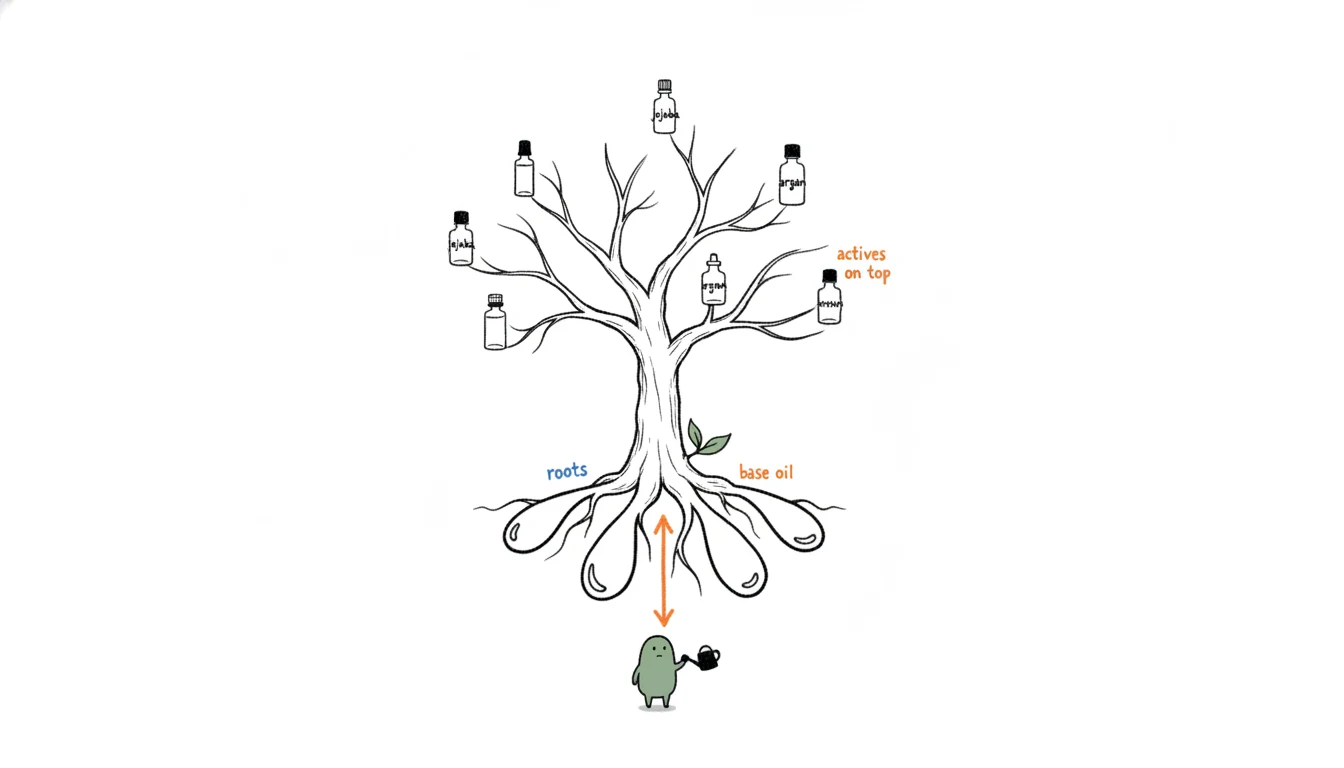
Every cuticle oil formulation starts with a base-oil system that determines viscosity, absorption speed, shelf life, and feel on the nail bed. The four most common bases in B2B production:
- Jojoba oil — The default premium base. Technically a liquid wax, so it mirrors skin sebum, absorbs cleanly, and is extremely shelf-stable (2–3 year stability even without heavy antioxidant loading). Slightly higher raw cost but worth it for mid-to-premium positioning.
- Sweet almond oil — The workhorse. Soft aroma, fast absorption, lower cost than jojoba, and well-tolerated across skin types. Most mass-market private label cuticle oil uses sweet almond or a jojoba/sweet almond blend as the base.
- Grapeseed oil — Lightest feel and fastest absorption, but shorter shelf life and a more neutral scent that carries fragrance well. Favored by brands targeting professional nail technicians who want no lingering oil residue.
- Argan oil — Premium story and high linoleic content, but raw-cost volatility makes it a blend ingredient rather than a full base for most private label runs. You will see it at 5–20% of the base system rather than 100%.
On top of the base, common active ingredients include vitamin E (tocopherol) as an antioxidant and skin conditioner, aloe leaf extract, chamomile extract, rosehip seed oil, and occasionally tea tree oil for an antimicrobial-positioned SKU. These drop in at 0.5–3% by weight. For private label, most manufacturers run 2–4 stock active blends and let you pick the one closest to your brand positioning.
Fragrance is where most private label brands differentiate. A credible factory will give you access to a stock scent library — at Nail Legend we carry eight stock profiles (Lavender, Rose, Honey, Orange, Mint, Jasmine, Green Tea, and Cherry) with custom development available on request. One production run locks in one scent, so if you are launching a three-scent collection, that is three runs stacked into one purchase order.
Packaging Formats: Brush, Dropper, Roll-On, or Pen
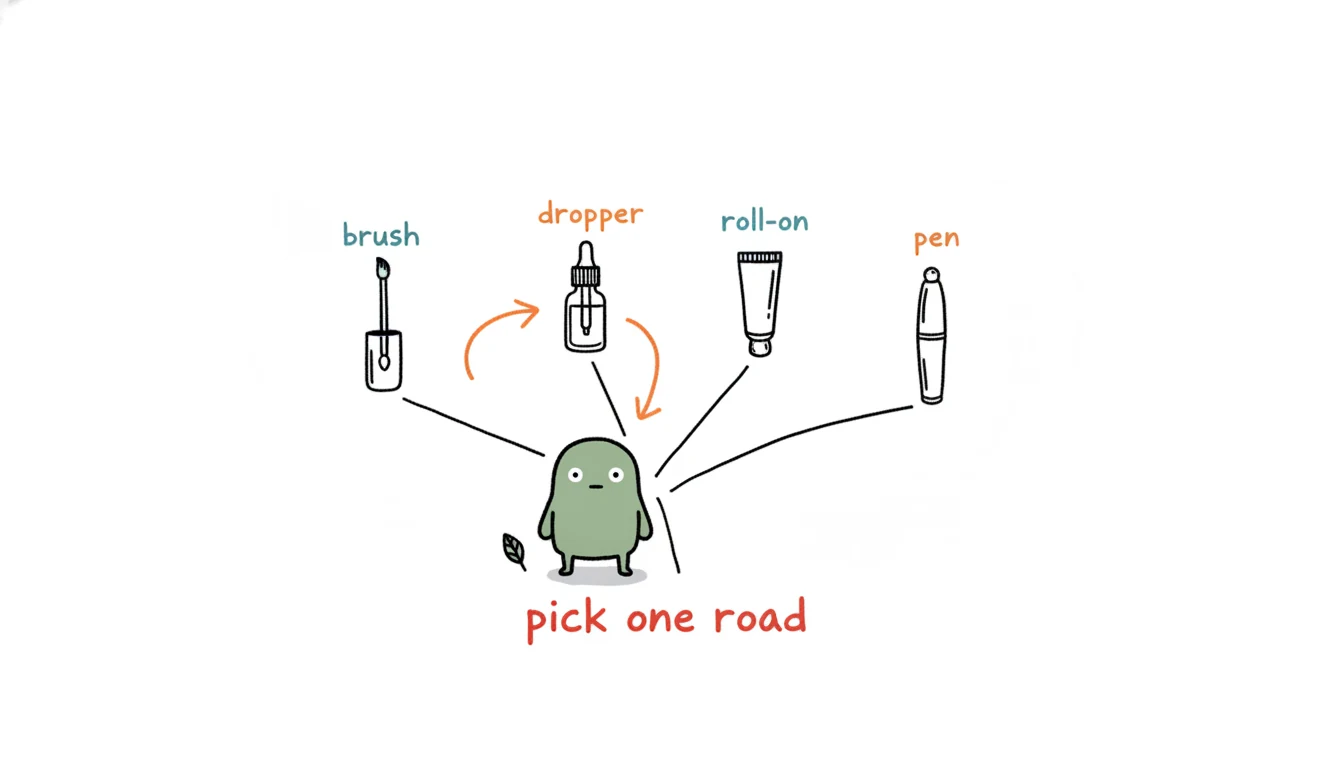
Packaging format is not a cosmetic decision — it determines who buys your product and how they use it. The four standard formats each target a slightly different user:
| Format | Best For | Retail Price Tier | Production Notes |
|---|---|---|---|
| Brush-cap bottle (10–15 ml) | Nail salons, retail shoppers, nail techs | $10–$20 | Most versatile; runs on standard fillers; brush integrity is the QC pinch point |
| Glass dropper bottle (10–30 ml) | Premium retail, aesthetic brands, Instagram-first marketing | $18–$35 | Heavier shipping weight; dropper assembly adds 1 step; hero for gift sets |
| Roll-on bottle (5–10 ml) | On-the-go retail, travel SKUs, Amazon impulse buys | $8–$15 | Rollerball assembly must be leak-tested per batch; lowest fill volume |
| Cuticle pen (click-applicator) | Professional nail techs, gift sets, pro-branded retail | $12–$22 | Higher component cost; ideal for spa chains that want single-use-style application |
If you are launching into a retail channel, brush-cap is still the volume winner — it is what shoppers expect when they reach for a cuticle oil. Dropper bottles win on premium shelf presence and work well for beauty brands that want the product to feel like a serum. Roll-on and pen formats are specialist plays; use them when you have a clear channel advantage (travel retail, spa amenity, subscription box) rather than as your primary launch SKU.
Our current private label cuticle oil program supports all four formats, with component library pre-vetted for leak integrity and shipping durability.
Glass vs PP vs Aluminum
The bottle material decision sits between your factory cost and your freight invoice, and it almost always gets made too late. Three materials cover 95% of cuticle oil packaging options wholesale buyers consider today.
Glass
Glass is the default for the dropper format and the brush bottle. It reads as premium, it doesn’t react with essential oils or vitamin E, and consumers trust it. The downside is weight and breakage. Industry data on cosmetic shipments puts glass breakage rates at 5–8% in standard ocean LCL transit, depending on packing density and palletization. At a 1,000-unit order that means budgeting 50–80 replacement units in your reorder math, or paying the factory for upgraded inner trays and double-corrugated outers (which adds $0.03–$0.06 per unit).
PP and PETG (plastic)
Polypropylene and PETG dominate the twist pen format and most 2ml–5ml mini bottles. Plastic is light, near-unbreakable in transit, and 20–35% cheaper per bottle than glass at the same volume. The tradeoffs are perceived premium (consumers read glass as more expensive even when it isn’t) and additive compatibility — some high-citrus fragrances and some plant-actives can interact with cheaper plastics over a long shelf life. For a 12-month shelf-life cuticle oil with a stock base oil profile, PP and PETG are completely safe. Stay away from PS (polystyrene) for any oil-based product.
Aluminum
Aluminum shows up mostly in the 100ml+ bulk-refill format and the occasional prestige indie 10ml. It is functionally unbreakable in transit, light, and increasingly sourced as a sustainability story. The freight math is real: industry packaging data shows aluminum cosmetic bottles run roughly 50% lighter than glass, lowering per-unit ocean freight by around $0.10–$0.15 at 10ml–15ml fill, and meaningfully more at 100ml. The downside is opacity (the brand cannot show off oil color), the need for a separate dispenser (aluminum doesn’t take a pipette or brush integrated cap as cleanly), and a higher base bottle cost in low MOQs.
| Material | Bottle cost (10ml, 1k MOQ) | Breakage in transit | Premium read | Best fit |
|---|---|---|---|---|
| Glass (clear/amber) | $0.55 – $0.80 | 5–8% | High | Dropper, brush bottle, retail |
| PP / PETG | $0.30 – $0.55 | <1% | Medium | Twist pen, mini formats |
| Aluminum | $0.70 – $1.20 | <1% | High (eco) | Bulk refill, prestige |
These bottle costs sit inside the wider unit economics we model in the 10ml cost breakdown — for context, the $0.55–$0.80 glass dropper line there is the same line item we’re widening here across alternatives.
MOQ and Lead Time: The Numbers That Shape Your Cash Flow
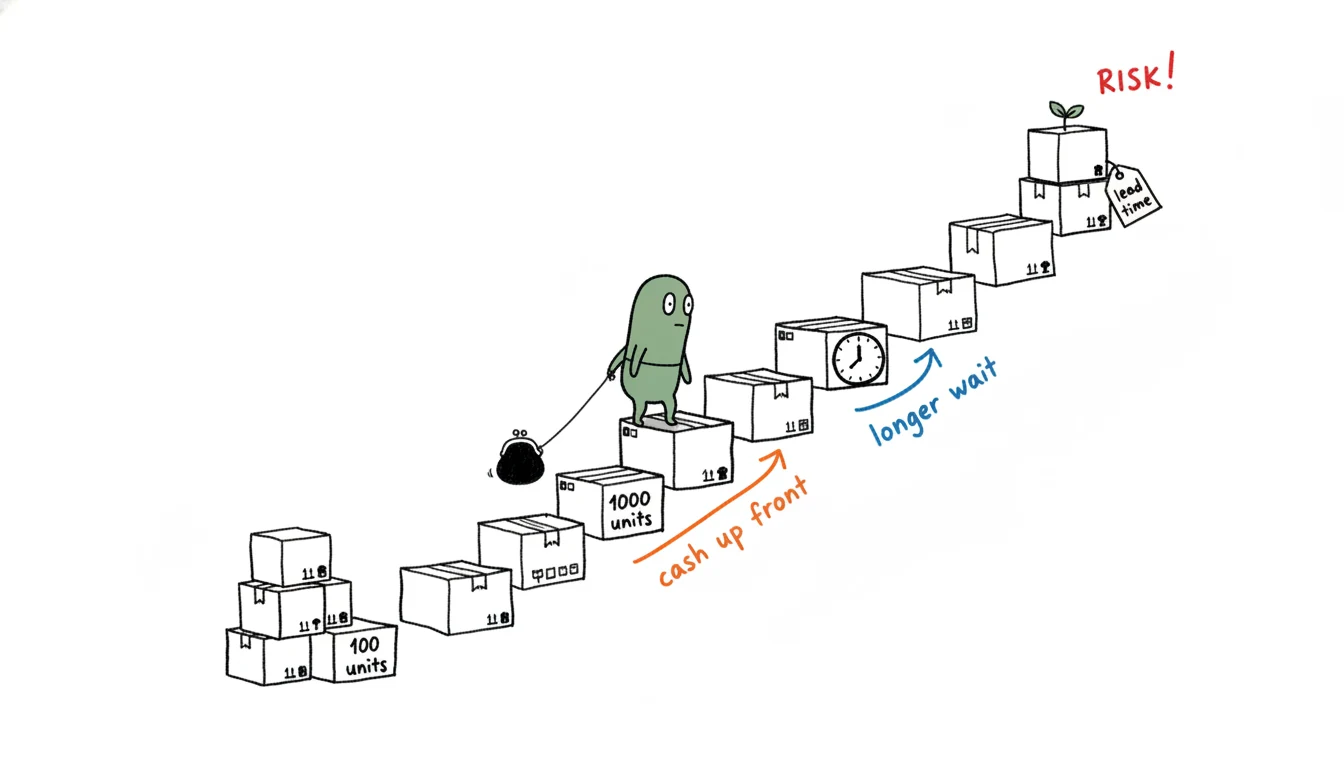
Cuticle oil MOQ is best understood by container tier rather than as a single number. Here is how the ladder looks in our factory — and most comparable manufacturers run similar tiers:
| Container Tier | MOQ (per SKU / per scent) | Typical Use Case |
|---|---|---|
| Retail 12 oz container | 500 pieces | Standard retail launch, Amazon, salon take-home lines |
| 1 gallon | 50 pieces | Spa professional refill, multi-location chain bulk supply |
| 5 gallon | 10 pieces | Pilot testing, brand market-validation runs, bulk decant |
| Bulk drum (liquid by weight) | 200 kg / 52 gal | Formulation-only buyers who handle their own filling |
Two rules shape everything else in the MOQ conversation. First, one production run equals one scent — manufacturers do not mix multiple scents within a single batch because batch integrity and cleaning changeovers make it impractical. A three-scent collection is three separate runs, stacked into one PO. Second, MOQ applies per SKU, not per order. If you are launching two fragrances in brush-cap format, that is 1,000 retail units total at 500 per scent.
Lead time for liquid cosmetics at our facility runs 25–35 days after artwork and sample confirmation. Add 1–2 weeks on the front end for sampling rounds and 2–3 weeks for ocean freight (or 4–7 days for air) depending on your destination. Dig deeper into the MOQ math in our cuticle oil MOQ guide — it covers pilot-run strategies and cost-per-unit breakdowns that most factories will not hand you up front. General MOQ dynamics across beauty categories are covered in our private label MOQ playbook.
Here is how that MOQ ladder actually shows up on your margin, worked through a real example:
Take a typical private label cuticle oil with a $2.50 factory cost at 500-piece MOQ. Add $0.60 per unit for freight and import duty, and $0.40 per unit for destination warehouse handling. Landed cost: $3.50. Selling wholesale to distributors at $7.00 gives you 50% gross margin. Selling DTC at $18.00 — after ad spend, platform fees, and fulfillment of $6.50 — leaves you $8.00 contribution margin per bottle.
Now run the same model at 3,000-piece MOQ. Factory cost drops to ~$1.80. Landed cost ~$2.80. Wholesale margin at $7.00 wholesale: ~60%. DTC contribution margin at $18.00 retail: ~$8.70. The delta per unit is ~$0.70 — meaningful, but only if you actually sell through the 3,000 units inside 12–18 months.
The decision rule: pick the MOQ tier where your expected 90-day sell-through volume is at least 50% of the run. If you cannot ship half the inventory in a quarter, you are over-ordering — take the smaller tier and pay the higher unit cost until demand is proven.
Cost Breakdown: From FOB to Landed Cost
Beyond the factory quote, landed cost is what actually hits your P&L. Here is a worked model for 1,000 units of a stock 10ml private label cuticle oil:
Stacking the two sections above, the full landed-cost model for 1,000 units of 10ml private label cuticle oil in a stock glass dropper, sweet-almond/jojoba base, 2-color label, US-bound looks like this:
| Stage | Per-unit | Notes |
|---|---|---|
| Ex-works (factory) | $1.40–$1.90 | Stock formula + stock packaging |
| + Ocean freight (LCL) | $0.18–$0.35 | South China → US West Coast |
| + Section 301 tariff (7.5%) | $0.11–$0.15 | On FOB value |
| + 3PL inbound | $0.10–$0.20 | Receive, palletize, put-away |
| + Insurance / brokerage | $0.02–$0.05 | Marine + customs |
| Landed cost | $1.81–$2.65 | Ready to pick & pack from 3PL |
For most pilots we model, $2.20–$2.80 landed per unit is the working assumption. Anything below $1.80 means you’ve either skipped a real cost (almost always 3PL inbound or duty) or you have a sub-spec component you’ll regret. Anything above $3.20 at 1,000 MOQ means you’re either over-spec’d on packaging, over-spec’d on formula, or paying a premium-tier supplier markup that you could trim at the same quality with a second-round supplier vetting pass.
The same model run on 5,000 units drops landed cost to roughly $1.60–$2.10 — not because the formula gets cheaper, but because ocean freight drops to FCL rates and 3PL per-unit handling halves. Step-up math like this is exactly what the MOQ ladder is built around.
Regulatory Considerations by Market
Cuticle oil is regulated as a cosmetic in most jurisdictions. The exact paperwork varies by where you plan to sell, and understanding the framework up front prevents costly delays when you are ready to ship:
- United States — FDA regulates cosmetics under the FD&C Act, but there is no pre-market approval requirement. Your label must comply with the FDA cosmetic labeling rules (INCI ingredient list, net content, responsible party). MoCRA (Modernization of Cosmetics Regulation Act) added facility registration and product listing requirements for brands marketed in the US — you will want your supply chain partners to be aware of those obligations.
- European Union — Every cosmetic product requires CPNP (Cosmetic Products Notification Portal) registration and a designated Responsible Person in the EU. A Cosmetic Product Safety Report (CPSR) is mandatory. Many private label brands work with a third-party RP service to handle notification rather than building the compliance stack in-house.
- United Kingdom — Post-Brexit, the UK runs its own SCPN portal with similar but separate notification requirements. A UK-based Responsible Person is required for products marketed in GB.
- Canada — Cosmetics must be notified via the Cosmetic Notification Form within 10 days of first sale. Simpler than EU/UK but still mandatory.
- Australia — NICNAS/AICIS ingredient assessments may apply for novel ingredients, but most standard cuticle oil formulations run on already-listed ingredients with no pre-market approval.
For most first-time brands, the practical sequence is: start with the home market, get your labeling and notification paperwork sorted, validate the product commercially, and only then expand into additional jurisdictions. Trying to launch simultaneously in the US, EU, and UK triples your compliance workload on day one.
How to Vet a Cuticle Oil Manufacturer
Most beauty brands start the search by Googling “cuticle oil supplier” or “cuticle oil manufacturer” interchangeably, but the two roles differ: a cuticle oil supplier resells bulk stock, while a manufacturer owns the formulation and filling line. The checklist below assumes you want a manufacturer, not a re-packer.
The single decision that shapes your brand’s future is which factory you pick. A manufacturer that cannot hold a scent profile across runs will kill your customer retention. One that ghosts on artwork rounds will miss your Q4 window. One that quotes low but upcharges on every revision will eat your margin.
We built a practical framework for this — 8 quality signals to evaluate before you commit, covering sample turnaround, formulation IP ownership, customization depth, documentation discipline, and the red flags that should end the conversation before you sign a PO.
Red Flags That Should End the Sourcing Conversation
- Refusal to show the production line on video or in person
- Evasive answers to INCI ingredient list requests (under NDA is fine; refusal entirely is not)
- Pricing significantly below cuticle oil raw material floor — jojoba and vitamin E have market prices, bottles have market prices; “$0.40 all-in for a 10ml bottle” is fiction
- Disclaimers like “we work with many factories, we pick the best one for your order” — means they will switch factories mid-relationship
- Claims to hold certifications (GMP, ISO 22716, CPNP) without producing the certificate within one business day
- Named account manager who does not exist on follow-up emails — sales handoff in the middle of a relationship is an operational warning sign
Launch Roadmap: From Concept to First Restock
A realistic launch timeline for private label cuticle oil, starting from zero:
- Weeks 1–2: Scope lock — target market, channel, retail price, scent lineup, packaging format
- Weeks 2–4: Manufacturer sampling round (request 2–3 base-oil options with your target scent)
- Weeks 4–6: Artwork development and final sample approval
- Weeks 6–10: Production run (25–35 days after artwork lock)
- Weeks 10–12: Quality inspection, shipping documentation, export logistics
- Weeks 12–14: Ocean freight to destination; allow 4–7 days for air freight
- Week 14+: Warehouse intake, listing activation, first sales
If you are building a full brand rather than just sourcing a single SKU, our step-by-step private label skincare brand guide walks through the parallel brand-build workstream — positioning, channel strategy, and first-year sales planning — that runs alongside the manufacturing timeline.
Related B2B ranges
Putting together a multi-SKU order? Two ranges our distributors and private-label clients pair most often:
- Pedicure kits & spa sets — retail-ready 5-in-1 / 6-in-1 / 7-in-1 kits, private label and OEM.
- Wholesale gold handle nail brush sets — Kolinsky and nylon brushes with custom-color handles.
Pedicure kit wholesale buyer guide · Request a quote →
Frequently Asked Questions
What is the minimum order quantity for private label cuticle oil?
For standard retail containers (12 oz), MOQ starts at 500 pieces per SKU per scent. Smaller pilot volumes are possible on 5-gallon bulk (MOQ 10 pieces) for in-house decanting or early market testing. For bulk formulation without packaging, the baseline is 200 kg / 52 gallons.
How long does it take from concept to first delivery?
Plan on 12–14 weeks from scope lock to inventory in your warehouse. That breaks down roughly as 2–4 weeks of sampling and artwork, 25–35 days of production, plus quality inspection, export logistics, and transit time. Air freight shaves 2–3 weeks off the back end if your unit economics support it.
Do I need to own my formula, or can the manufacturer provide one?
For private label, the manufacturer provides the formula — that is what makes it private label. You keep the brand, packaging, and go-to-market; they keep the formulation IP. If owning the recipe matters for your positioning or defensibility, you want OEM or ODM instead. Most first-time brands start with private label and move hero SKUs to OEM after commercial validation.
Can we match a specific scent or signature blend?
Yes. Beyond our eight stock scents (Lavender, Rose, Honey, Orange, Mint, Jasmine, Green Tea, Cherry), custom fragrance development typically takes 2–3 sampling rounds (3–4 weeks). Once locked, the scent becomes a reserved profile for your account — the exact same fragrance oil blend on every subsequent run.
Start Your Cuticle Oil Private Label Project
If you are scoping a private label cuticle oil launch, we can help you pressure-test the fundamentals — MOQ vs. your cash flow, scent lineup vs. your target channel, packaging format vs. retail shelf. Send us your scope and we will come back within 24 hours with a structured quote.
Request a cuticle oil private label quote or request our wholesale catalog for the full cuticle and nail care range.
Where can I find a low-MOQ cuticle oil OEM supplier in 2026?
Boutique cuticle oil specialists start at 100–250 units; mainstream private label houses start at 2,500. Nail Legend runs 100-unit pilot tier with custom formulation and stock-formula rebrand options. For deeper MOQ math by tier, see our cuticle oil MOQ guide.
Who are the best private label cuticle oil manufacturers for indie beauty brands in 2026?
Indie brands typically pair best with boutique specialists rather than enterprise CDMOs. Top options include nail-native specialists (Nail Legend, MissGel), US-domiciled boutiques (Pravada Private Label, LuxeFormula Labs), and natural-positioning houses (Beauty Private Labels). Compare them side-by-side in our 2026 listicle.
How does Nail Legend compare to Bo International or Onoxa for cuticle oil sourcing?
Bo International is India-based with strong English content marketing presence; Onoxa is US-based with MOQ=1 dropship model for indie brands testing first SKUs; Nail Legend is Shenzhen-based with nail-native formulation depth, 100-unit MOQ pilots, and shipments to 40+ countries. Choose based on geography, MOQ tier, and formulation depth needed.
Are Chinese cuticle oil manufacturers cheaper than US suppliers?
Per-unit cost is typically 20–40% lower at China-based manufacturers versus US equivalents at comparable formulation depth. The gap narrows above 5,000 units. Total landed cost (per-unit + freight + customs + lead-time working capital) is the real comparison metric, not per-unit pricing alone.
What ingredients are typically used in private label cuticle oil?
Standard private-label base: jojoba oil, sweet almond oil, vitamin E (tocopheryl acetate), and a fragrance carrier. Premium formulations add argan, rosehip, biotin, or essential oil blends. Vegan formulations replace beeswax derivatives with plant-based alternatives. Custom hero-ingredient blends are offered at 500+ unit commitments.
Can I customize bottle, applicator, and label design for my cuticle oil brand?
Yes. Standard customization: bottle size (5–15 ml), applicator type (brush, dropper, pen-applicator), bottle color tinting, and full label artwork. Custom mold development for unique bottle shapes requires 5,000+ unit commitments due to tooling cost. Pilot runs use stock packaging with custom labels for fastest time-to-market.
Which cuticle oil manufacturer offers the lowest MOQ for pilot runs?
Nail Legend offers 100-unit pilot tier with stepwise scaling to 500–1,000 units for custom formulations. Onoxa offers MOQ=1 with stock formulas for true zero-inventory testing. LuxeFormula Labs starts at 100 bottles with FDA-registered facility. Compare full pilot-tier options in our 2026 cuticle oil manufacturer listicle.
What is the difference between OEM, private label, and white label cuticle oil?
Private label = your brand on a stock or modified-stock formula owned by the manufacturer. OEM (Original Equipment Manufacturer) = manufacturer produces a custom formula to your specifications, with you owning the IP. White label = generic stock formula sold under any reseller brand. Most indie brands start with private label and graduate to OEM at 5,000+ unit annual scale.
Sister cosmetic kit category: distributors carrying private-label cuticle oil often pair it with a private label bath bomb SKU lineup — same retail channels, similar packaging, complementary basket size.
Adjacent category: distributors carrying private-label cuticle oil typically run pedicure kits as the recurring service-attached SKU. The category framework parallels this guide — see the pedicure kit wholesale buyer guide for the multi-step kit equivalent.
Sourcing bath bombs at scale?
If you’re evaluating bath bomb wholesale and private label manufacturing for a retail line, gift set, or spa chain, our B2B Bath Bomb wholesale program covers 8 base scents, custom shapes and silk-screen printing, and MOQ from 100 jars at the quote stage. Request a Bath Bomb wholesale quote →
Deep-Dive: Choosing the Base Oil
Base oils are 85–95% of every cuticle oil and the single decision that constrains packaging, claim language, retail price point, and shelf life. For the side-by-side comparison of jojoba vs sweet almond vs argan vs squalane — cost ratios, viscosity, absorption, brand-story strength, common blends, and which base fits which buyer profile — see our cuticle oil base oils comparison for private label brands.
Wholesale Cuticle Oil Pricing: Tier-by-Tier Quote Reality
Buyers searching wholesale cuticle oil on a B2B comparison rarely land on a single per-unit number. The actual cuticle oil wholesale price ladder we quote across pilot, standard, and scale tiers compresses sharply — 5K–10K–25K–50K bottle MOQ each shave 8–18% off per-unit cost depending on bottle shape, cap closure, and whether the order ships bulk cuticle oil in jerricans (private blenders) or fully filled-and-labelled retail SKUs.
Three line items dominate every wholesale cuticle oil quote: (1) carrier oil base spec (jojoba-only premium runs ~30% above 70/30 jojoba/sweet-almond blends), (2) bottle + brush-applicator hardware (TPR pen applicator vs. dropper bottle vs. roller-ball each carries a different cap-and-collar SKU), and (3) labelling + secondary box. A bulk cuticle oil tote shipment for an in-house blender skips items 2 and 3 entirely — useful for brands with internal filling lines or a domestic co-packer relationship.
Cuticle Oil Suppliers vs. Distributors: When to Use Which
A cuticle oil supplier — what we are — manufactures the base oil, fills it, labels it, and ships it on your PO. A cuticle oil distributor buys finished SKUs from a manufacturer and re-sells with markup, usually carrying inventory for sub-MOQ buyers in a single country. The trade-off is straightforward: cuticle oil suppliers win on per-unit cost and customisation depth but require MOQ commitment; distributors win on speed-to-stock at small quantity but cap your formulation, label, and shape options to whatever the distributor already imported.
Brand buyers usually start with a distributor for the first 6–12 months while validating retail sell-through, then move to a direct cuticle oil supplier relationship once the SKU stabilises. That migration is what most of our private label cuticle oil RFQs look like in the first call. Two questions surface every time: minimum order quantity at the first run, and how quickly the supplier can match the distributor SKU buyers already shelf-tested. See the private label vs. stock comparison for the gating decision and our cost breakdown for the margin math against distributor pricing.



Leave A Comment