
Note: We’ve folded this into our complete private label cuticle oil guide — see the full picture (formulation, packaging, MOQ, cost, regulatory, vetting) here: Private Label Cuticle Oil Manufacturing Guide.
Minimum order quantity is the first number most brand founders ask about — and the first number most factory sales teams dodge until they understand how serious you are. This guide lays out the full MOQ ladder for private label cuticle oil, by container tier, with the pilot-run strategies and scale-up math you need to plan cash flow intelligently.
For broader MOQ dynamics across beauty categories, our private label MOQ playbook covers the cross-category pattern. This article goes one layer deeper into cuticle oil specifically — because liquid cosmetics run on their own ladder.
Why MOQ Decides Your First Launch
MOQ sets three things in motion the moment you sign a PO: your working capital lock-up, your inventory risk exposure, and the unit economics that flow through to your retail margin. A 500-piece MOQ at $2.50 per unit ties up $1,250 plus shipping and compliance. A 3,000-piece MOQ at the same unit price is $7,500 — and that is before you know whether the market actually wants your scent combination.
The right MOQ for your brand is not the lowest MOQ a factory will accept. It is the MOQ that lets you finish one full sell-through cycle (ideally 60–90 days for nail aftercare) while still holding reserve capital for your next run. Plan from there, not from the quoted floor.
When buyers search for a “private label cuticle oil minimum order” online, the answer that surfaces is almost always a single number — usually 500 or 1,000 units. The real answer depends on whether you’re committing to a stock formula (which can ship at the lowest MOQ tier within 18–25 days because the chemistry is already validated) or a modified-stock formula that adds a development round and a higher production floor. Both paths are valid; the choice should follow your launch timeline and cash position, not the lowest quoted number.
MOQ Breakdown by Container Size
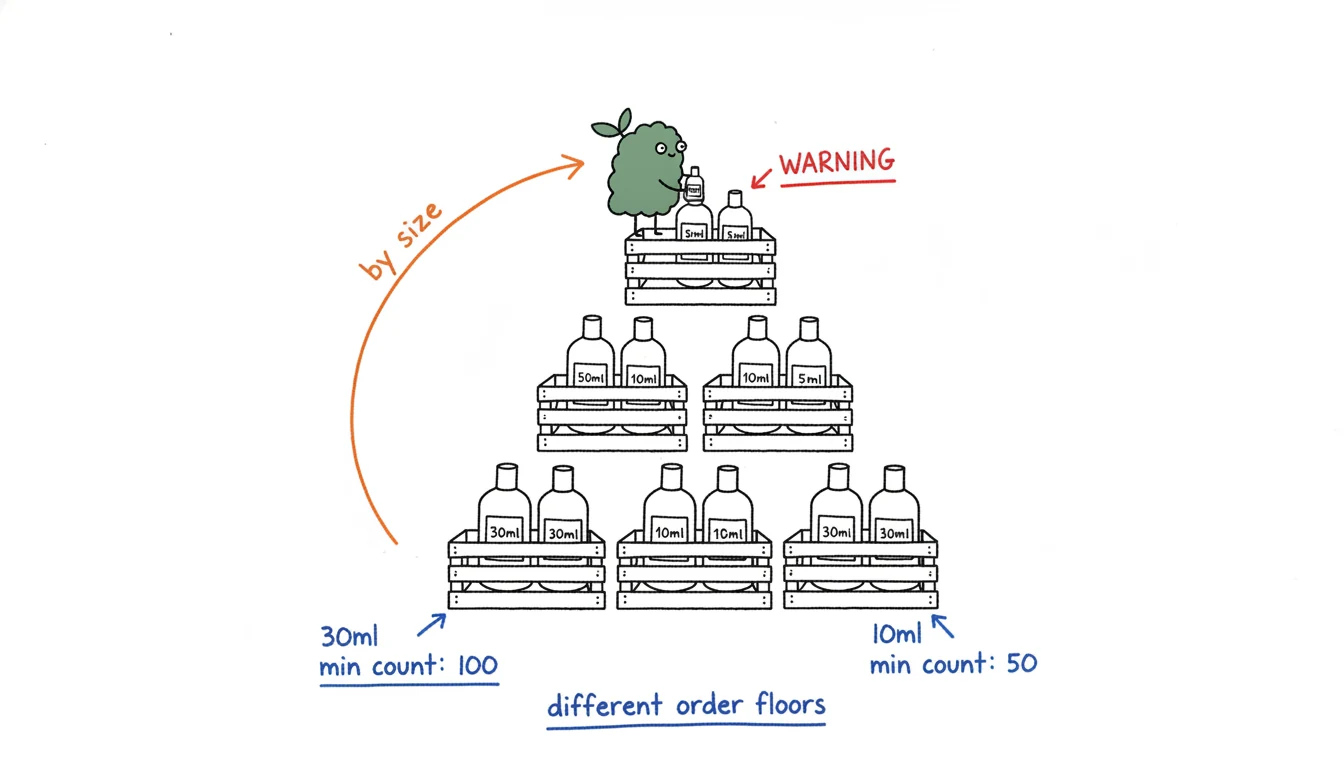
Cuticle oil does not have a single MOQ number — it has a ladder. Each rung targets a different buyer type and a different production economics model:
| Tier | MOQ (per SKU / per scent) | Per-Unit Cost Sensitivity | Typical Buyer |
|---|---|---|---|
| 12 oz retail bottle | 500 pieces | Baseline (index 100) | Amazon sellers, salon retail, DTC brands |
| 1 gallon jug | 50 pieces | ~70% of retail tier | Spa refill programs, professional channel |
| 5 gallon pail | 10 pieces | ~55% of retail tier | Pilot runs, bulk decant, market validation |
| Bulk drum (by weight) | 200 kg / 52 gal | ~40% of retail tier | Formulation-only buyers, brand owners who fill in-house |
The 12 oz retail tier is where most private label brands start. The 5-gallon tier is where smart operators start when they want to test scent and packaging without committing to 500 retail units. And the bulk drum is for brands that already have their own filling line or a co-packer relationship — generally not year-one operators.
A separate cuticle oil bulk MOQ quote applies when you buy unbottled liquid for in-house or co-packer filling. The bulk drum tier (200 kg / 52 gal) typically prices in the $18–$28 per kilogram band for a stock jojoba-blend formula, with lead times of 18–28 days — meaningfully faster than packaged-goods MOQs because you skip the bottling, labeling, and packout stages. The trade-off is that the buyer takes on packaging sourcing, label compliance, and filling-line QC, so the bulk path only makes sense for operators with their own filling capacity or a trusted co-packer relationship.
Why 1 Production Run = 1 Scent (And What It Means for Multi-SKU Launches)
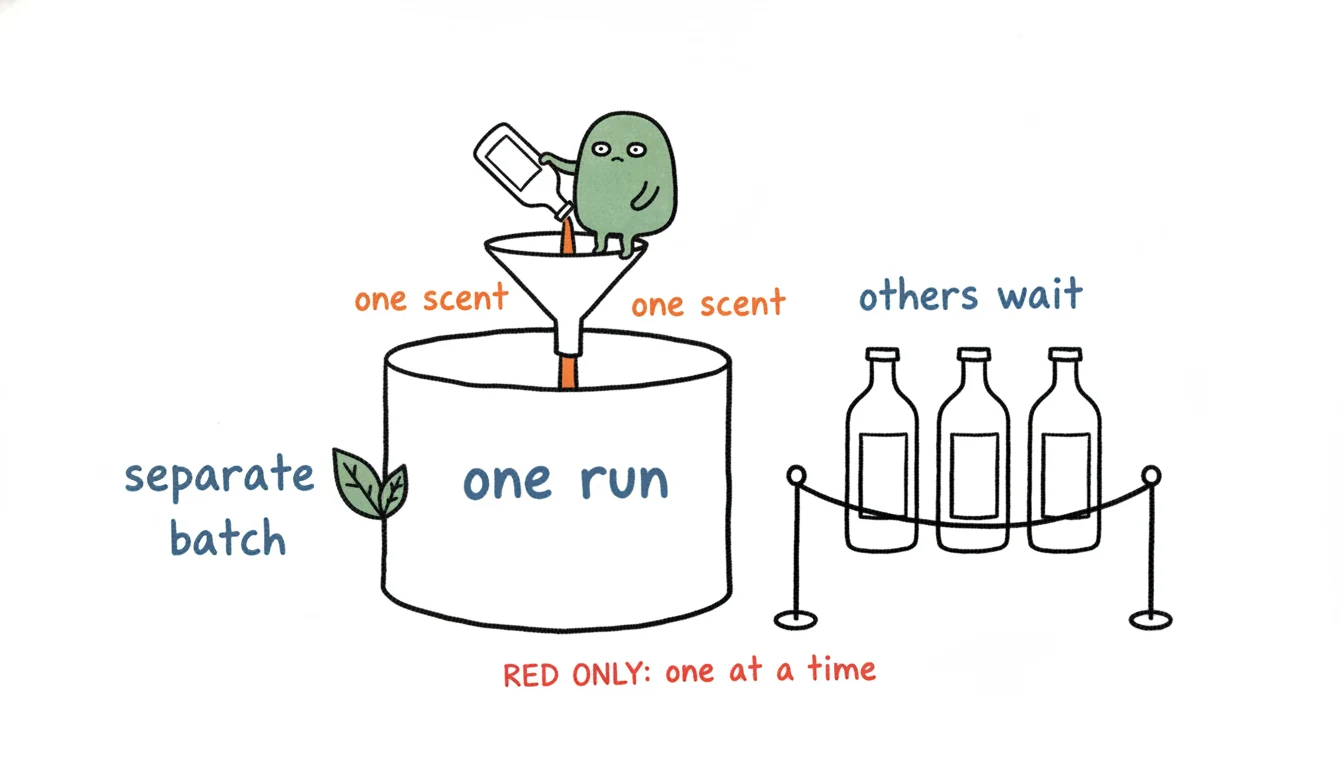
This is the rule every new brand underestimates: one production run covers one scent. Factories do not “mix up to three scents in a single run” — batch integrity, cleaning changeovers, and QC sampling all break down when you try to share a run across multiple fragrance profiles. If someone tells you they will mix scents within a run, either they are misunderstanding the question or they are running a small-batch operation where consistency is not guaranteed batch-to-batch.
What this means for a three-scent launch collection: your minimum order is 500 pieces × 3 scents = 1,500 retail units. That is still achievable for most first-time brands — but the math needs to be explicit from day one, not a surprise on the invoice.
The workaround used by experienced operators: launch with one hero scent in retail format, and validate the second and third scents via 5-gallon pilot runs that you manually decant into sample bottles for influencer or trade-show distribution. Once the pilot scent proves out, you graduate it to a full 500-piece retail run.
Bundling multiple scent variants into a single PO does not reduce the per-scent MOQ floor (each scent still needs its own production run), but it can reduce per-unit cost by 8–15% through shared setup fees, batched ocean freight, and consolidated 3PL inbound. If your launch plan needs three scent variants, ordering them together in one PO almost always beats ordering them sequentially across three separate POs — both on landed unit cost and on time-to-shelf for the second and third SKUs.
Pilot-Run Strategies: Start Smart Without Sitting on Inventory
A pilot run is any production below standard retail MOQ that lets you validate market response before committing to full inventory. Three pilot strategies that work well for cuticle oil:
- 5-gallon bulk decant. Order 10 × 5 gallon pails (MOQ minimum) at three different scent profiles. That is ~150 gallons of liquid, roughly 75,000 × 10 ml fills if you decant in-house. Most brands only decant 500–1,000 samples and freeze the rest until demand signal is clear.
- Single-scent hero launch. Commit full MOQ (500 pieces) to your most-validated scent and packaging. Launch, collect 60–90 days of sales data, then plan scent #2 and #3 based on real demand curves.
- Influencer pilot + retail production parallel. Run a 5-gallon bulk pilot for influencer seeding and trade shows while a 500-piece hero SKU is in production. By the time retail launches, you have social proof from the pilot ready to deploy in ads.
The common trap: ordering 500 × 3 scents on launch, spending a quarter of your launch budget on inventory, and discovering two of the three scents generate 80% less velocity than the third. You cannot unwind that commitment — the inventory sits on your shelf for 12+ months.
The Scale-Up Math: Cost per Unit at Every Tier
Unit cost drops meaningfully as you climb the MOQ ladder, but not linearly. The biggest drops happen between pilot and first full MOQ, then between first MOQ and 5,000+ unit runs. Approximate cost indices for a standard 10 ml brush-cap cuticle oil, private label format, jojoba + vitamin E base:
| Run Size | Relative Unit Cost | Notes |
|---|---|---|
| 500 pieces (MOQ floor) | 100 (baseline) | Setup, cleaning, and QC amortize over small volume |
| 1,000 pieces | ~85 | Setup cost spreads over 2× volume; raw-material bulk discount kicks in |
| 3,000 pieces | ~72 | Component sourcing moves to direct mold order; label printing per-unit drops |
| 5,000+ pieces | ~65 | Container and cap sourcing approaches OEM-tier pricing |
| 10,000+ pieces | ~58 | Raw-material purchase volume unlocks further base oil discounts |
The practical implication: if your sell-through is solid and you are confident in the scent, doubling from 500 to 1,000 pieces gets you ~15% better unit economics — often worth it if you have the working capital. But jumping from 500 to 5,000 on a launch (without market validation) locks in 35% lower unit cost on inventory you may never sell through.
MOQ and Pricing: How the Math Shows Up on Your P&L
Take a typical private label cuticle oil with a $2.50 factory cost at 500-piece MOQ. Add $0.60 per unit for freight and import duty, and $0.40 per unit for destination warehouse handling. Landed cost: $3.50. Selling wholesale to distributors at $7.00 gives you 50% gross margin. Selling DTC at $18.00 — after ad spend, platform fees, and fulfillment of $6.50 — leaves you $8.00 contribution margin per bottle.
Now run the same model at 3,000-piece MOQ. Factory cost drops to ~$1.80. Landed cost ~$2.80. Wholesale margin at $7.00 wholesale: ~60%. DTC contribution margin at $18.00 retail: ~$8.70. The delta per unit is ~$0.70 — meaningful, but only if you actually sell through the 3,000 units inside 12–18 months.
The decision rule: pick the MOQ tier where your expected 90-day sell-through volume is at least 50% of the run. If you cannot ship half the inventory in a quarter, you are over-ordering — take the smaller tier and pay the higher unit cost until demand is proven.
Frequently Asked Questions
What is the lowest MOQ I can start with for private label cuticle oil?
The lowest full retail-ready MOQ is 500 pieces per SKU per scent in a 12 oz container. If you want to go lower, the 5-gallon bulk pail (MOQ 10 pails) is the pilot tier — you get ~50 gallons of liquid for sample decanting and market testing, with no retail packaging attached.
Can I split my 500-piece MOQ across two scents?
No. MOQ applies per scent because each scent requires its own production run. Two scents means two runs at 500 each (1,000 total). Batch integrity and cleaning changeovers are why — it is a technical constraint, not a commercial one.
Do MOQ numbers include the packaging, or just the liquid?
The 500-piece retail MOQ includes full packaging — bottle, cap, brush, label, and secondary packaging if specified. Bulk drum MOQ (200 kg / 52 gal) is liquid only — you handle packaging separately, which is why per-unit economics are lowest at that tier.
How much working capital should I plan for a first cuticle oil launch?
A single-scent 500-piece launch, landed cost, typically runs $1,500–$2,200 including freight and duty. A three-scent 500-piece each launch runs $4,500–$6,500. Add a 20–30% buffer for sampling rounds, compliance filings, and unexpected artwork revisions on your first run.
Plan Your MOQ Against Real Numbers
Send us your target retail price, scent lineup, and expected 90-day sell-through, and we will come back with a structured quote that maps MOQ to your cash flow rather than the other way around. Request a cuticle oil private label quote — 24-hour response.
Before you commit to a factory, run it through our 8-signal manufacturer vetting framework. And for the full category guide: cuticle oil private label manufacturing — the complete 2026 playbook.
Base-Oil Tier Affects MOQ
Premium-base runs (argan, squalane) typically carry higher MOQ floors than sweet-almond / jojoba volume blends because the per-batch capital outlay shifts. Our cuticle oil base oils comparison walks the four base oils, their cost ratios, and which blend each buyer profile should target.
📚 Related pillar: see our full Cuticle Oil private label & OEM sourcing guide for the broader sourcing frame, MOQ tiers, lead times, and decision framework.



Leave A Comment