
Before a brand team requests a single quote for a private label body scrub, three format decisions quietly determine the entire cost and compliance profile of the product: the abrasive (sugar, salt, coffee, or a specialty grain), the carrier system (anhydrous oil-based vs. emulsifying), and the base oils and butters that follow. Most sourcing conversations skip straight to “what’s your MOQ?” — and then unravel three rounds later when the brand realises an oil-based salt scrub and an emulsifying sugar polish are completely different products with different price ladders, different safety labelling, and different shelf-life behaviour. This guide maps the full body scrub category the way a manufacturer actually quotes it, so your spec sheet is clean before the first quote round.
The Body Scrub Category Map: Five Formats Buyers Actually Quote
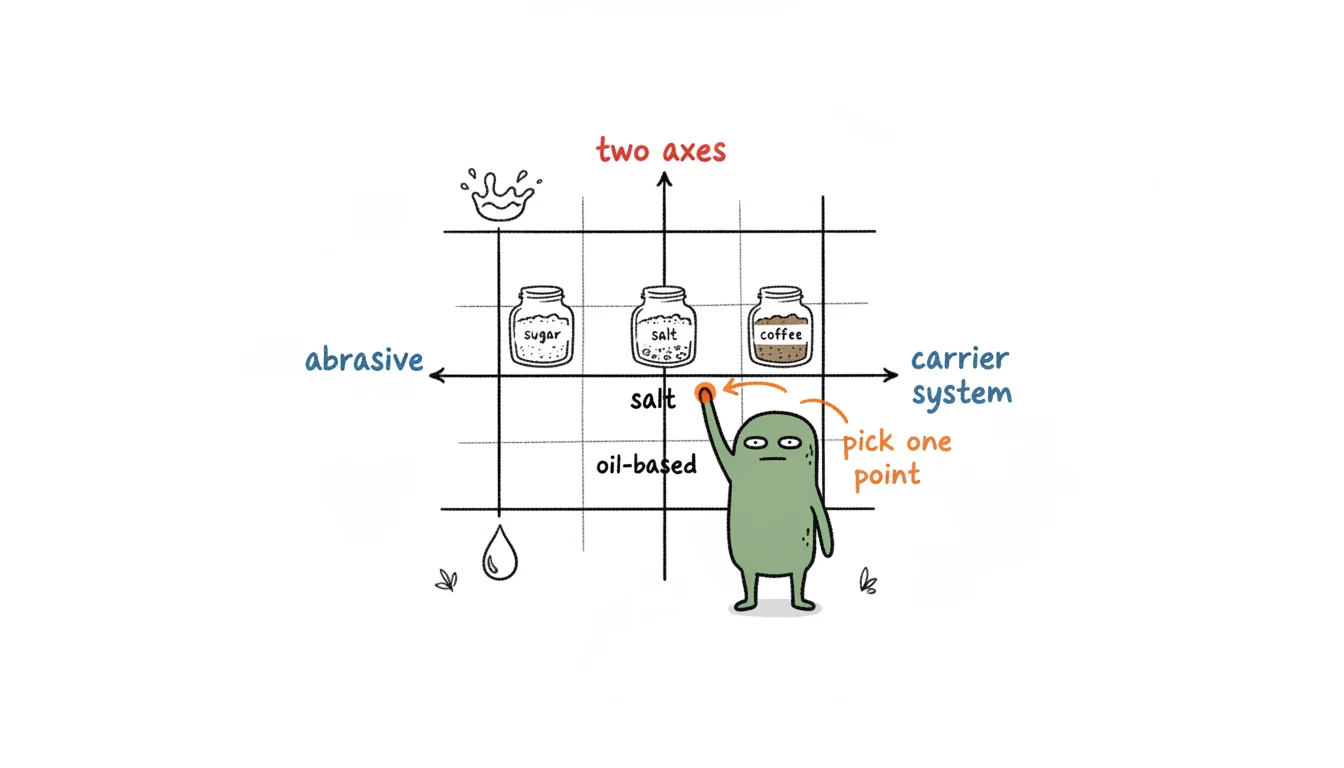
“Body scrub” is an umbrella term. Underneath it sit two orthogonal decisions that a private label body scrub manufacturer treats as separate line items: which abrasive and which carrier system. Get these two axes right and almost every downstream question — scent, jar, MOQ tier, preservation, compliance — falls into place.
- Sugar scrub — rounded grains, fast-dissolving, gentle. The default retail format; face-and-body friendly. Covered in depth in our sugar scrub private label sourcing guide.
- Salt scrub — angular, mineral, aggressive exfoliation for rough body zones. Carries one labelling contraindication (below) that sugar does not.
- Coffee & specialty scrubs — coffee grounds, fruit-seed powders, or blended abrasives used for brand storytelling and differentiation.
- Oil-based (anhydrous) — abrasive suspended in oils and butters, no water. Rich, slippery, preservative-light.
- Emulsifying — the same base plus an emulsifier so it rinses to a milky, non-greasy finish. The premium upgrade.
A brand rarely needs all five. The job of a good sourcing brief is to pick one point on each axis — for example “emulsifying coffee scrub” or “anhydrous sugar polish” — and specify it precisely. The sections below give you the language to do that.
Sugar vs. Salt Scrub: Abrasion, Skin Type & the Contraindication You Must Label
The single most common question a body scrub manufacturer fields is “should we make the sugar version or the salt version?” It is not a matter of taste — the two abrasives behave differently at a physical level, and one of them carries a safety constraint your label copy must address.
| Dimension | Sugar Scrub | Salt Scrub |
|---|---|---|
| Grain shape | Rounded, few sharp edges | Angular, hard, abrasive |
| Behaviour in water | Dissolves fast, gets finer as you rub | Dissolves slowly, abrasion persists |
| Exfoliation strength | Gentle | Strong, mineral |
| Moisture role | Sugar is a humectant — conditions as it exfoliates | Slightly drying |
| Best for | Sensitive skin, the face, full-body daily use | Rough zones — heels, elbows, knees |
| Key contraindication | Relatively forgiving | Not for freshly shaved, broken, or scratched skin — salt stings open skin |
That last row is the one that bites brands. A salt scrub aimed at “post-workout” or “after-shave” use needs a clear “do not use on broken or freshly shaved skin” caution on the label — a detail many private label briefs forget until a customer complaint surfaces it. If your line is built around bath rituals and soaking, a related format worth understanding is the dissolving bath soak; our bath soak salt sourcing guide covers where mineral salts go when exfoliation isn’t the goal. The short version for format selection: gentle, facial, sensitive, daily → sugar; heavy-duty body exfoliation → salt.
Oil-Based vs. Emulsifying Scrubs: Solving the “Slippery Floor” Problem
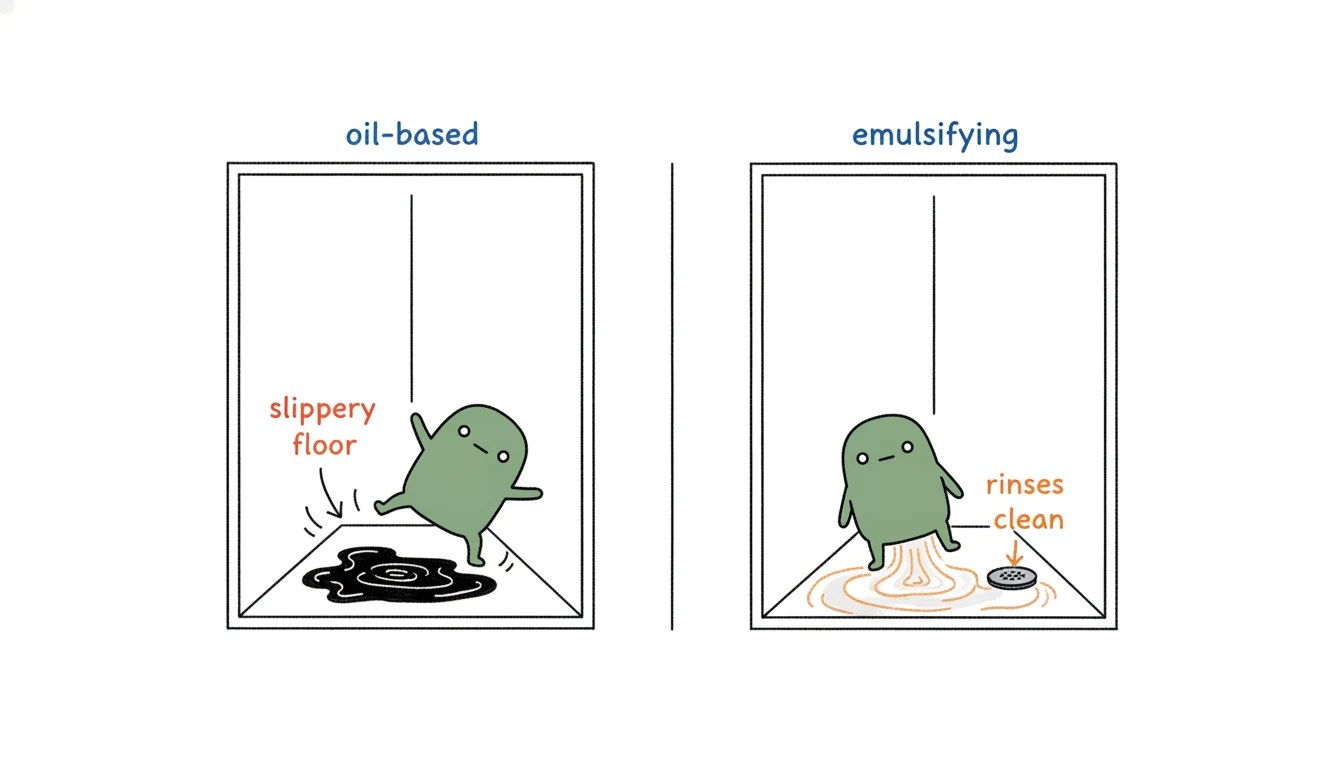
This is the axis brands underestimate most, and it is where a manufacturer’s quote can swing materially. A standard scrub is anhydrous oil-based: abrasive suspended in carrier oils and butters, no water. It feels rich and leaves a conditioning oil film — but it also makes the shower floor and the user’s feet slippery, and it rinses greasy. That slipperiness is not a defect; it is inherent to the format, and it is the single most important thing your label must warn about (see compliance below).
An emulsifying scrub adds an emulsifier (an emulsifying wax or cetearyl-type system) to that same base. When water hits it in the shower, the oils emulsify into a milky lotion that rinses clean — no greasy film, far less slip. The trade-off: more complex formulation, higher cost, and — critically — once you introduce an emulsifier and the product is designed to interact with water, you have changed the preservation maths (again, see below). Emulsifying is the natural upgrade for a mid-to-premium retail line where “clean, non-greasy finish” is part of the pitch. If a brief simply says “sugar scrub” without specifying the carrier system, a careful manufacturer will ask — and you should answer before quoting, because oil-based and emulsifying are different products at different price points.
Coffee & Specialty Abrasive Scrubs: Niche Formats for Differentiation
Beyond sugar and salt, the abrasive itself becomes a branding device. Coffee scrubs use spent or milled coffee grounds for a caffeine-and-antioxidant story and a distinctive scent; fruit-seed powders (apricot, walnut) and blended grains let a brand build a signature texture. These specialty formats quote much like a sugar or salt scrub — the carrier system, base oils, and packaging dominate cost — but they let a smaller brand stand out on a crowded shelf without reformulating the whole base.
One sourcing note: coarser or harder specialty abrasives (some seed powders) raise the same “is this too aggressive for sensitive skin?” question as salt. Confirm the available grain sizes (the mesh/grit range) with the manufacturer, and match the abrasive to the positioning — a “gentle glow” face-and-body scrub and a “heavy-duty foot polish” are not the same grit.
Carrier Oils & Butters: How Your Base Drives Cost and Claims
Whatever the abrasive, it sits in a base of carrier oils (sweet almond, jojoba, grapeseed, coconut, sunflower) and often butters (shea, cocoa) that thicken the paste and raise the “nourishing” claim. This base is a major cost lever: at matching grade, coconut oil sits well below jojoba, and a butter-rich “body polish” texture costs more than a thin pourable scrub. The base also drives your marketing claims — “nourishing,” “rich,” “buttery” all come from this layer, not the sugar.
Two technical points worth specifying up front. First, the base oils oxidise over time and can go rancid, which is why a small load of vitamin E (tocopherol) as an antioxidant is standard — ask whether it is included. Second, the ratio of abrasive to oil (the sugar-to-oil or salt-to-oil ratio) is the real formulation know-how: too much abrasive and the scrub feels dry and separates; too much oil and it loses exfoliating bite and floats oil on top. That ratio is each factory’s proprietary parameter — ask for it to be tuned to “more scrub feel” or “more conditioning,” and don’t assume two suppliers mean the same thing by “standard.” For the carrier-oil decision specifically, the same base-oil trade-offs we map for massage oil carrier oils and blends apply directly to scrubs.
Anhydrous & the Preservative-Free Myth: Why “No Water” ≠ “No Risk”
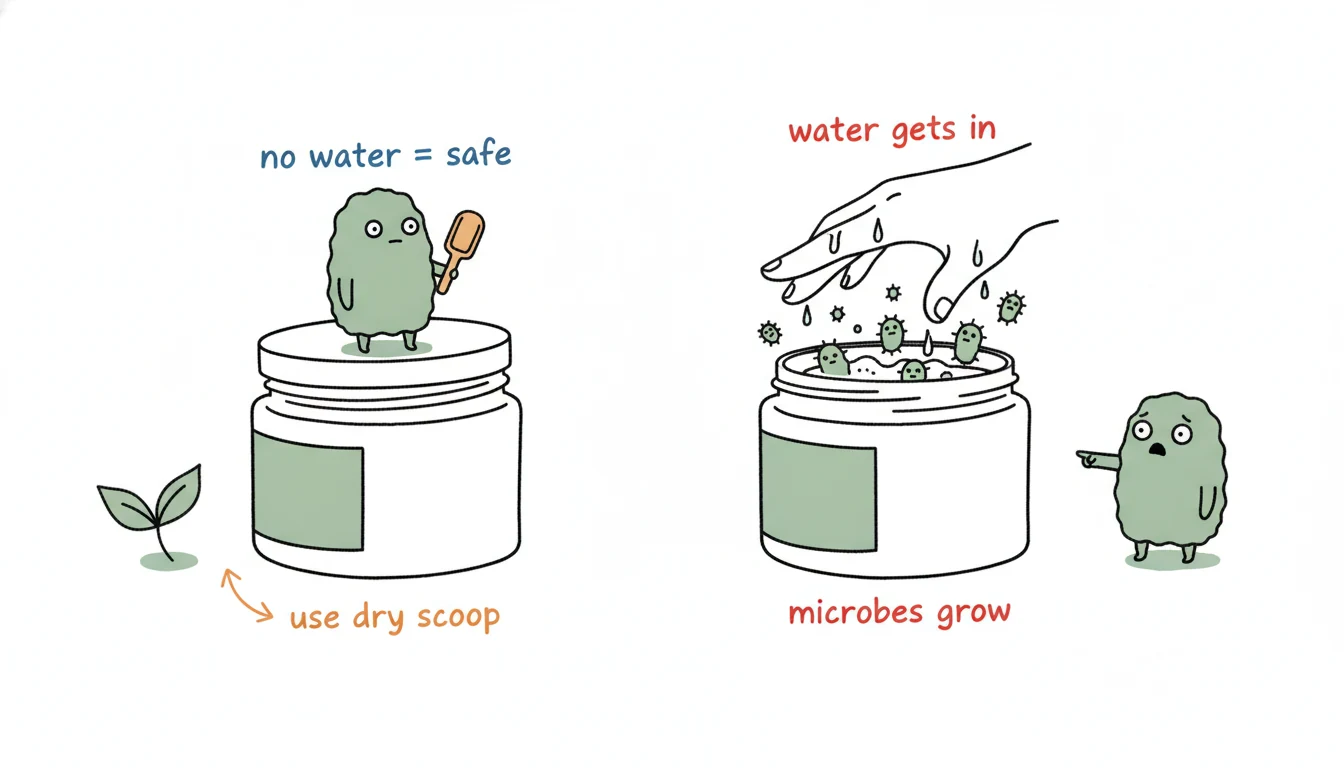
Here is the compliance point that separates a professional sourcing partner from a broker. A standard anhydrous (water-free) oil-based scrub can be exempt from traditional preservatives — with no water, microbes struggle to grow. Brands hear “preservative-free” and treat it as a clean-label win. The exemption is real, but it is conditional, and the condition is “no water gets in.”
- In use, a customer scoops the jar with wet hands in the shower. Water enters the product, dissolves some sugar, and creates exactly the moist environment microbes need.
- The defences: label guidance to use a clean, dry spoon and avoid getting water in the jar; supplying an included scoop; or adding an antimicrobial system as insurance.
- Any emulsifying or water-containing formula loses the exemption immediately and must be properly preserved and challenge-tested. If you upgrade an anhydrous scrub to emulsifying, preservation is no longer optional.
Two more labelling essentials for a US-market cosmetic scrub: keep the copy to cosmetic claims (cleansing, exfoliating, moisturising, scenting) — the moment a label claims to treat a condition, the product risks being regulated as a drug. And for any oil-based format, include the “may make surfaces slippery — use caution” warning. A manufacturer who raises the anhydrous-exemption nuance and the slip warning before you ask is one who will not leave you exposed after launch. (As a matter of policy we describe our own quality processes plainly and never claim third-party certifications we don’t hold.)
MOQ, Lead Time & Packaging: B2B Sourcing Parameters
Once the format is locked, the commercial parameters are straightforward to compare across quotes. For a typical private label body scrub programme:
- MOQ — around 5,000 units for a private label run; bulk (drum/pail) programmes for spas and distributors who re-pack are quoted separately by weight.
- Lead time — roughly 25–35 days for a standard bulk fill, 35–45 days for a custom private label formulation (new ratio, oils, scent, or emulsifying system).
- Packaging — wide-mouth PET or glass jars (the paste is thick; users scoop it), often amber or opaque to protect oils from light. Thick pastes need temperature-matched filling so the abrasive doesn’t sink and the oil doesn’t float. Ship light-protected and temperature-controlled.
- Customisation tiers — private label (your label on a stock base) vs. full OEM (reformulated ratio, oils, scent, sugar/salt, oil-based/emulsifying, and bespoke packaging).
Packaging is also a quiet safety feature: an included scoop directly supports the “keep water out” preservation story above, so it is worth specifying even though it adds a few cents. Body scrubs sit naturally alongside the rest of a body-care line — if you’re building the broader range, our body butter private label manufacturing guide walks the adjacent anhydrous-base category, and the live sugar scrub product range shows current stock formats.
How to Brief a Body Scrub Manufacturer: The 8-Line RFQ Spec
The cleanest way to get comparable quotes is to hand every supplier the same eight-line spec. Fill these in and your quote round compares apples to apples:
- Abrasive — sugar / salt / coffee / specialty, and desired grit (gentle vs. heavy-duty).
- Carrier system — anhydrous oil-based or emulsifying (state it explicitly).
- Base oils & butters — e.g. coconut + shea, or jojoba for a premium claim.
- Scrub-to-oil feel — “more scrub feel” or “more conditioning.”
- Scent — vanilla / coffee / coconut / citrus / lavender, etc.
- Preservation — anhydrous exemption with scoop, or fully preserved (mandatory if emulsifying).
- Packaging — jar type, size, opacity, included scoop, gift-set or refill.
- Volume & documents — target MOQ and which compliance docs you need (INCI list, SDS).
A supplier who answers all eight precisely — and proactively flags the salt contraindication, the slip warning, and the preservation condition — is sourcing you a product that survives contact with real customers. Ready to spec your body scrub line? Start with the sugar scrub deep-dive, then send us your eight-line brief for a quote.
FAQ
What is the difference between a sugar scrub and a salt scrub?
Sugar grains are rounded and dissolve quickly, giving gentle exfoliation suitable for sensitive skin and the face; sugar also acts as a humectant, conditioning as it exfoliates. Salt grains are angular and abrasive for heavy-duty exfoliation on rough zones like heels and elbows, but salt must not be used on freshly shaved, broken, or scratched skin because it stings open skin.
What is an emulsifying body scrub and why does it cost more?
An emulsifying scrub adds an emulsifier to the oil base so that, when it meets water in the shower, the oils turn milky and rinse off without a greasy film or slippery floor. It solves the main drawback of oil-based scrubs but requires more complex formulation and full preservation, so it sits at a higher price point than a standard anhydrous scrub.
Can a body scrub really be preservative-free?
A water-free (anhydrous) oil-based scrub can be exempt from traditional preservatives because microbes need water to grow. The exemption is conditional on keeping water out of the jar in use — so it relies on label guidance to use a dry scoop, often an included scoop, and sometimes an antimicrobial backup. Any emulsifying or water-containing scrub loses the exemption and must be properly preserved and challenge-tested.
What is the typical MOQ and lead time for a private label body scrub?
A private label body scrub run is typically around 5,000 units, with bulk drum or pail programmes quoted separately by weight for spas and distributors. Lead time runs roughly 25–35 days for a standard bulk fill and 35–45 days for a custom private label formulation involving a new ratio, oils, scent, or an emulsifying system.
Which carrier oils are used in body scrubs?
Common carrier oils include sweet almond, jojoba, grapeseed, coconut, and sunflower, often combined with butters such as shea or cocoa for a richer body-polish texture. The choice drives both cost (coconut sits below jojoba at matching grade) and marketing claims, and a small load of vitamin E is usually added to stop the oils from oxidising and going rancid.



Leave A Comment