
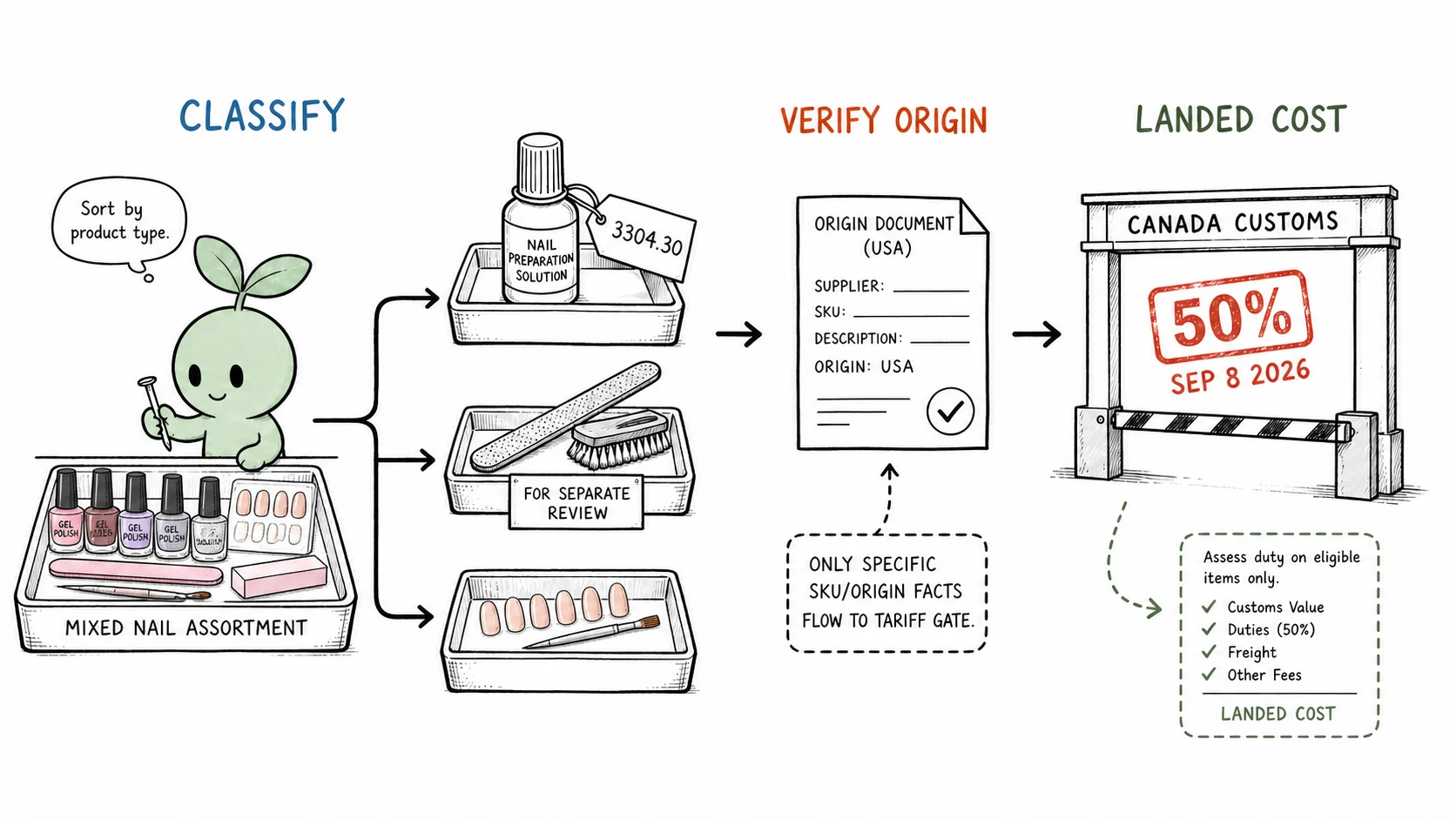
Canada’s Department of Finance has listed tariff item 3304.30.00, “manicure or pedicure preparations,” among U.S. products subject to a 50% counter-tariff effective at 12:01 a.m. on September 8, 2026. For nail brands and distributors, that is a landed-cost event—not a reason to make a blanket assumption about every item in a manicure assortment.
This Canada nail product tariff 2026 guide explains the operational questions a B2B buyer should take to its customs broker, supplier and finance team. Product classification, country of origin and import facts determine the actual treatment. This article is commercial planning information, not customs, legal or tax advice.
What the official notice says
The Department of Finance product list shows a 50% rate for 3304.30.00. The government’s consolidated counter-tariff page says the measures apply to targeted products imported from the United States and identifies September 8, 2026 as the effective date.
Three details matter:
- Tariff item: the notice identifies manicure or pedicure preparations under 3304.30.00, not every tool, accessory or machine used in nail services.
- Origin: the list addresses U.S. products. Shipping from a U.S. warehouse does not by itself prove U.S. origin, and a U.S. brand name does not settle origin.
- Import date and rules: the effective date and customs treatment need to be checked against the actual entry and current official instructions.
Use the official list together with the 2026 Canadian Customs Tariff and current CBSA notices. Ask a qualified broker to confirm the tariff classification and origin for each SKU.
Do not apply one rate to the whole assortment
A nail program can contain liquid or gel preparations, files, brushes, tips, lamps, tools, wipes and packaging. These products can fall under different tariff items. The first response should be SKU-level mapping, not a portfolio-wide surcharge.
| Data field | Why it matters | Owner |
|---|---|---|
| Product description and formula | Supports classification review | Regulatory/product team |
| Current tariff code | Identifies the declared classification | Broker/import team |
| Country of origin | Determines whether the U.S.-product measure may apply | Supplier and broker |
| Incoterm and importer of record | Shows who manages entry and duty cash flow | Purchasing/logistics |
| Entry date and inventory position | Separates in-transit, pre-change and future stock | Logistics/finance |
Request origin documentation and a bill-of-materials explanation where origin is not obvious. Do not instruct a supplier to change a country-of-origin statement to reduce duty. Origin must reflect the applicable rules and real manufacturing facts.
Rebuild landed cost at the SKU level
Duty affects more than the invoice line. It can increase tax base, broker disbursement, financing needs, safety stock cost and the amount tied up in transit. Build scenarios using confirmed customs inputs.
A practical landed-cost sheet includes:
- ex-factory product and packaging cost;
- inland transport and export charges;
- international freight and insurance;
- customs value and applicable duty or counter-tariff;
- brokerage, handling and destination delivery;
- testing, relabeling or compliance costs;
- inventory carrying cost and a documented contingency.
Run at least three cases: current verified route, changed-duty route and qualified alternative origin. Compare gross margin, cash requirement and replenishment time. A lower factory price can lose its advantage when freight, MOQ or lead time rises.
Evaluate supply alternatives without creating a new risk
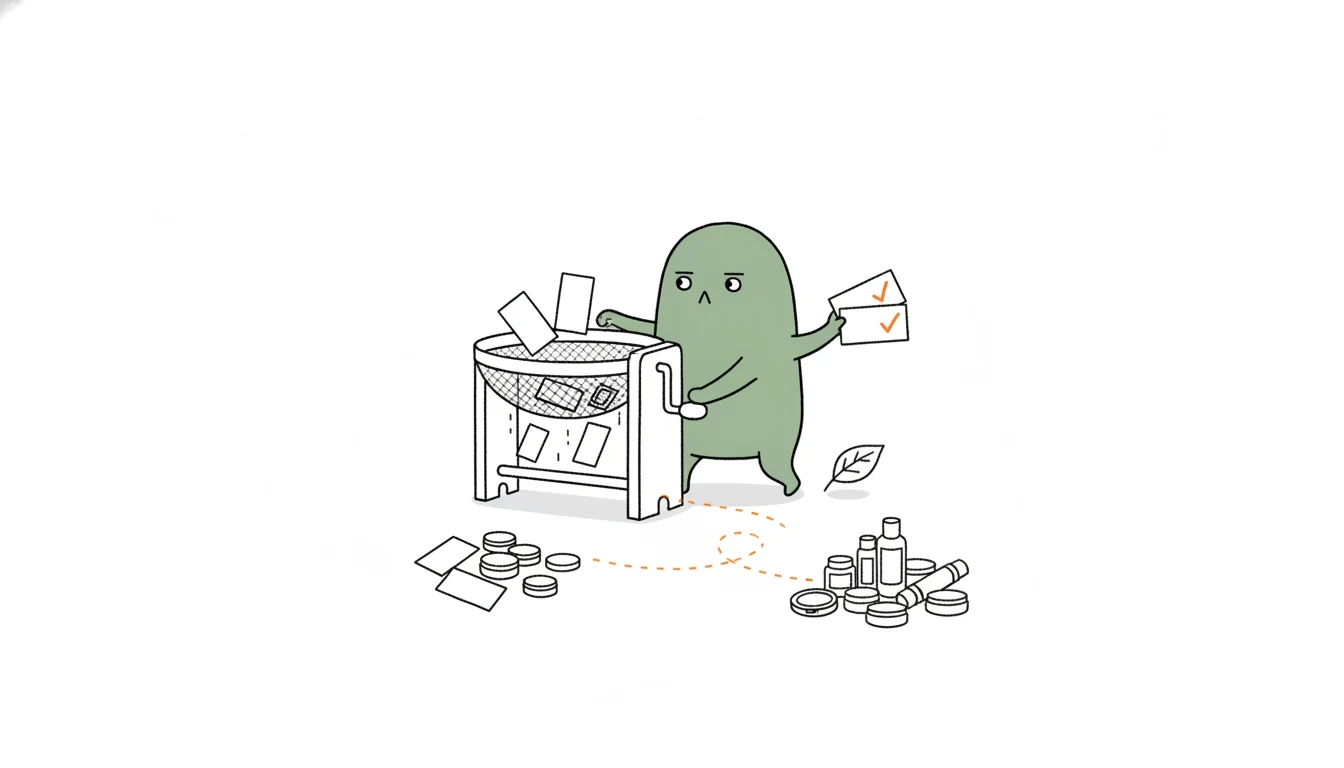
A non-U.S. manufacturing source may change the tariff exposure if the product genuinely has a different country of origin and the classification is confirmed. It does not remove the need for formula review, safety documents, label compliance, quality validation or traceability.
When qualifying an alternative OEM supplier, request:
- formula and finished-product specification;
- manufacturing site and origin statement;
- ingredient and safety documentation required for the destination market;
- packaging compatibility and stability evidence appropriate to the product;
- batch coding, retain-sample and complaint-traceability process;
- MOQ, lead time, capacity and change-control terms.
Use a controlled sample and pilot-order sequence. Our beauty supplier due-diligence guide and quality-control checklist provide additional review points.
Protect continuity before renegotiating price
Map the weeks of supply for each affected or potentially affected SKU. Identify open purchase orders, production stage, shipment dates and inventory already in Canada. Then decide which products need a buffer, which can pause and which can switch after validation.
Update supplier agreements and purchase orders so the following are explicit: declared origin, manufacturing location, notification of origin or formulation changes, Incoterm, importer-of-record responsibility, supporting documentation and treatment of unexpected government charges. Commercial language should be reviewed by the relevant professionals.
A 10-day buyer response plan
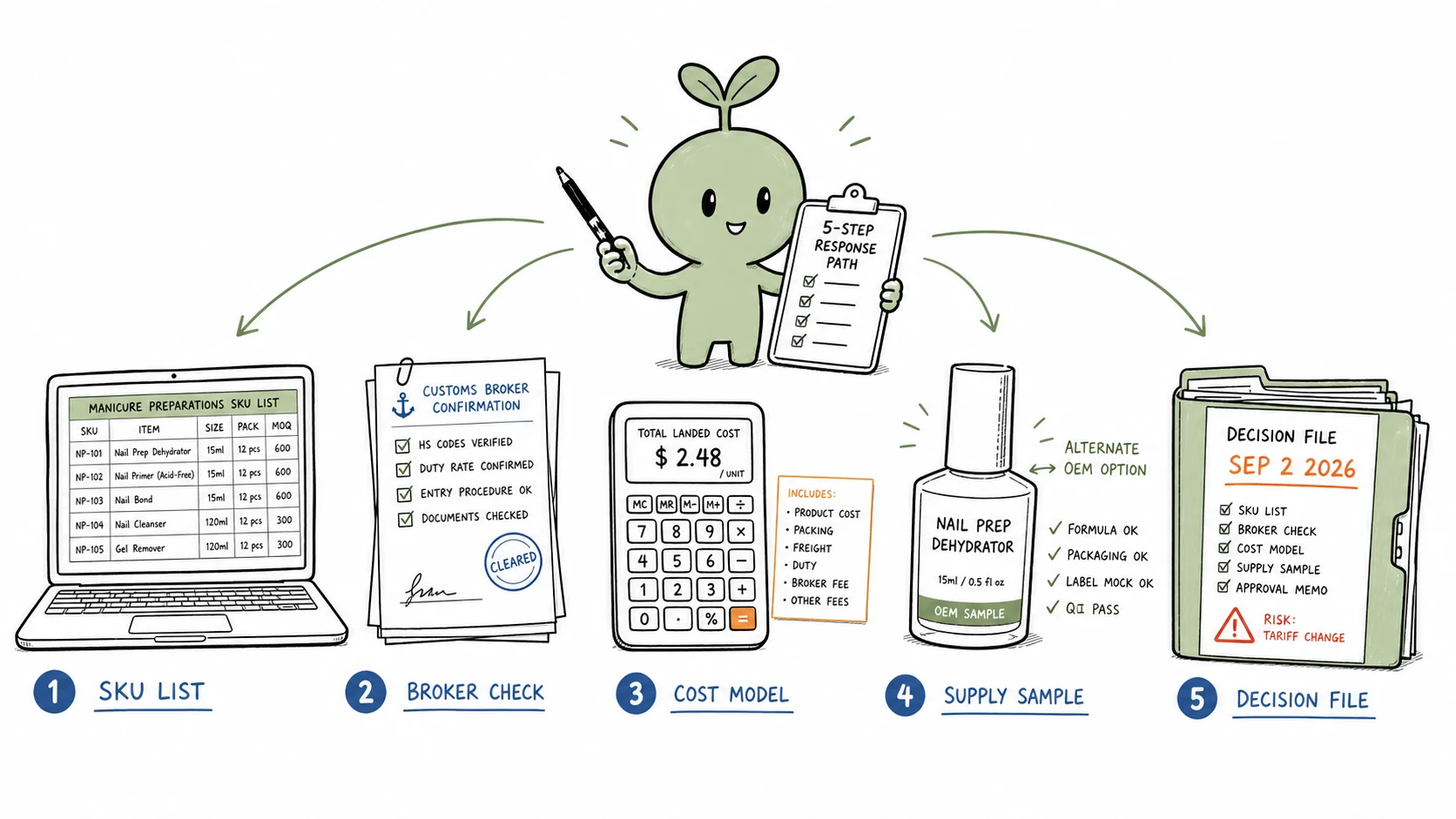
- Days 1–2: export the active SKU list and flag products currently declared under or near 3304.30.00.
- Days 2–3: ask the broker to confirm classification, origin evidence, effective-date treatment and duty calculation.
- Days 3–5: rebuild landed cost and margin by SKU; avoid publishing an unverified blanket price increase.
- Days 4–6: review open orders and inventory continuity.
- Days 5–8: request qualified alternative-origin samples and documentation where the economics justify it.
- Days 8–10: approve a sourcing decision, customer communication and monitoring owner.
Keep a dated decision file containing the official source, broker advice, classification record, origin support and management approval. Government measures can change, so assign someone to monitor the authoritative Canadian pages.
How Nail Legend supports a sourcing review
Nail Legend supports B2B OEM and private-label programs for global markets. We can provide a quote based on the chosen product format, MOQ, packaging, customization and lead time; the importer and its broker remain responsible for final customs decisions.
Review our Private Label vs OEM vs ODM guide, MOQ planning guide and OEM capabilities. For an alternative-supply feasibility review, contact us to request a quote with the destination market, product type, target quantity and packaging brief.
Frequently Asked Questions
Does Canada’s 50% counter-tariff apply to every nail product?
No. The official list specifically includes tariff item 3304.30.00 for manicure or pedicure preparations. Other goods may have different classifications and treatment. Confirm each SKU with a customs broker.
Is every product shipped from the United States considered U.S.-origin?
No. Shipping location and country of origin are different concepts. Origin must be determined from the applicable rules and manufacturing facts.
When is the listed measure effective?
The Canadian government’s consolidated page states 12:01 a.m. on September 8, 2026. Confirm entry-specific treatment through current CBSA guidance and your broker.
Can changing suppliers reduce tariff exposure?
A genuine alternative origin may change treatment, but classification, origin, product compliance, quality, MOQ and lead time all require validation before switching.
What information should be included in an alternative-supply quote?
Include product format, destination market, target quantity, formula requirements, packaging, customization, required documents and delivery target. The supplier can then confirm MOQ, lead time and feasibility.



Leave A Comment