
If you are sourcing top body butter manufacturers for a wholesale, private-label, or OEM program in 2026, the hardest part is not finding a factory — it is matching the right factory to your order size, margin target, and branding ambition. A US small-batch house that pours 50-piece stock runs is a poor fit for a 30,000-unit retail rollout; a high-volume Asia OEM line is overkill for a 100-unit boutique test on Etsy.
Quick answer: Pravada and RainShadow are strong US private-label starting points; Poleview and Nail Legend fit export OEM programs. Before shortlisting, decide between whipped anhydrous butter and an emulsified cream because heat behavior, preservation, filling and claims differ materially.
Methodology and evidence standard (reviewed 2026-08-07): Public evidence from manufacturer and product pages is used to establish category relevance. A public claim is a shortlist signal, not an audit. Legal manufacturer, facility, formula ownership, MOQ, lead time, capacity, certification scope and destination-market documents must be confirmed for the exact SKU in the RFQ.
Official pages checked: Pravada Private Label; RainShadow Labs; Poleview Group.
Body butter has quietly become one of the most attractive categories in personal care. It sells the premium end of the moisturizer shelf — rich, natural plant butters, a whipped cloud-like texture, and a clean-beauty story — which is exactly the kind of margin retailers and e-commerce brands now want to own instead of reselling. That demand has produced three very different kinds of supplier, and picking the wrong tier is the most common, and most expensive, sourcing mistake brands make.
This guide profiles eight body butter manufacturers across those three sourcing tiers — established US producers, boutique small-batch specialists, and Asia-based OEM powerhouses — so you can shortlist by what actually matters: minimum order quantity (MOQ), customization depth, lead time, formulation route, and the kind of brand you are building. Every supplier below is profiled neutrally; the goal is to help you choose well, not to push one name.
How to Read This List: Three Sourcing Tiers
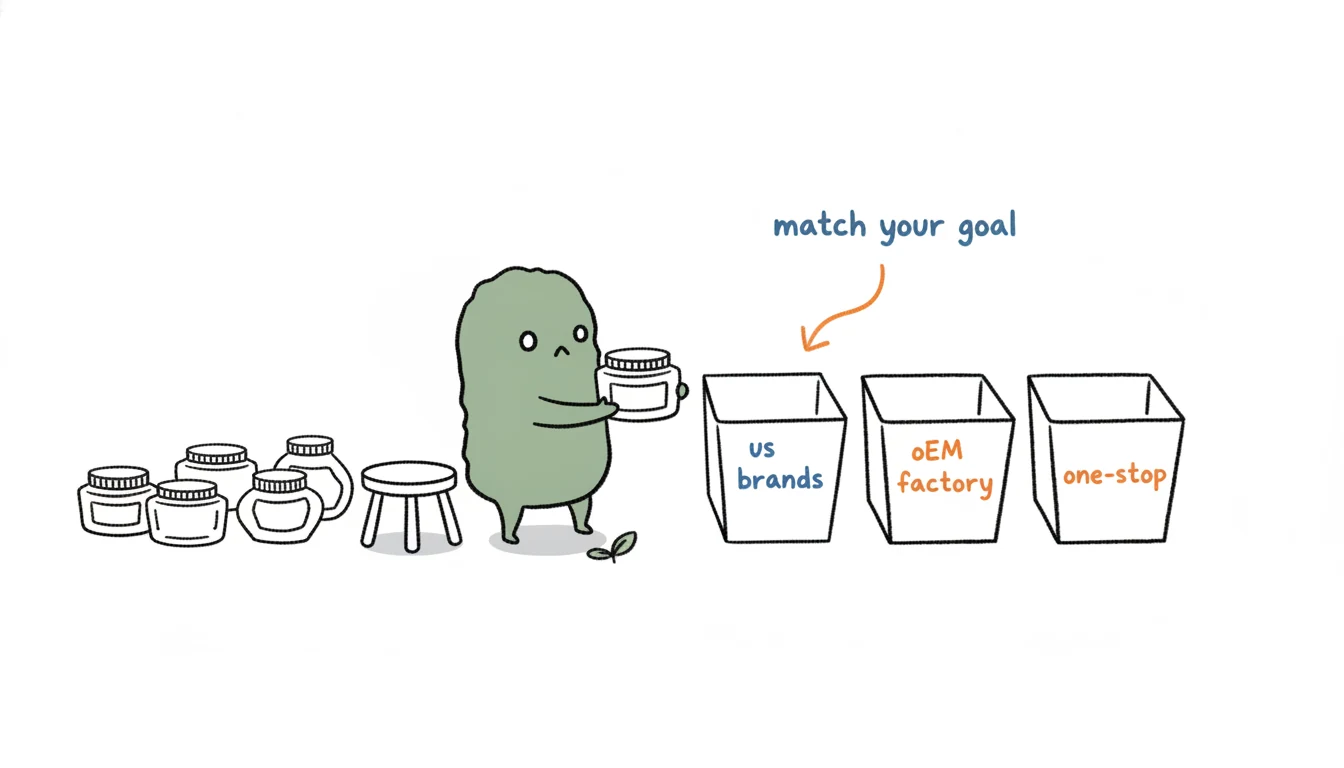
Body butter suppliers cluster into three groups, and the right pick depends on where your brand sits today:
- Established US Manufacturers — full production capacity, domestic shipping, GMP-style facilities, and ready-to-label programs. Best when you sell mainly in North America and value speed, short logistics, and a made-in-USA narrative over the lowest unit cost.
- Boutique & Small-Batch Specialists — handmade character, very low MOQs, natural and triple-butter blends. Best for early-stage brands, clean positioning, and Etsy-to-retail scaling where flexibility beats throughput.
- Asia-Based OEM Powerhouses — lowest unit cost at volume, deep custom-formulation capability across butter blends, both anhydrous-whipped and emulsified routes, and fast sampling. Best for brands optimizing margin, building custom blends, or sourcing body butter alongside scrubs, salts, and nail SKUs from one partner.
What Separates a Reliable Body Butter Manufacturer
Before the list, it helps to know what “good” looks like. Body butter is deceptively technical — the texture is not a recipe, it is a temperature curve and a whipping step — so the manufacturers worth your time share seven traits that separate a real formulator from a label-slapper:
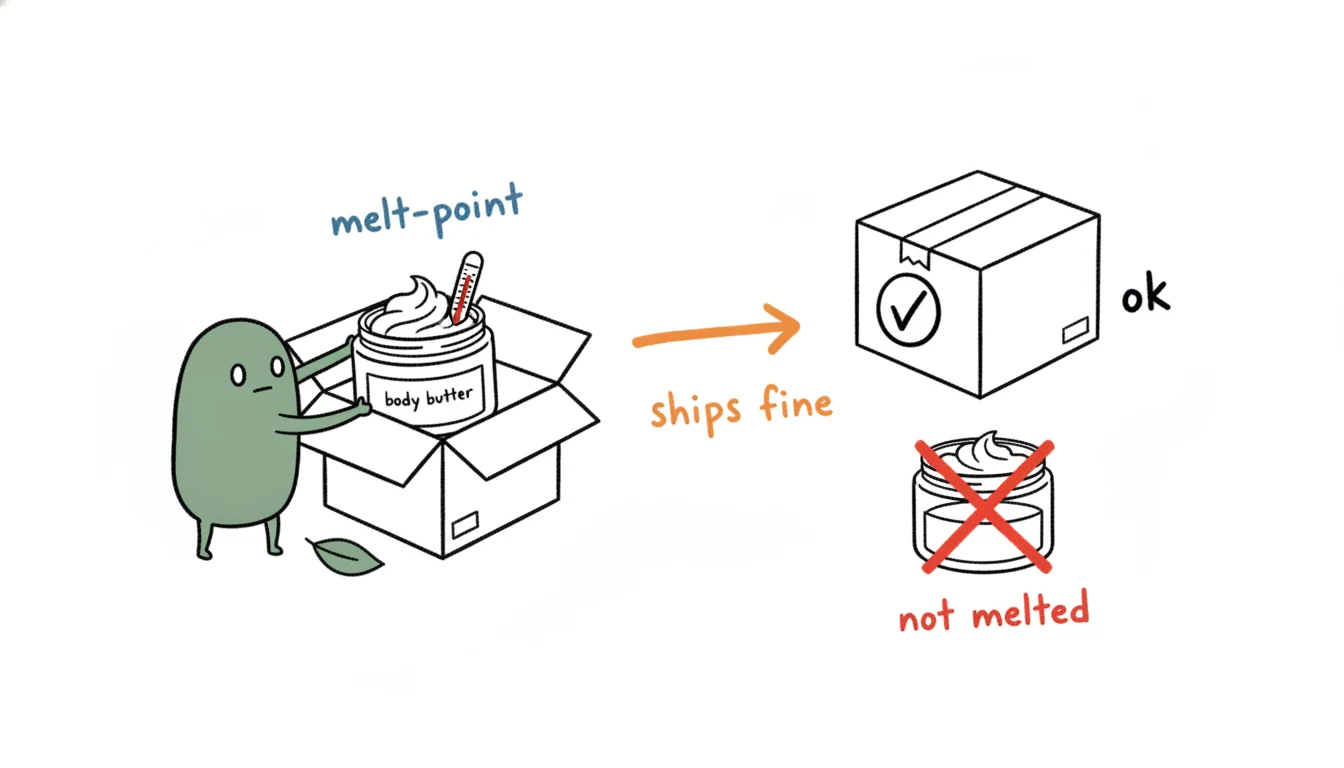
- Melt-point control for your climate: The number one body butter complaint is a jar that slumps into oil in a hot warehouse or turns rock-hard and un-scoopable in winter. A serious maker tunes the hard-butter-to-liquid-oil ratio for your target market so the product stays a firm balm at room temperature and melts on skin. Ask directly how they handle hot-climate shipping.
- Anti-bloom crystallization know-how: Cocoa butter is a polymorphic fat that can migrate to the surface and form a harmless but ugly white “fat bloom” after temperature swings. A capable factory controls it with a stable cooling curve, tempering, and temperature-managed storage. The higher your cocoa content, the more this matters.
- A clear formulation route: Whipped anhydrous (all butters and oils, no water, no preservative, antioxidant-stabilized) versus emulsified (contains water, lighter feel, requires a preservative). A good supplier asks which route you want before quoting, because it changes the claim story, compliance, and price.
- Transparent butter sourcing: Serious makers can tell you exactly what is in the base — the shea, cocoa, and mango ratio, the liquid-oil blend, the fragrance load, and any actives — and back it with documentation.
- Real sampling, not stock photos: A capable factory ships a physical sample in days so you can judge texture, scoop, scent, and skin-feel. Sampling speed is one of the best early predictors of how a production run will go.
- Honest MOQ tiers: Good suppliers offer a sample tier, a pilot tier, and a production tier — so you can validate before you commit serious capital.
- Compliance and document support: Retail-ready means INCI lists, SDS, allergen and source declarations (shea, cocoa, mango, and nut-derived oils all carry allergen flags), and claims that stay cosmetic rather than drifting into drug territory. Whether a factory hands these over cheerfully is the clearest dividing line between a professional OEM and a reseller.
Quick Comparison Table
| Manufacturer | Base | Best For | Typical MOQ | Custom Formulation |
|---|---|---|---|---|
| Pravada Private Label | Canada / USA | Low-minimum clean private label | Low (from ~50 pcs) | Yes |
| RainShadow Labs | Oregon, USA | Custom & organic formulation house | Medium (by batch) | Yes (full custom) |
| Shea Butter USA | USA | Bulk butters & ready-to-label | Flexible | Yes |
| Trilogy Laboratories | USA | Premium small-batch butters | Low–Medium | Yes |
| Alimar Private Label | USA | Ultra-low MOQ, woman-owned | Very low (~16 units) | Partial |
| Jaded Body Butter | USA | Triple-butter natural blends | Low | Partial |
| Poleview Cosmetics | China | High-volume custom blends | 1,000+ | Yes |
| Nail Legend | Shenzhen, China | Low-MOQ custom + spa/nail one-stop | Low (pilot tier) | Yes (both routes) |
Part 1 — Established US Manufacturers
1. Pravada Private Label
Profile: A well-known North American private-label house manufacturing creams and butters in FDA-registered, GMP-compliant facilities, with a catalog that lets brands launch a moisturizing line at low minimums.
- Strengths: Low entry minimums (a stock body butter line can start around 50 pieces), clean and natural ingredient positioning, and a broad bath-and-body catalog under one roof. A strong fit for brands that want a domestic, compliant partner without a long development cycle.
- Best for: Early and mid-stage North American brands wanting clean private label with a low capital commitment.
- Watch-outs: Stock-based programs limit deep bespoke formulation, and North American production economics mean higher unit costs than Asia at comparable volume.
2. RainShadow Labs (Oregon, USA)
Profile: A premier custom-formulation house and private-label manufacturer operating since 1983 from St. Helens, Oregon, with a full R&D department and a focus on organic and botanical skincare, including body butters built on shea, cocoa, and essential-oil bases.
- Strengths: Genuine ground-up custom formulation, an organic and natural ingredient library, and decades of contract-manufacturing experience for spas, salons, and beauty brands. Semi-custom programs let you modify a stock base, while full custom develops a formula from target claims and benchmarks.
- Best for: Brands that need a real formulation partner for a differentiated, natural body butter and can support batch-level minimums.
- Watch-outs: Full custom formulation carries development cost and a longer timeline, and minimums are priced by batch volume rather than a handful of units.
3. Shea Butter USA / Body Butter Supplies (USA)
Profile: A US supplier of unrefined, wholesale shea and cocoa butter that also runs a private-label manufacturing program serving cosmetic sellers and brands across Amazon, eBay, and Etsy.
- Strengths: Direct access to bulk butters at competitive pricing plus a ready-to-label path, useful when raw-material quality and a natural-butter story are central to your positioning.
- Best for: Brands that want a butter-led, ingredient-forward narrative and value sourcing the raw butters and the finished product from one place.
- Watch-outs: The offering leans toward butter-centric and ready-to-label formats; complex emulsified or actives-heavy formulations may be better served by a dedicated contract lab.
Part 2 — Boutique & Small-Batch Specialists
4. Trilogy Laboratories (USA)
Profile: A US manufacturer with a strong reputation for premium small-batch skincare, including mango, whipped cocoa, and shea body butter formulations made with attention to richness and ingredient quality.
- Strengths: Premium, small-batch philosophy that suits brands wanting a rich, high-end butter and careful formulation rather than the cheapest possible run. Good for a curated, quality-led assortment.
- Best for: Premium and natural-positioned brands prioritizing texture and ingredient quality over lowest cost.
- Watch-outs: Small-batch throughput caps very large runs, so high-volume retail programs can stretch lead times.
5. Alimar Private Label (USA)
Profile: A woman-owned company specializing in private label and limited contract manufacturing for personalized skin and hair care, with notably low minimums.
- Strengths: Among the lowest MOQs in the market — runs starting around 16 units — making it a low-risk way to test a body butter before scaling. Personable, flexible service suits founders launching a first SKU.
- Best for: First-time and micro-brands validating a body butter with minimal capital.
- Watch-outs: Very small minimums come with higher per-unit cost, and deep custom formulation and large-scale capacity are narrower than dedicated OEM lines.
6. Jaded Body Butter, LLC (USA)
Profile: A natural skin-moisturizer maker whose butters are blended from unrefined shea, raw organic cocoa, and raw organic mango butter, with a private-label and wholesale program.
- Strengths: A clean triple-butter (shea + cocoa + mango) story that maps directly onto natural and clean-beauty positioning, with low minimums and an authentic small-batch character.
- Best for: Natural and ingredient-led brands that want a recognizable triple-butter blend without building a formula from scratch.
- Watch-outs: Customization centers on the established natural base; brands needing emulsified, actives-heavy, or highly custom formats may find scope limited.
Part 3 — Asia-Based OEM Powerhouses
7. Poleview Cosmetics (China)
Profile: An established Chinese bath, body, and personal-care OEM running automated production lines, offering custom body butter alongside a broad bath-and-body catalog with custom blends, scents, and packaging.
- Strengths: High-volume capacity, deep custom formulation across vegan, organic, and scented whipped body butters, competitive unit cost at scale, and fast sampling. A strong fit when tight per-unit pricing and custom blends are the priority.
- Best for: Brands scaling volume with custom butter blends and tight margins.
- Watch-outs: Cross-border logistics and lead times require planning around production windows and freight, and minimums typically start around 1,000 pieces per formula.
8. Nail Legend (Shenzhen, China)
Profile: A Shenzhen-based spa, body-care, and nail OEM/ODM manufacturer with 10+ years of experience producing body butter alongside sugar scrubs, soak salts, massage oils, bath products, and a full nail-care line. Nail Legend runs both whipped anhydrous and emulsified body butter routes and supports brands worldwide with global freight.
- Strengths: Low-MOQ pilot runs, in-house custom formulation across the shea, cocoa, and mango butter blend, climate-tuned melt-point control to limit summer slump and winter hardness, and anti-bloom crystallization handling for high-cocoa formulas. Nail Legend offers both Private Label and full OEM, provides INCI and SDS documentation support, and lets brands source body butter, spa, and nail SKUs from a single partner — useful when building a full personal-care assortment rather than one product. English-language support with responses typically within 24 hours.
- Best for: Brands that want to test the market at low MOQ, develop a custom whipped or emulsified body butter, or consolidate body, spa, and nail sourcing under one OEM/ODM partner.
- Watch-outs: Cross-border shipping applies, though documentation, sampling, and global freight are handled end-to-end.
You can review Nail Legend’s approach in its body butter private label manufacturing guide, browse the wholesale body butter range or wider product catalog, see its full OEM capabilities, and request a quote.
Stock, White Label, Private Label, or OEM: Which Model Fits?
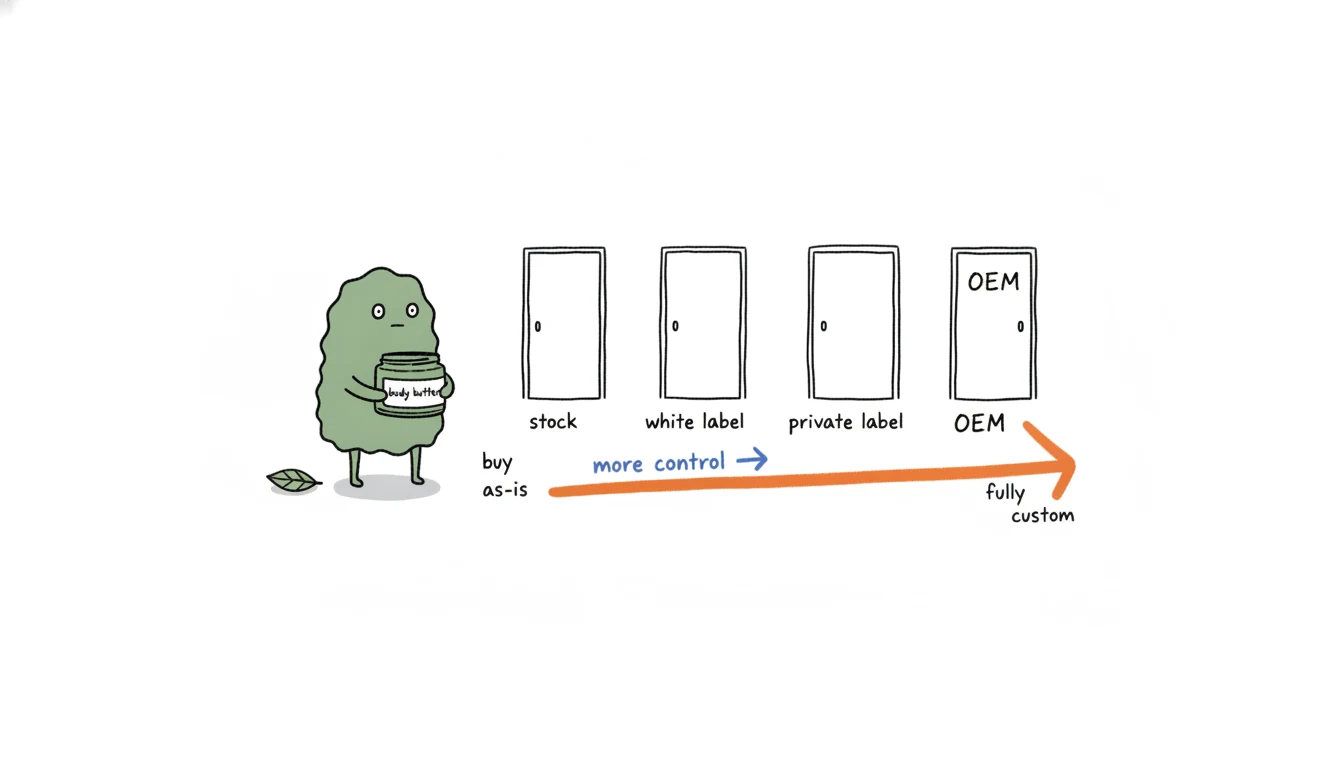
- Stock / wholesale: Buy the maker’s existing body butter as-is. Fastest and cheapest, but no brand differentiation.
- White label: A ready formula sold under your brand and packaging. Quick to launch with light customization — choose a scent and a label and go.
- Private label: Your branding plus selective tweaks to scent, color, butter ratio, or packaging on an established base.
- OEM / custom formulation: A body butter built to your spec — route (whipped vs emulsified), shea/cocoa/mango blend, fragrance, actives, melt-point target, and packaging. Highest differentiation and the route most serious brands take once they scale.
Sourcing Timeline: From Inquiry to Delivery

Knowing the typical sequence helps you plan a launch and spot a slow supplier early:
- Inquiry & quote (days 1–3): Share your target product, route (whipped or emulsified), volume, and customization. A responsive factory returns a clear quote and MOQ tiers quickly.
- Sampling (days 3–10): Approve a physical sample for texture, scoop, scent, melt-on-skin behaviour, and skin-feel. Iterate the butter blend or melt point if needed.
- Proforma invoice & deposit: Lock formula, packaging, climate target, and timeline before production starts.
- Bulk production (3–6 weeks): Lead time scales with volume, custom blends, and whether you are running a stock or fully custom formula.
- QC & shipping: Confirm quality control — including bloom and melt-point checks — then choose freight terms (FOB, CIF, or DDP) and, for body butter especially, account for temperature-controlled or insulated transit so the product arrives intact.
How to Choose Your Body Butter Manufacturer — 6 Decision Criteria
- Formulation route first: Decide whipped anhydrous (natural story, no preservative, manage oil oxidation) versus emulsified (lighter, faster-absorbing, must be preserved) before anything else — it shapes claims, compliance, and price.
- MOQ vs your cash flow: Match minimums to a volume you can sell through in one season; pilot tiers let you validate before scaling.
- Customization depth: Stock vs tweaked base vs full custom blend — be honest about how differentiated your butter ratio and scent really need to be.
- Climate and crystallization handling: Ask how the factory controls melt point for your market and prevents cocoa-butter bloom in transit. This is where amateurs and professionals diverge.
- Logistics & landed cost: A low unit price can be erased by freight, duties, and the temperature-controlled shipping body butter often needs — always compare landed cost, not factory price.
- Assortment breadth & documents: If you plan to sell body butter alongside scrubs, salts, or nail care, a one-stop OEM saves coordination overhead; and confirm they supply INCI, SDS, and allergen declarations before you commit.
Editor’s Take
For North American brands that sell domestically and want a clean, compliant launch, a US private-label house like Pravada or a custom formulation partner like RainShadow Labs is the safe default. For first-time and natural-positioned brands, the boutique specialists — Trilogy for premium small-batch, Alimar for ultra-low minimums, Jaded for a ready triple-butter story — offer low risk and genuine character. And for brands optimizing margin, building a fully custom whipped or emulsified blend, or assembling a full body-spa-nail assortment, an Asia OEM partner — Poleview for pure volume, or Nail Legend for low-MOQ custom formulation across personal-care categories with both formulation routes and end-to-end documentation — typically delivers the best mix of cost, customization, and one-stop convenience. The strongest shortlist usually includes one option from at least two tiers, so you can compare a domestic and an overseas quote side by side, and judge each on the things that actually break body butter programs: melt-point stability, bloom control, and sampling speed.
Frequently Asked Questions
What is the difference between whipped (anhydrous) and emulsified body butter?
A whipped, anhydrous body butter is made only of butters and oils whipped with air for a fluffy texture. With no water, it needs no preservative system and relies on antioxidants like vitamin E to stop the oils oxidizing. An emulsified body butter contains water and an emulsifier, giving a lighter, faster-absorbing cream, but it must include a preservative because any water-containing formula carries microbial risk. The route you choose changes the claim story, the compliance burden, and the price, so decide it before you request quotes.
What is a typical MOQ for private-label body butter?
It varies widely by tier. Some US private-label houses start as low as 50 pieces of a stock formula, while custom formulation is usually priced by batch volume rather than units and carries a higher entry point. High-volume Asia OEM lines optimize for larger runs but offer low-MOQ pilot tiers so you can validate the market before committing capital.
Why does my body butter melt in summer or go rock-hard in winter?
That is a melt-point and re-hardening problem, the single most common body butter complaint. It is controlled by the ratio of hard butters and waxes to liquid oils. A capable manufacturer tunes the formula for your target climate so the product stays a scoopable balm at room temperature and melts on skin contact without slumping in a hot warehouse or freight container.
What is fat bloom and how do manufacturers prevent it?
Fat bloom is the white film that appears when cocoa butter, a polymorphic fat, migrates to the surface after temperature swings in storage or transit. It looks like spoilage but is harmless. Manufacturers control it with a stable cooling curve, careful tempering, and temperature-controlled storage and shipping. The higher the cocoa butter content, the more this matters.
Are US or Asia body butter manufacturers better?
Neither is universally better; they optimize for different things. US makers win on domestic speed, short logistics, and a made-in-USA story. Asia OEM factories win on unit cost at volume, deep custom formulation across butter blends, and fast sampling. The right choice depends on where you sell, your margin target, and whether you want to source body butter alongside other personal-care SKUs.
Can I customize the shea, cocoa, and mango butter blend?
Yes. The butter blend is the heart of a body butter and the main lever for richness, hardness, scent, and the natural story. Shea brings a high level of unsaponifiables and a repairing feel, cocoa adds firmness and chocolate aroma, and mango is a neutral, easy-to-whip middle. A capable OEM partner will adjust the ratio to your target texture and positioning, along with fragrance, actives, and packaging.
What compliance documents should a body butter OEM provide?
Ask for an INCI ingredient list, an SDS, formula disclosure within agreed limits, and allergen and source declarations, since shea, cocoa, mango, and nut-derived oils carry potential allergen flags. For the EU you will also need support toward CPNP notification and a safety assessment. Keep claims cosmetic, for example deeply moisturizes for very dry skin, rather than drug-like claims such as treats eczema, which trigger far heavier regulation.
Last reviewed: 2026-08-07. Supplier capabilities and commercial terms can change; reconfirm them for the exact SKU.



Leave A Comment