
If you are sourcing nail art brushes wholesale for a salon group, distributing to nail techs, or building a private-label brush line, the supplier you pick decides whether your customers get clean cut-lines and smooth gel application or constant complaints about shedding and fraying. This guide is written for B2B buyers: nail salons and chains buying in volume, distributors stocking SKUs for resale, and brands commissioning a custom branded brush set. At Nail Legend we manufacture 17+ brush styles in-house and ship globally, with MOQs that start low for stock items and pilot OEM runs, typical lead times of 25–45 days for customized orders, and full customization on handle color, bristle blend, set composition, and packaging. Below is how the categories work, what separates a durable brush from a disposable one, and exactly what to ask a factory before you place an order.
Why nail art brushes are a high-frequency reorder, not a one-off SKU
Brushes are consumables. Even with careful cleaning, bristles splay, ferrules loosen, and gel residue eventually ruins the tip. A working tech replaces detail and liner brushes far more often than they replace a lamp or a drill. That makes brushes one of the most reliable repeat-purchase categories in nail supply: a single active salon will reorder liner, gel, and acrylic brushes several times a year, and distributors who stock the right assortment see steady velocity rather than seasonal spikes.
It also means brush quality directly shapes the work a tech can produce. A liner that holds a fine point lets an artist pull a crisp 2 mm line in one stroke; a frayed one forces three passes and a smudged result. A gel flat with the wrong stiffness drags product instead of laying it down evenly. When you buy wholesale, you are not just buying a tool, you are buying the consistency of every set your customers paint. That is why bristle material and ferrule construction matter more than price-per-piece on a spec sheet. You can see the full range of stock styles on our nail brush category page.
The core nail art brush types every buyer should stock
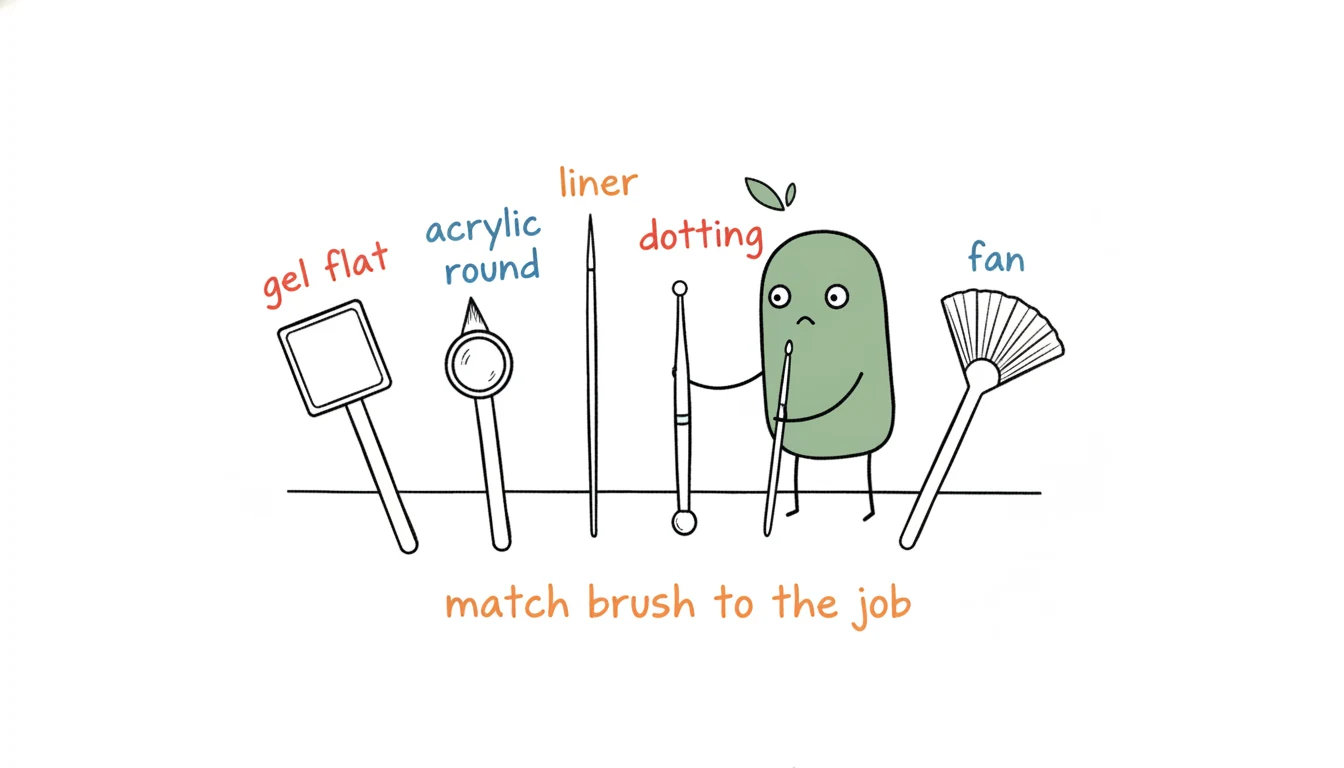
A complete wholesale or private-label range usually combines daily-use application brushes with detail and finishing tools. Use the table below to map each style to its job and the bristle material that performs best for it.
| Brush type | Primary use | Recommended bristle |
|---|---|---|
| Gel flat / oval | Building and smoothing gel and builder over the nail | Synthetic nylon or taklon (holds shape in gel, easy to clean) |
| Acrylic round (bellied) | Picking up and placing acrylic beads, sculpting | Kolinsky sable (snap and bead-pickup) or premium synthetic |
| Liner / detail | Fine lines, outlines, micro-detail nail art | Synthetic for a crisp consistent point; sable for flow |
| Striper (long bristle) | Long continuous stripes and stripes-in-one-stroke | Long synthetic filaments for paint load and control |
| Dotting pen / point | Dots, flowers, beadwork (metal tip, not bristle) | Stainless dual-head tips of varying diameters |
| Ombre / gradient | Blending color transitions and gradients | Soft dense synthetic (even diffusion, low streaking) |
| French | Smile-line and French-tip work | Angled synthetic or fine sable for clean edges |
| Fan | Spreading glitter, foil, and loose effects | Synthetic fan for controlled scatter |
| Dust / cleanup brush | Sweeping filings and dust between steps | Soft nylon, larger head |
Most distributors anchor their range with multi-piece kits because they sell faster than single brushes. Common stock configurations include 6-piece color-handle art sets, 20-piece salon sets that bundle liners, gel flats, and dotting pens, and dual-head tools that combine a brush with a dotting tip to save bench space. When you plan an assortment, balance high-turn daily brushes (gel, acrylic, liner) against lower-volume specialty styles (fan, ombre) so you are not tying up inventory in slow movers.
Bristle material: Kolinsky sable vs synthetic nylon
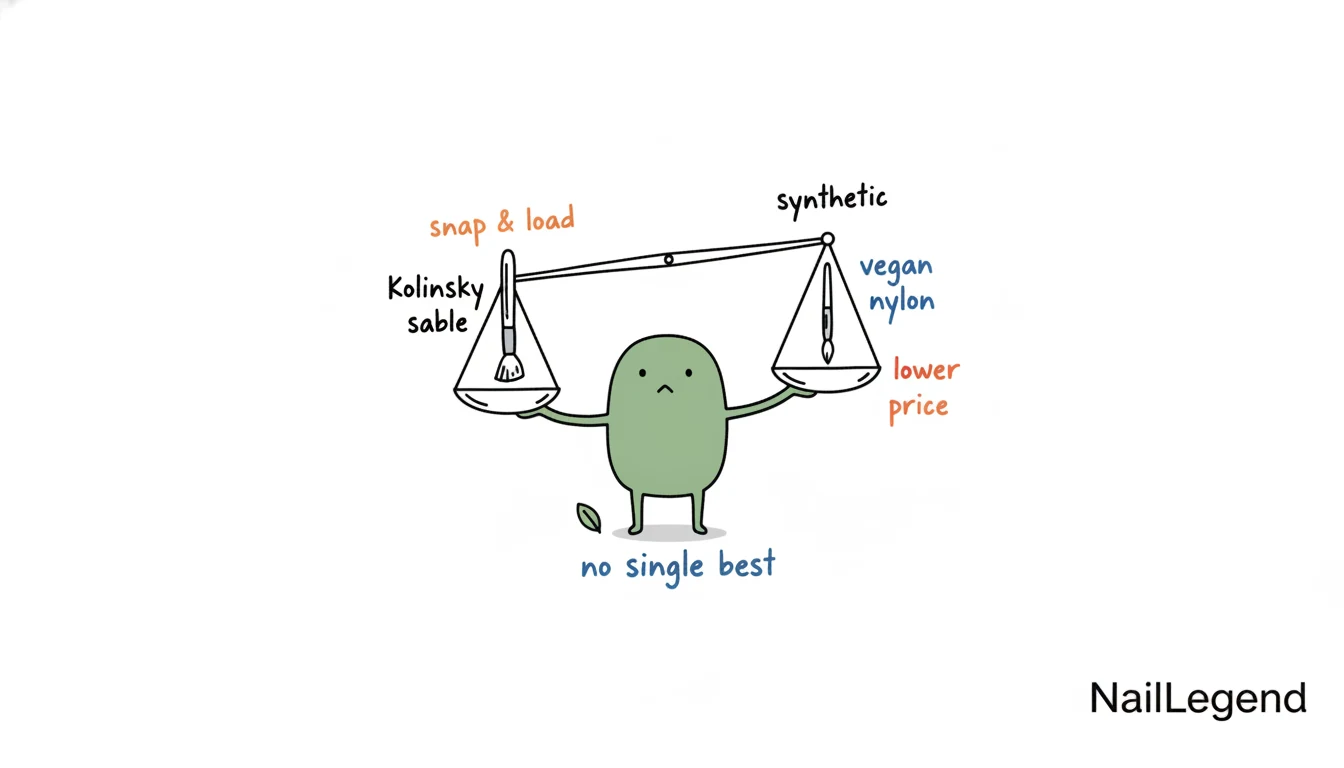
The bristle is where quality is won or lost, and the two main families behave very differently.
Kolinsky sable (natural animal hair)
Kolinsky is prized for acrylic work because each hair has a natural taper and “belly” that holds a large bead of liquid-and-powder and releases it in a controlled flow, then snaps back to a fine point. It absorbs monomer well and gives experienced techs excellent control for sculpting. The trade-offs: it is the most expensive bristle, it is not vegan, and the market is full of mislabeled “Kolinsky” brushes that are actually weasel-blend or synthetic. If you are sourcing genuine sable, ask the factory to state the hair source plainly rather than relying on the word “Kolinsky” on the label, and validate it on samples (see the QA checklist below). We state material honestly on every spec and do not market a synthetic blend as pure sable.
Synthetic nylon / taklon
Modern synthetic filaments have closed much of the gap. For gel application they are often the better choice: they resist the solvents in gel cleaners, do not bloat, clean up easily, and hold their shape over more cycles. They are also vegan, lower cost, and far more consistent batch-to-batch because the filament is engineered rather than sorted from natural hair. For liners and stripers, a good synthetic holds a reliable point that many techs now prefer. The trade-off is slightly less “snap” and liquid-loading than top-grade sable in heavy acrylic sculpting. For most distributors, a synthetic-led range with a small premium sable tier for acrylic specialists is the practical mix.
How to read the handle, ferrule, and overall build
Bristle aside, build quality determines how long a brush survives daily salon use:
- Ferrule (the metal band): it should be seamless or tightly crimped, corrosion-resistant, and glued so bristles do not shed. A loose or rusting ferrule is the most common failure point. Press and fan the bristles on a sample; nothing should pull free.
- Bristle set: check that the tip forms a clean point or even edge when wet, with no stray “fly-away” filaments. The glue plug inside the ferrule should be fully cured so solvents do not dissolve it.
- Handle: wood, acrylic, or metal. Metal and acrylic handles take custom colors and printing cleanly and feel premium; balance matters for fatigue during long appointments.
- Cap: liner and detail brushes should ship with a protective cap to keep the fine tip from bending in transit and storage.
The questions to ask any nail brush supplier before you order
Before committing to a wholesale or OEM run, get clear answers on:
- Exact bristle material per style — is the “Kolinsky” genuine sable, a weasel blend, or synthetic? Get it in writing per SKU.
- MOQ per style and per custom variant, and whether mixed kits count toward one MOQ.
- Lead time for stock vs customized orders, and sampling time before bulk.
- Shedding and solvent testing — how does the factory QC the ferrule glue and bristle retention?
- Customization scope — handle color, printed logo, kit composition, brush sizes, packaging.
- Packaging options — bulk poly, individual sleeve, blister, branded box, retail-ready set.
- Sample policy and in-house QC — can you get production-spec samples and is inspection done in-house before shipment?
If a supplier is vague on bristle source or QC, treat that as a sourcing risk. The same discipline applies across nail tooling generally — our nail drill wholesale buyer guide walks through the parallel checklist for e-files, and our 2026 nail drill manufacturers roundup shows how to tier suppliers by business model.
Private label and OEM nail art brushes
If you are building a brand rather than reselling stock, brushes are an excellent private-label entry because the customization options are visible and affordable. Typical OEM scope for nail art brushes includes:
- Custom handle color and finish — frosted, glossy, rose-gold, matte black, brand color matching.
- Logo printing or engraving on the handle, plus branded ferrule options.
- Custom kit composition — choose the exact mix of liner, gel, acrylic, dotting, and specialty brushes and the sizes in each set.
- Bristle specification — synthetic, sable, or a tiered “good/better/best” line within one brand.
- Packaging — branded sleeve, blister card, magnetic box, or roll-up case for a retail-ready or salon-pro presentation.
For pilot programs we keep MOQs low so you can test a market before scaling, with typical customized lead times of 25–45 days after sample sign-off and all inspection handled in-house before shipment. Brushes also pair naturally with the rest of a nail and spa range, so many brands launch a brush set alongside other categories under one label — see our broader OEM and private-label capabilities and the full product range to plan a combined order.
Frequently asked questions
What is the typical MOQ for wholesale nail art brushes?
For stock brush styles, MOQs are low so distributors and salons can mix several SKUs into one order. For custom OEM brushes with branded handles or custom kit composition, MOQs are higher but still kept modest for pilot runs. We confirm exact figures per style and per customization on quote.
What is the lead time for customized brush orders?
Stock items ship quickly. Customized and private-label orders typically run 25–45 days after you approve the production sample, depending on handle decoration, kit composition, and packaging complexity.
Kolinsky sable or synthetic — which should I stock?
Stock both, weighted toward synthetic. Synthetic nylon/taklon is the practical default for gel work, is vegan, lower cost, and more consistent batch-to-batch. Keep a smaller premium Kolinsky sable tier for acrylic specialists who want maximum bead control.
How do I verify a brush is really Kolinsky?
Don’t rely on the printed label alone — much of the market mislabels blends as Kolinsky. Ask the supplier to state the hair source per SKU in writing, then validate on samples (point recovery when wet, bead pickup, no shedding). We disclose material honestly and never market a synthetic blend as pure sable.
Can you put our logo and brand colors on the brushes?
Yes. We customize handle color and finish, print or engrave your logo, and can build branded packaging from sleeves to retail-ready boxes. Send your brand assets and target presentation and we’ll quote the options.
Can I build a custom brush set with specific styles and sizes?
Yes. You choose the exact mix — liner, gel flat, acrylic round, dotting pen, striper, ombre, French, fan, dust — plus sizes and bristle grade, and we assemble it as a branded kit.
What packaging options are available?
Bulk poly for distributors, individual protective sleeves with caps for fine brushes, blister cards, branded boxes, and roll-up cases for salon-pro or retail-ready sets. We tailor packaging to your channel.
Ready to source or build your nail art brush line?
Whether you need a fast-moving stock assortment for distribution or a fully branded private-label brush set, we can map the right bristle, build, and packaging to your channel and budget. Request a Quote with your target styles and quantities, or Download our Catalog to review the full brush range and the rest of our nail and spa lineup. Contact Us and we’ll respond within one business day.
By Lareina, Nail Legend



Leave A Comment