
Note: We’ve folded this into our complete private label cuticle oil guide — see the full picture (formulation, packaging, MOQ, cost, regulatory, vetting) here: Private Label Cuticle Oil Manufacturing Guide.
TL;DR
A 10ml private label cuticle oil in a glass dropper bottle typically costs $1.40–$1.90 ex-works at a 1,000-unit MOQ. Add $0.35–$0.60 for printed labels, $0.45–$0.70 for freight + duty + 3PL inbound, and your landed cost lands around $2.20–$3.20 per unit. A healthy three-tier pricing structure puts that same SKU at $3.50–$6.00 wholesale and $12–$28 retail, which leaves room for both your distributor channel and your own margin once retailer fees are factored in. The single biggest cost driver after MOQ is the base-oil tier (sweet almond vs jojoba vs argan), which can swing the formula line by 30–60%. The single biggest margin driver is whether you sell DTC, wholesale, or both — they require different price ceilings and different unit economics.
When founders ask us about cuticle oil cost per unit, the question almost always sits behind a financial model that hasn’t been built yet. They have a target retail price in mind, a guess at MOQ, and an Excel sheet with three columns and a lot of question marks. The numbers float around online — “cuticle oil costs 50 cents to make,” “cuticle oil margins are 90%,” “Amazon sellers buy at $2 and sell at $20” — and they’re all simultaneously true and useless, because the real number depends on which 10ml you’re building.
This guide breaks down what a 10ml private label cuticle oil actually costs to manufacture, ship, and shelve, line by line. It uses the same numbers we quote in our own RFQs, with no padding for retail mystique. If you want the full sourcing framework behind these numbers, our complete private label cuticle oil manufacturing guide covers formulation, packaging, and supplier vetting end-to-end. If you want to size your first order against this cost math, our cuticle oil MOQ guide walks the per-SKU and bulk MOQ ladders.
The Real Cost of 10ml: Component-Level Breakdown
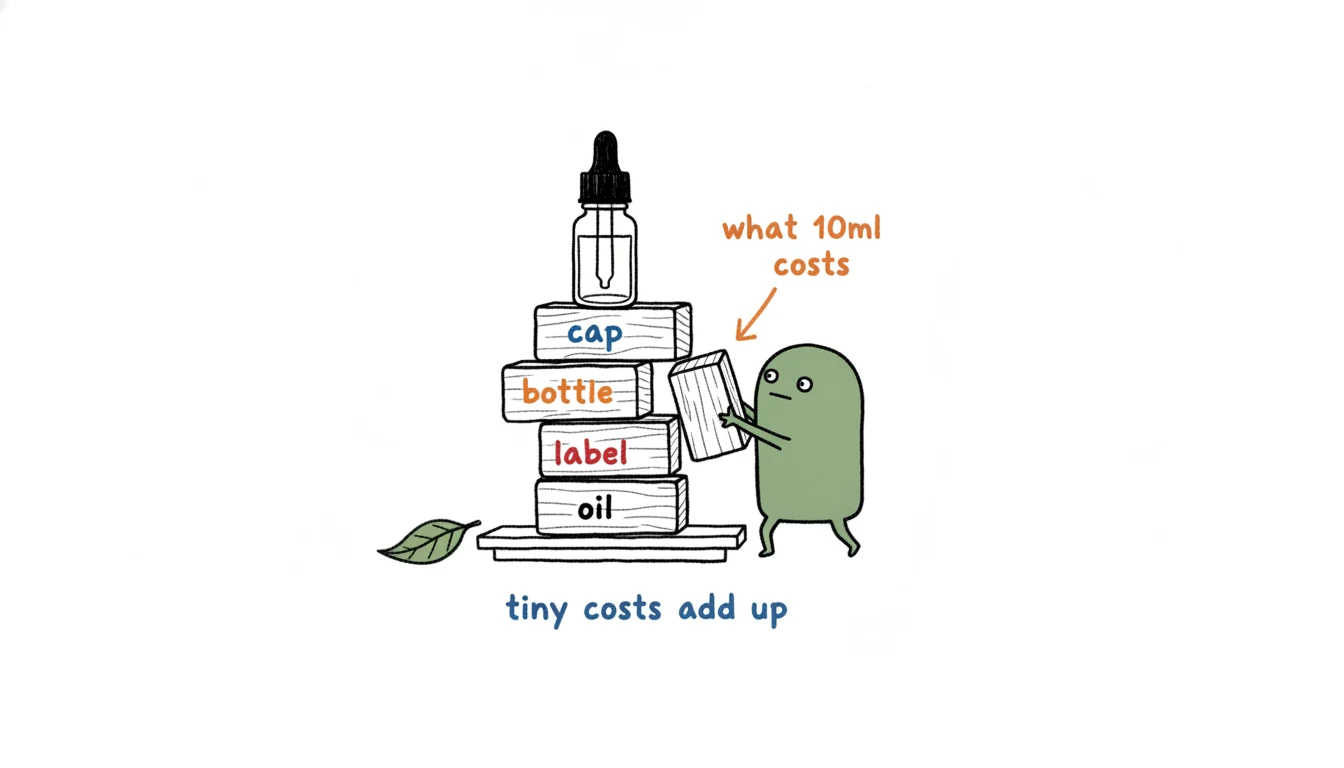
A finished 10ml private label cuticle oil leaves the factory as the sum of six discrete cost lines. None of them is hidden, but a lot of first-time buyers price only the first two and get surprised on landed cost.
At a 1,000-unit MOQ with a stock formula and stock 10ml glass dropper packaging, the component breakdown looks like this:
| Line | Range (per unit) | What’s in it |
|---|---|---|
| Formula (base oil + actives + fragrance) | $0.55–$0.95 | Sweet almond / jojoba blend, vitamin E, stock fragrance |
| Glass dropper bottle + pipette + cap | $0.55–$0.80 | Stock 10ml clear or amber glass, standard pipette |
| Filling + assembly + QC | $0.15–$0.25 | Hot-fill or cold-fill line, in-line viscosity and color check |
| Printed label (front + back) | $0.10–$0.20 | Silk-screen or paper label, standard 2-color |
| Carton + inner divider | $0.05–$0.10 | Inner pulp tray + outer master carton |
| Ex-works total | $1.40–$2.30 | What appears on your FOB invoice |
A few things worth flagging up front.
Formula is not the biggest line at 10ml — packaging usually is. At larger fill sizes (30ml, 100ml) formula starts to dominate, but at the retail 10ml format you are paying as much for the bottle and pipette as for what’s inside.
The range exists because of base-oil choice. A sweet-almond stock formula lands at the low end of the formula line; a jojoba-dominant or argan-blend formula lands at the high end. Our base oil comparison guide breaks the four standard bases down on cost-vs-positioning.
Labels can quietly inflate. A 2-color paper label on a flat bottle is $0.10. A 4-color silk-screen with hot-stamp gold and a clear varnish on a curved bottle can push past $0.45 — a 4× swing that does not show up in the formula line and usually appears only after artwork is final.
What FOB Doesn’t Include: The Four Hidden Cost Lines
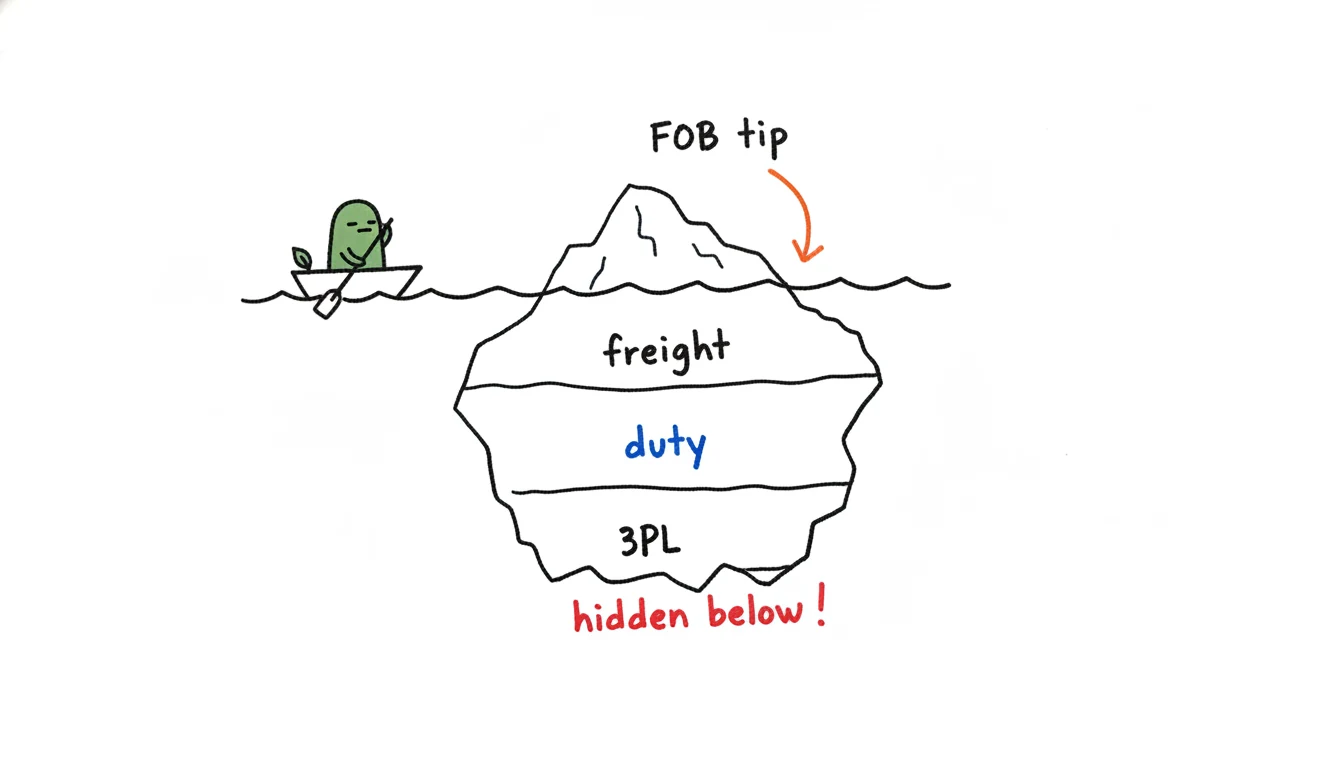
Your factory quote ends at “FOB Shenzhen” or “FOB Ningbo.” That number is not what each bottle costs when it sits in your 3PL ready to ship. Four cost lines bridge the gap, and three of them are non-negotiable.
1. Ocean freight. At LCL (less than container load) rates for a 1,000-unit order, expect $0.18–$0.35 per unit from a South China port to Long Beach or Rotterdam. FCL becomes economical somewhere around 5,000 units of glass-packed cuticle oil; below that, LCL is the only path and per-unit ocean freight is meaningfully higher.
2. Import duty. US cuticle oil imports typically fall under HTS 3304.30 (manicure or pedicure preparations) at a 0% base duty, but Section 301 tariffs add 7.5% on top of FOB value for China-origin goods. EU CN 3304.30 carries a 0% duty on cosmetics from most-favored-nation origins. The net add to your per-unit cost lands at $0.05–$0.15 depending on origin and FOB value.
3. 3PL inbound, receiving, and put-away. Once your container arrives, the 3PL charges for unloading, receiving, palletizing, and putting away. Expect $0.10–$0.20 per unit at a US 3PL handling beauty SKUs; less in the EU, more in Australia.
4. Insurance and customs broker. Often forgotten because the dollar amounts are small at first-PO scale — $0.02–$0.05 per unit combined for marine insurance and customs brokerage fees.
Add it all up and your FOB → landed cost bridge is $0.35–$0.75 per unit, with $0.45–$0.70 being the realistic center of the range for a US-bound private label cuticle oil order at 1,000 units.
From FOB to Landed Cost: A Worked Model
Stacking the two sections above, the full landed-cost model for 1,000 units of 10ml private label cuticle oil in a stock glass dropper, sweet-almond/jojoba base, 2-color label, US-bound looks like this:
| Stage | Per-unit | Notes |
|---|---|---|
| Ex-works (factory) | $1.40–$1.90 | Stock formula + stock packaging |
| + Ocean freight (LCL) | $0.18–$0.35 | South China → US West Coast |
| + Section 301 tariff (7.5%) | $0.11–$0.15 | On FOB value |
| + 3PL inbound | $0.10–$0.20 | Receive, palletize, put-away |
| + Insurance / brokerage | $0.02–$0.05 | Marine + customs |
| Landed cost | $1.81–$2.65 | Ready to pick & pack from 3PL |
For most pilots we model, $2.20–$2.80 landed per unit is the working assumption. Anything below $1.80 means you’ve either skipped a real cost (almost always 3PL inbound or duty) or you have a sub-spec component you’ll regret. Anything above $3.20 at 1,000 MOQ means you’re either over-spec’d on packaging, over-spec’d on formula, or paying a premium-tier supplier markup that you could trim at the same quality with a second-round supplier vetting pass.
The same model run on 5,000 units drops landed cost to roughly $1.60–$2.10 — not because the formula gets cheaper, but because ocean freight drops to FCL rates and 3PL per-unit handling halves. Step-up math like this is exactly what the MOQ ladder is built around.
Healthy Three-Tier Pricing: Factory → Wholesale → Retail
Once you have landed cost in the $2.20–$2.80 band, the rest of the pricing structure is downstream math.
A pricing structure is healthy when it leaves enough margin at each tier to absorb the inevitable channel costs (returns, slotting fees, marketing, payment processing) without forcing you to choose between margin and growth.
For 10ml private label cuticle oil, the healthy pattern in 2026 looks like:
| Tier | Per unit | Margin over landed cost | Notes |
|---|---|---|---|
| Factory (ex-works) | $1.40–$1.90 | — | What you pay your manufacturer |
| Landed at 3PL | $2.20–$2.80 | — | What it costs to be ready to ship |
| Wholesale (to distributors / retailers) | $3.50–$6.00 | 30–55% | Sustainable distributor channel |
| DTC retail / Amazon FBA | $12–$28 | 75–85% gross | Before ad spend and platform fees |
| Premium / spa retail | $24–$45 | 85–92% gross | Premium glass + custom scent + brand story |
A few patterns worth committing to muscle memory.
The 5× rule of thumb. Healthy DTC retail price ≈ 5× landed cost. A $2.50 landed cuticle oil sells comfortably at $12–$14 on Shopify or Amazon. Below 4× and you’ll struggle to absorb ad spend and returns; above 6× you’d better have a brand story that justifies the premium.
The 2× wholesale rule. Wholesale price ≈ 2× landed cost minimum. Anything tighter and your distributor channel becomes the bottleneck on your own brand growth.
Premium positioning is its own decision. A $24–$45 spa-retail SKU is almost never the same product as a $12 DTC SKU — different packaging, different scent profile, sometimes different fill volume. Don’t try to bridge both segments with one SKU; build two and let pricing follow positioning.
If you’re early enough in the journey that you haven’t picked between private label, OEM, or stock yet, the model fits all three — what changes is the ex-works number, not the downstream margin structure.
How Formulation Upgrades Change the Math
The single biggest swing variable in cuticle oil cost is the base oil. Each step up the premium ladder adds $0.20–$0.50 to the ex-works line, but more importantly, each step changes what retail price you can credibly defend.
| Base oil tier | Formula line add | Retail ceiling lift |
|---|---|---|
| Sweet almond (value tier) | baseline | $10–$14 |
| Jojoba blend (default premium) | +$0.20–$0.30 | $14–$22 |
| Argan blend (premium hero) | +$0.35–$0.55 | $20–$30 |
| Squalane base (luxury clean-beauty) | +$0.45–$0.80 | $28–$48 |
The math gets interesting because the retail ceiling lifts faster than the formula cost. Upgrading from sweet almond to jojoba adds $0.25 to landed cost but lets you defend a $4–$8 higher retail price — an 8× return on the formula upgrade. Squalane adds $0.65 but unlocks the $30+ retail tier where competitor analysis matters more than ingredient cost.
Hero ingredients (vitamin E, hyaluronic acid, peptides, plant extracts) are similar — they add $0.05–$0.25 to the formula line and either let you defend a higher price or sharpen your brand story enough to move volume at the same price.
Where the math goes wrong: brands routinely over-spec packaging while under-spec’ing formula. A $0.80 frosted-glass bottle on a sweet-almond formula at $14.99 retail is the most common margin-killing pattern we see. The smarter spend is $0.55 on a clean stock dropper bottle plus $0.30 on a jojoba upgrade, and you keep the same $14.99 retail price with a meaningfully better product.
MOQ Step-Up Math: How 2x MOQ Lowers Unit Cost
The other lever on cost-per-unit is order size. As MOQ steps up, every line in the cost model gets thinner — not all at the same rate, but consistently.
For the same 10ml jojoba-blend cuticle oil in a glass dropper:
| MOQ | Ex-works | Landed cost | DTC margin at $14.99 retail |
|---|---|---|---|
| 500 units (pilot) | $1.85–$2.40 | $2.65–$3.30 | 78–82% |
| 1,000 units (default) | $1.40–$1.90 | $2.20–$2.80 | 81–85% |
| 5,000 units (production) | $1.10–$1.50 | $1.60–$2.10 | 86–89% |
| 10,000 units (retail-launch) | $0.90–$1.20 | $1.30–$1.70 | 89–91% |
A 2× MOQ jump from 1,000 to 2,000 units typically cuts ex-works by 15–25%, not because the factory is doing you a favor, but because the fixed costs (label print plate setup, machine changeover, QC sampling) spread across more units. By 5,000 units the same factory is running a meaningfully different production economy — FCL ocean freight, palletized 3PL inbound, label print runs that hit the per-piece floor instead of the setup-fee floor.
The MOQ → unit-cost curve is the single most powerful financial lever in your first 24 months. A founder who can wait two weeks and double the first PO almost always comes out ahead on margin and on inventory health, because the alternative — restocking the same SKU at 1,000 units four times — pays the 1,000-unit unit-cost penalty every single time.
Our cuticle oil MOQ guide walks the same ladder from a different angle: how to choose the right MOQ tier given your cash position, channel mix, and scent-variant plan.
Frequently Asked Questions
What is the realistic cost per unit for 10ml private label cuticle oil at 1,000 MOQ?
Ex-works (factory) cost is $1.40–$1.90 per unit for a stock formula in stock 10ml glass dropper packaging at 1,000-unit MOQ. Landed at a US 3PL, expect $2.20–$2.80 per unit after ocean freight, Section 301 tariff, customs, and inbound handling. Sweet-almond formulas land at the lower end of the range; jojoba and argan blends land at the higher end.
How much retail margin should I plan on a cuticle oil SKU?
A healthy DTC or Amazon retail SRP sits at roughly 5× your landed cost — meaning $12–$14 retail for a $2.50 landed unit. That yields 80–85% gross margin before ad spend, platform fees, and returns. For wholesale to distributors and retailers, plan on 2× landed cost as a minimum wholesale price ($3.50–$6.00 for the same SKU) to keep your channel partners motivated.
What is the single biggest cost driver I should focus on?
Below 5,000 MOQ, packaging is usually a larger line than formula at the 10ml retail format — so stock glass and stock pipette decisions matter more than premium formula choices. Above 5,000 MOQ, the math flips: formula and base-oil tier become the dominant cost line, and packaging negotiations have already hit their floor. The 1,000–5,000 MOQ range is where the decision is closest to even.
What is the fastest way to lower per-unit cost without sacrificing quality?
Doubling MOQ from 1,000 to 2,000 typically cuts ex-works cost by 15–25% — more impact than any single component substitution at the same MOQ. The second-fastest lever is consolidating two or three scent variants into a single production run (one filling-line changeover instead of three). Substituting packaging components without a sample round is the highest-risk lever — it can save $0.10 per unit and cost you a 5% return rate from leaking bottles.
If you’re sizing a first cuticle oil PO and want a line-by-line landed-cost model against your target SRP, scent count, and packaging spec, send us your brief — we’ll send back a costed quote within 24 hours covering ex-works, landed cost, and the three MOQ tiers most relevant to your stage.
For the full sourcing framework these numbers sit inside, see our complete private label cuticle oil manufacturing guide. For the decision between private label, full OEM, and rebadged stock, see our OEM vs Private Label vs Stock comparison. Browse our cuticle oil category for the flagship range, or jump to our cuticle oil program.



Leave A Comment