
“Should I do cuticle oil OEM, private label, or just buy stock and stick my logo on it?” is the single most common first question we get from beauty brand operators. The framework answer (private label vs OEM vs ODM) covers the universal trade-offs. This guide walks the same trade-offs through cuticle oil specifically — the MOQ math, IP boundary, switching cost, and worked examples for the four buyer profiles we see most.
For the broader cuticle oil category guide, see Cuticle Oil Private Label: The 2026 OEM Guide. For the supplier shortlist, see Top Cuticle Oil Manufacturers 2026.
The Three Cuticle Oil Manufacturing Models, Defined
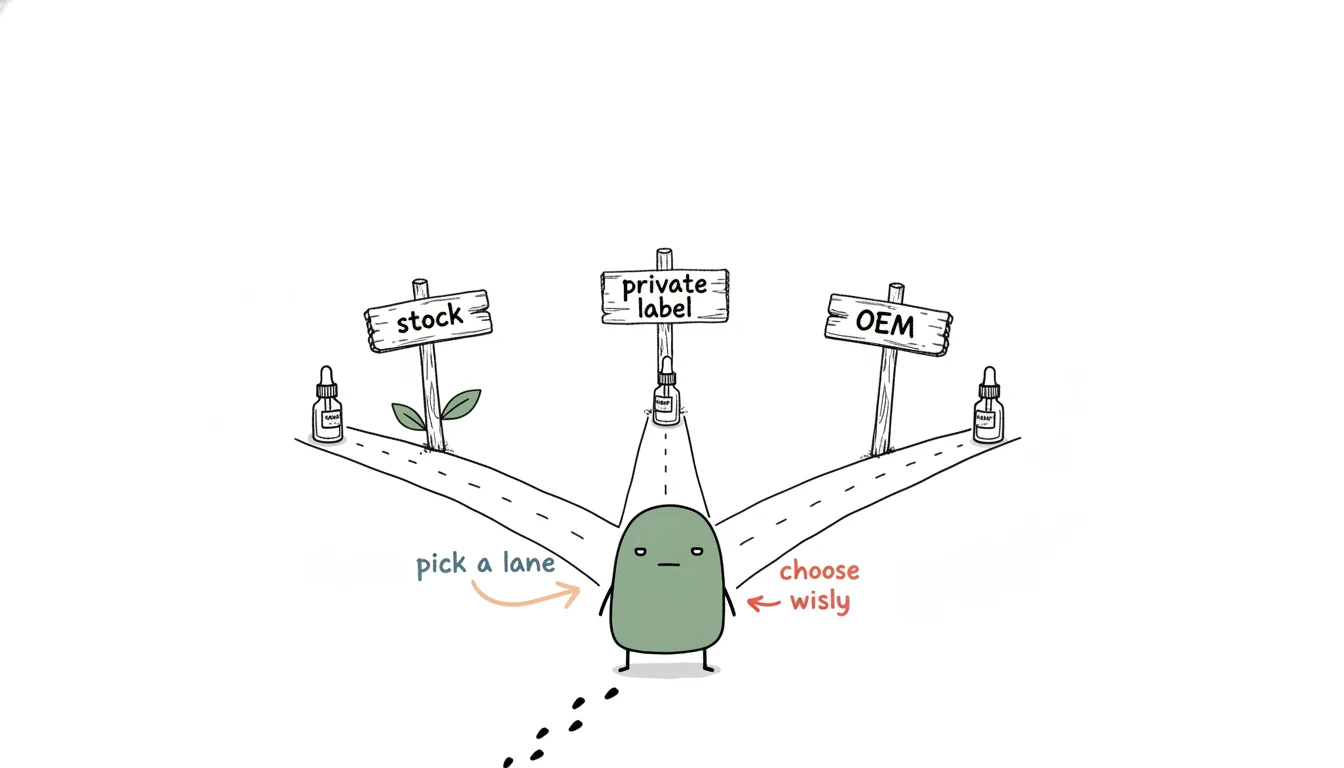
The terms get thrown around interchangeably in B2B beauty sourcing, but they describe three distinct supply relationships:
- Stock cuticle oil (a.k.a. unbranded bulk): the manufacturer’s existing formula, sold in bulk drum or pre-filled bottle, minimal branding. Buyers add a sticker and resell. Lowest cost-per-unit, lowest control, no formula ownership.
- Private label cuticle oil: manufacturer’s existing formula, but with your brand’s bottle, label artwork, secondary packaging, and marketing. Same recipe across many private-label clients of the same factory; differentiation is on packaging and brand story, not on formula.
- Cuticle oil OEM (a.k.a. custom formulation): you bring the formula or detailed specification, the factory produces to your spec. Highest control over recipe, highest IP ownership, highest MOQ and lead time.
The fourth model worth naming for completeness is ODM (Original Design Manufacturer) — where the factory designs a custom formula based on your brief but retains formulation IP. It is the middle ground between private label and full OEM, and most reasonable cuticle oil OEM partners offer it as a tier.
Side-by-Side: MOQ, Cost, Lead Time, IP
The four variables that decide which model fits:
- Stock cuticle oil: Lowest MOQ tier (often a single carton). Lowest unit cost. Lead time 1-2 weeks (essentially shipping time). Zero IP ownership — anyone else can buy the same bottle. Switching supplier mid-program is trivial because there is no formula to reproduce.
- Private label cuticle oil: Mid MOQ (typically 2-5x stock minimum). Mid unit cost. Lead time 3-6 weeks (artwork sign-off + production). Formula IP belongs to the manufacturer, brand IP belongs to you. Switching supplier requires either accepting a formula change or paying to reproduce the recipe at the new factory — both costly.
- Cuticle oil OEM: High MOQ (5-10x stock minimum, depending on formulation complexity). Higher unit cost initially, lower at scale. Lead time 8-14 weeks for first order including formulation, stability testing, and pilot batch. You own the formula spec. Switching is portable — you carry the formula to any compliant manufacturer.
Specific MOQ and pricing tiers depend on the factory and the formulation depth. The principle: cost-per-unit drops as you move from stock toward OEM at scale, but cash outlay and time-to-first-revenue rise sharply. Match model to your runway, not to the lowest theoretical per-unit cost. Request a quote with your target tier.
Why Most Brands Pick the Wrong Model First
Two failure patterns we see repeatedly:
- “OEM-too-early.” A founder with $50K total launch budget commits 60% of it to a custom cuticle oil OEM formula development run before testing market demand. By the time the first PO lands, marketing budget is gone, and they have a shelf full of beautifully formulated product nobody knows about. Custom formulation is a winning move after demand is proven, not before.
- “Stock-too-long.” A brand running stock cuticle oil for 18 months hits a competitive wall — every other private-label brand on Amazon is selling the same bottle at a 10% lower price. Switching to a custom formula at month 18 means starting over on stability testing, packaging artwork, and compliance documentation. Should have moved to private label or OEM at month 6.
The right pattern: start with stock or private label to validate demand (3-6 months), move winning SKUs to OEM as sell-through data justifies the formulation investment, keep slow movers as private label or stock to avoid sunk cost in custom formulas with no traction.
Worked Examples by Buyer Profile
Different buyer profiles map to different models:
- Salon distributor stocking nail-care backbar: stock cuticle oil. The salon end-user does not care about brand on a back-bar bottle; they care about hand-feel, price, and reorder reliability. Stock wins on cost and lead time.
- Spa chain building a private retail line: private label cuticle oil. The brand needs to be theirs (retail margin requires brand equity), but custom formulation cost is hard to justify at the volumes a regional spa chain moves. Private label hits the sweet spot.
- DTC beauty brand on Shopify with $200K+ ARR target: cuticle oil OEM after 6 months of validated demand. Custom formula becomes the moat against Amazon-clone competitors. The brand owns the IP and can switch suppliers if cost or quality demands.
- Cross-border seller listing on Amazon multi-region: private label as the volume tier, OEM for one or two flagship SKUs that justify the custom investment. Mixed model captures both volume and differentiation.
Switching Cost: The Variable Most Buyers Underestimate
The “stock vs private label vs OEM” comparison usually focuses on first-order economics. The variable that matters more over a 24-month horizon is switching cost — what happens when you want to change supplier:
- Stock cuticle oil switching cost: near zero. Buy from a different factory next month. Customer never notices the change because the formula was generic anyway.
- Private label switching cost: moderate-high. The new factory’s “stock formula” will not be identical. Color, viscosity, scent, and absorption profile will drift. Customer notices. Brand reviews on Amazon get hit with “this doesn’t smell like the old one” complaints.
- Cuticle oil OEM switching cost: high upfront, low recurring. The first move requires reproducing the formula at the new factory and paying for stability re-testing. After that move, the formula is portable across any compliant manufacturer.
OEM looks expensive on day one and cheap on day 730. Stock looks cheap on day one and expensive at the moment you decide to differentiate. Private label is in the middle on both axes. Pick the model that aligns with your commitment level to the category, not just first-order cost.
Adjacent cosmetic kit categories follow the same model logic — see our parallel guides for private label bath bombs and pedicure kits for category-specific MOQ and customization detail.
Frequently Asked Questions
Sourcing bath bombs at scale?
If you’re evaluating bath bomb wholesale and private label manufacturing for a retail line, gift set, or spa chain, our B2B Bath Bomb wholesale program covers 8 base scents, custom shapes and silk-screen printing, and MOQ from 100 jars at the quote stage. Request a Bath Bomb wholesale quote →



Leave A Comment