
The two questions every bath bomb wholesale buyer asks first — and the two questions most suppliers answer last — are about minimum order quantity and packaging architecture. This spoke is the practical math behind both: MOQ tiers by customization depth, packaging cost-vs-channel mapping, and the scent-library scaling rules that determine whether a private-label launch breaks even at 500 units or needs 2,000.
For the broader vetting checklist of private label bath bombs manufacturers, see our companion guide Best Private Label Bath Bomb Manufacturer: How to Choose. For decision-model context (private label vs OEM vs ODM), see Private Label vs OEM vs ODM.
Bath Bomb Wholesale MOQ Tiers: What Drives the Number
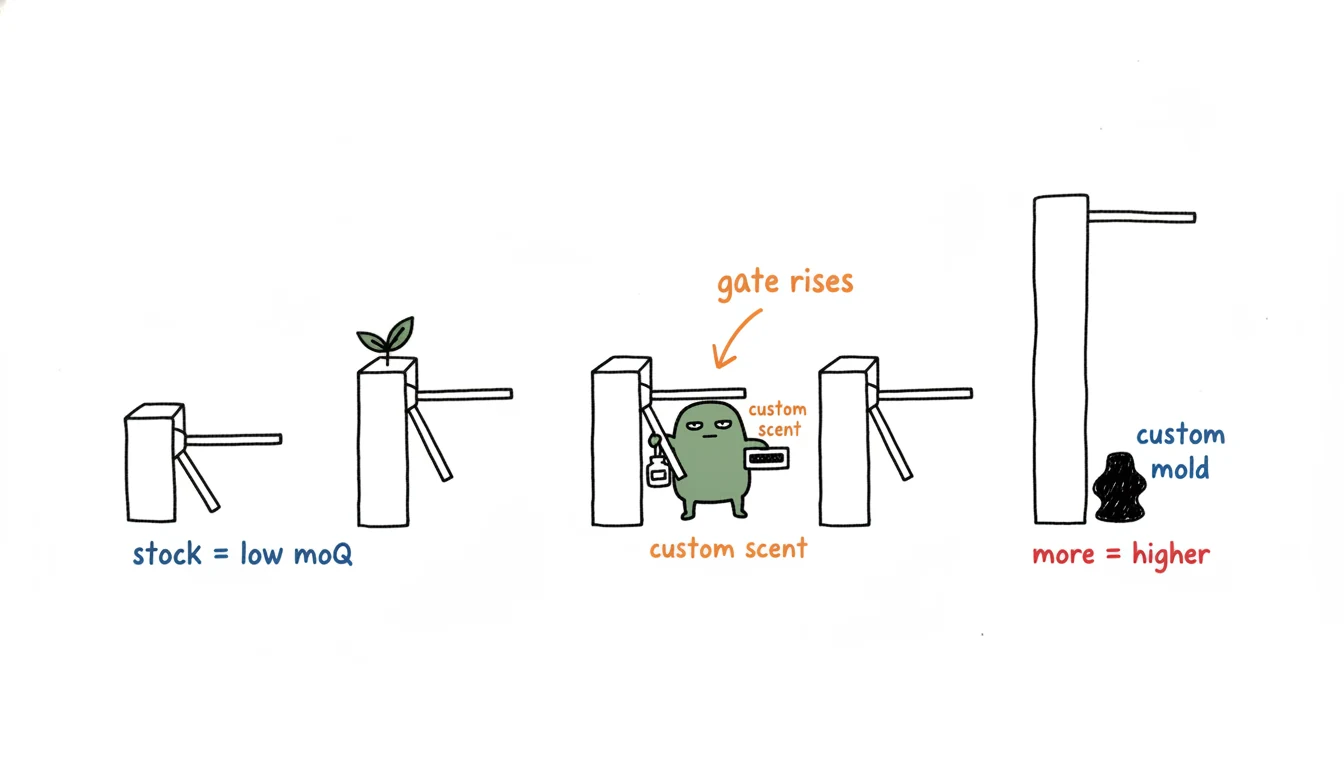
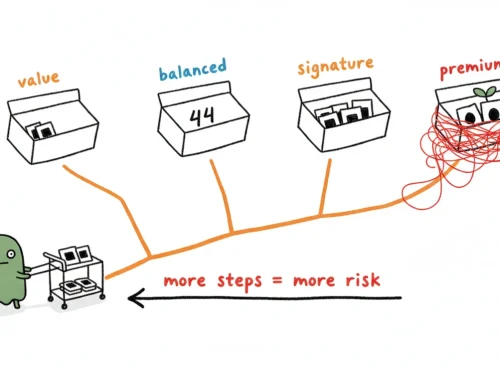
MOQ for bath bomb wholesale is not a single number — it scales with how much customization the buyer requests. The four standard tiers:
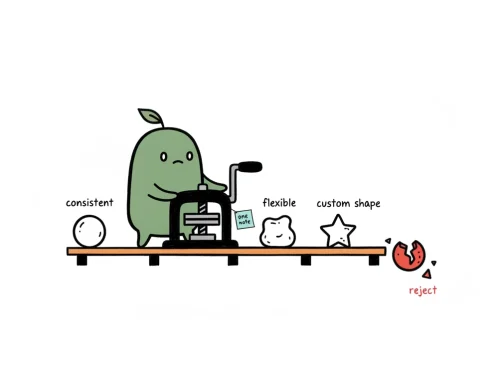
- Stock formula + your label. Lowest MOQ. Existing scent and color library, your brand sticker on stock packaging. Fastest path to first PO and the right starting point for first-time buyers testing market demand.
- Stock formula + custom packaging. Mid-tier MOQ. Your gift box artwork or shrink-sleeve design, our existing recipe. Adds 2-3 weeks for artwork sign-off and packaging procurement.
- Custom scent + stock formula base. Higher MOQ. Your fragrance brief, blended into our standard sodium bicarbonate / citric acid base. Requires fragrance development and stability testing — typically 4-6 weeks of additional lead time before production starts.
- Full custom (color, scent, shape, ingredient profile). Highest MOQ. Often paired with organic / vegan certification claims. The right tier only after 1-2 successful production runs at lower tiers prove sell-through demand.
Specific MOQ numbers depend on the supplier and the chosen formula complexity. The principle is: more customization = higher MOQ + longer lead time + lower per-unit cost at scale. The break-even unit count for custom development typically lands around 5x the stock-formula MOQ. Request a quote with your target customization tier for specific numbers.
Why MOQ Math Matters: Per-Unit Cost vs Cash Outlay
First-time bulk bath bomb buyers tend to ask “what’s the lowest MOQ” but the better question is “what MOQ minimizes my landed-cost-per-unit while staying under my cash ceiling?” Two competing forces:
- Per-unit cost drops with volume. A 500-unit run might cost $1.80/unit; a 2,000-unit run might cost $0.90/unit; a 5,000-unit run might cost $0.65/unit. The curve flattens around 5,000-10,000 units depending on packaging complexity.
- Cash outlay rises linearly. 5,000 units at $0.65/unit = $3,250 production cost. Plus packaging, freight, customs, warehousing — the real landed cost is 1.5-2.0x the production quote.
The right MOQ for a private-label launch is the volume your demand forecast can move within 12 months — not the volume that minimizes per-unit cost on paper. Inventory sitting in a warehouse is not cheaper than a higher per-unit cost on a smaller run that sells through. Match MOQ to forecasted velocity, not to the supplier’s pricing curve.
Packaging Architecture: Three Production Formats
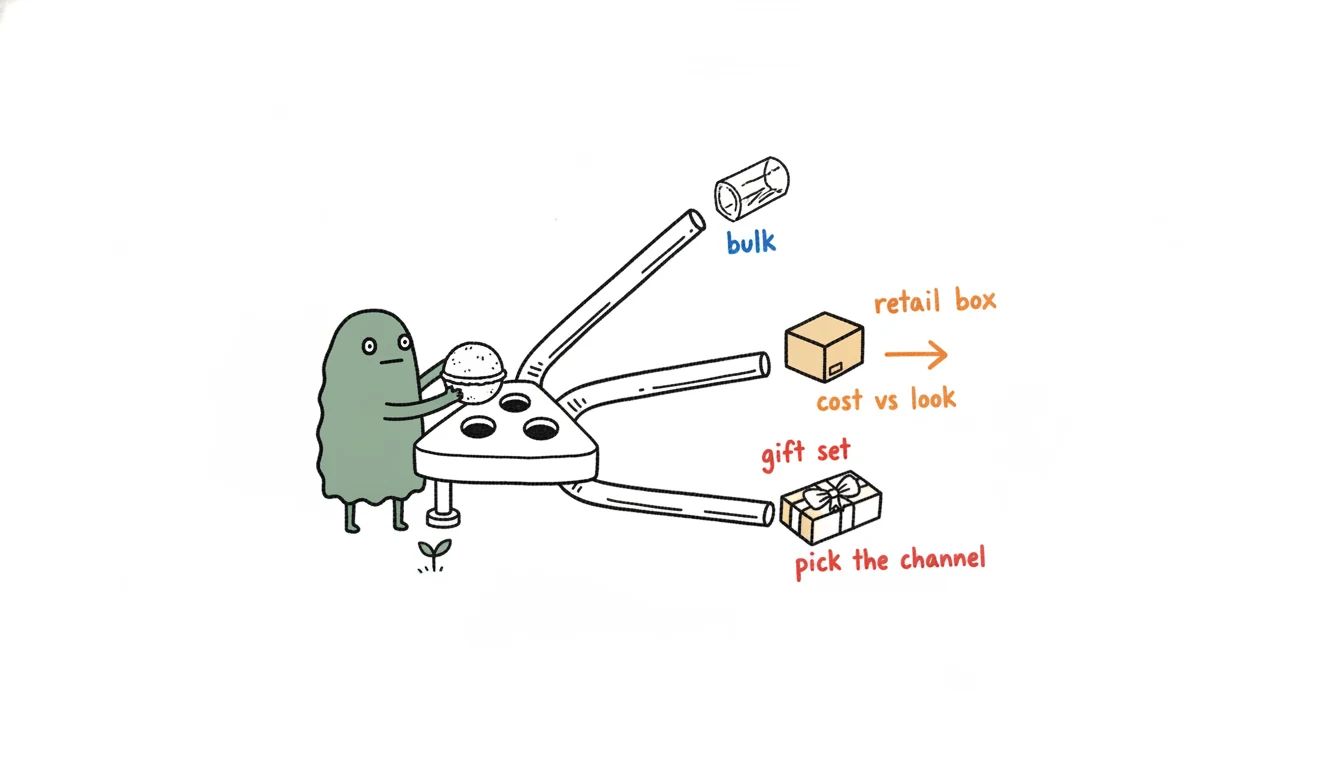
Same bath bomb, three packaging architectures, very different unit economics and channel fit:
- Shrink wrap (functional). Heat-shrink film around individual bombs, optional printed sticker for branding. Lowest packaging cost (~5-10% of unit cost). The default for spa amenity programs, salon back-bar use, and value-channel retail. Limited brand presentation but maximum unit-cost efficiency.
- Gift box (presentation). Multi-bomb assortment in printed box with insert tray, optional ribbon or sleeve. 25-40% packaging cost premium but enables retail margin pricing — a 4-bomb gift box wholesale at $6-8 retails at $20-35 in boutique gift shops and Amazon.
- Hybrid (single-use sachet or jelly cup). Each bomb pre-portioned in a sachet or PET cup, designed for single-use spa-bar applications and high-end hotel amenities. Higher packaging cost but enables service-tier upcharge for spa channel and “fresh per use” hygiene optic for retail.
For private-label brands, the right packaging strategy is usually two SKUs across two formats from the same production run: shrink-wrap for spa/amenity volume + gift box for retail margin. Same formula, two channels, one PO.
Scent Library Scaling: How Many Variants Pay Off
Scent multiplication is the most common MOQ-inflating mistake first-time bath bomb private label buyers make. The math:
- 1 scent. Cleanest economics. Single batch, fastest production, lowest landed cost per unit. The right starting point for amenity programs and brand testing.
- 3 scents. Captures most “variety” perception with manageable inventory complexity. Each scent typically gets 1/3 the run, so the practical MOQ per scent is the supplier’s MOQ floor — meaning a 3-scent program needs 3x the minimum buy.
- 6+ scents. Premium retail positioning. SKU complexity rises sharply — barcode tracking, packaging variations, batch storage, expiry rotation all multiply. Only economical when sell-through data justifies it.
The pattern we see across successful wholesale bath bomb launches: start with one signature scent, add 2-3 only after first-batch sell-through validates demand. Avoid the temptation to launch with 6 scents and a “discover your favorite” pitch — the inventory math punishes this hard at small MOQ.
Lead Time Math: First Order vs Reorder
Realistic lead times by tier:
- Stock formula + your label: 3-4 weeks first order, 2-3 weeks reorder.
- Custom packaging + stock formula: 4-6 weeks first order (artwork sign-off + box procurement), 3-4 weeks reorder.
- Custom scent + stock base: 6-10 weeks first order (fragrance development + stability testing), 4-5 weeks reorder.
- Full custom: 10-14 weeks first order, 5-6 weeks reorder.
Reorder lead time is consistently 50-60% of first order because formula, artwork, and compliance documentation are already approved. Suppliers quoting the same lead time for reorders are either disorganized or under-quoting first orders. Ask explicitly: “What’s the reorder lead time at 50% the original PO size?”
The Right First Order: A Practical Worked Example
For a B2B private-label brand testing a bath bomb line on Shopify or Amazon, the lowest-risk first order pattern looks like this:
- 1 signature scent (Lavender or Eucalyptus are the safest first picks)
- Stock formula + your label (lowest MOQ tier)
- Two packaging SKUs from one batch: shrink wrap (50% of run) for amenity / volume + 4-bomb gift box (50% of run) for retail margin
- 3-4 week lead time, then 2-3 week reorder cadence once sell-through data is in
This pattern minimizes cash outlay, validates demand across two channels, and sets up a fast reorder cycle for whichever channel sells through first. Once 1-2 reorders confirm velocity, expand to scent #2 and #3 — not before.
Adjacent cosmetic kit categories worth bundling under the same supplier relationship include private label cuticle oil and pedicure kits — same retail channels, complementary basket size, often sold together in spa-and-self-care gift assortments.
Supplier comparison: Use the private label bath ball manufacturer shortlist for bath-ball sourcing, or compare private label bath bomb manufacturers when the brief is focused on fizzy bath bombs. Confirm the exact formula, packaging and MOQ in the RFQ.
Frequently Asked Questions
Sourcing bath bombs at scale?
If you’re evaluating bath bomb wholesale and private label manufacturing for a retail line, gift set, or spa chain, our B2B Bath Bomb wholesale program covers 8 base scents, custom shapes and silk-screen printing, and MOQ from 100 jars at the quote stage. Request a Bath Bomb wholesale quote →
How Formulation Drives MOQ
Stock formulations ship at the lowest MOQ and unit cost; custom blends and premium actives push the order economics up. For the ingredient-level decisions that map to MOQ and lead time, see our bath bomb formulation guide for private label brands.
📚 Related pillar: see our full Bath Bomb private label & OEM sourcing guide for the broader sourcing frame, MOQ tiers, lead times, and decision framework.


Leave A Comment