
Note: We’ve folded this into our complete private label cuticle oil guide — see the full picture (formulation, packaging, MOQ, cost, regulatory, vetting) here: Private Label Cuticle Oil Manufacturing Guide.
TL;DR. Pen, dropper, and brush bottle are not interchangeable formats — each one signals a different end buyer. The 2ml–5ml twist pen with brush tip is built for retail shelves and Amazon FBA: high SRP per ml, tidy unboxing, almost zero spill risk. The 10ml–30ml glass dropper is the spa and salon backbar workhorse: low cost per ml, easy to refill from bulk, professional reading. The 15ml brush bottle (nail-polish-style cap with integrated brush) is the DIY nail studio format — fast application on multiple clients, no separate tool. At 1,000-unit MOQ, expect twist pens at $0.45–$0.85 each, stock glass droppers at $0.55–$0.80, and brush bottles at $0.40–$0.65. Lock fill volume, bottle material, and decoration method before you ask for samples — that single decision blocks 50% of the back-and-forth that kills lead times.
When a private label client asks us “which bottle should I pick for cuticle oil,” the honest answer is a question back: who is buying it from you? Cuticle oil is one of the few personal care SKUs where the same formula sells through three completely different channels — retail e-commerce, spa and salon backbar, and DIY nail studios — and each channel wants a different bottle in hand. Pick the wrong format and your sell-through stalls regardless of how good your oil is.
This guide walks through the three dominant cuticle oil bottle types used in B2B private label today, the volume tiers that map to realistic retail price points, the material tradeoffs that hit your freight invoice, and the decoration choices that quietly add 20–40% to unit cost. We use the same numbers we quote in our own RFQs. If you want the wider sourcing context, our complete private label cuticle oil manufacturing guide covers formula, packaging, and supplier vetting in one place. If you need a per-unit money map first, the 10ml cost breakdown shows where packaging fits in the total bill.
Three Containers, Three End Buyers
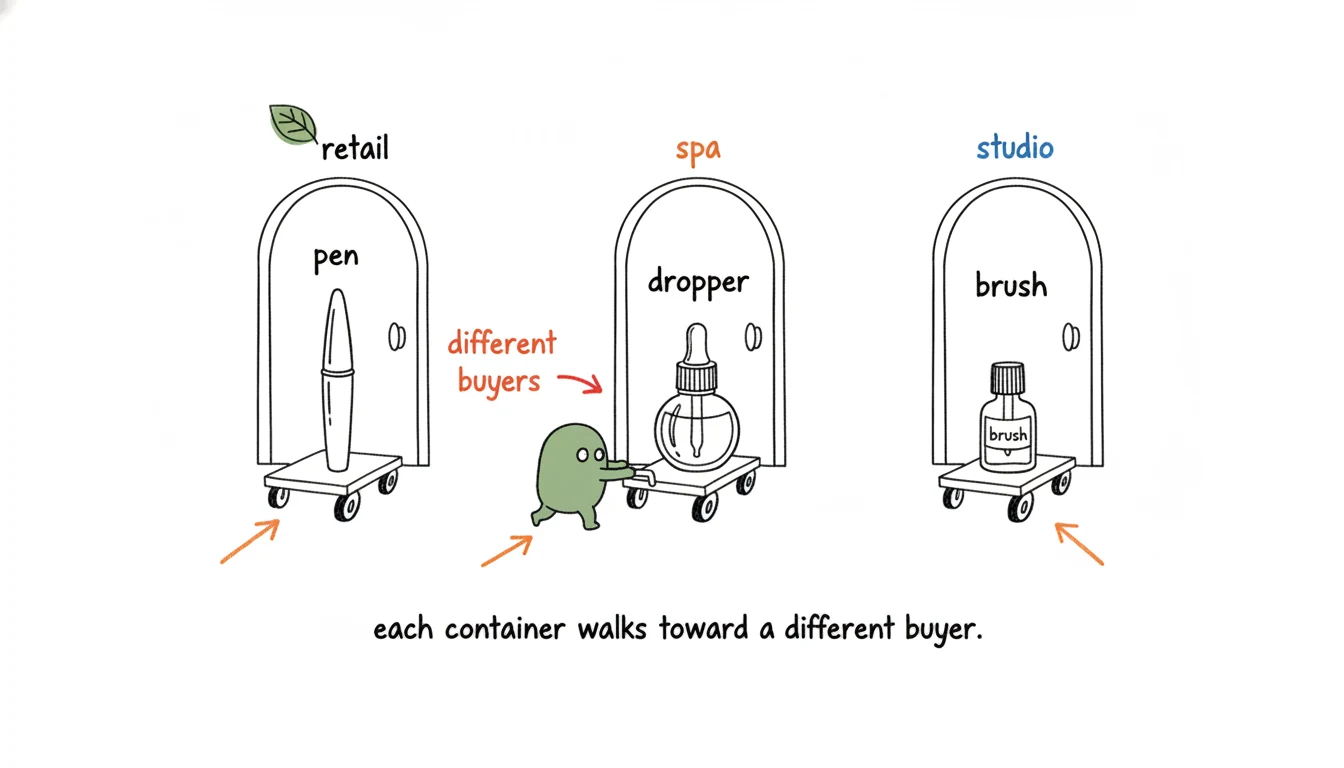
Cuticle oil packaging splits cleanly into three formats. Each one is designed around a different person actually opening the bottle. Picking the wrong format isn’t a cosmetic mistake — it’s a channel-fit mistake, and it shows up as slow rotation and bad reviews.
The twist pen with brush tip (2ml–5ml) — retail and Amazon FBA
The clear plastic twist pen brush applicator is the format that built the modern cuticle oil category on Amazon and Instagram. The user twists the bottom barrel, oil feeds through the wick, and a tiny brush tip lays it down on the nail bed. Spill risk is near zero, the format reads as “premium portable beauty,” and it tucks into a handbag. Your end buyer is a retail consumer paying $8–$28 for 2–5ml of oil. The brand owners who order this format are usually building a DTC, Amazon, or boutique retail line. Twist pens are not a good fit for a pro salon because refilling 200 of them by hand is a brutal use of staff time.
The glass dropper bottle (10ml–30ml) — spa and salon backbar
The amber or clear glass dropper with a rubber-bulb pipette is the workhorse for spa, nail salon, and esthetician backbar use. The technician squeezes a drop onto the cuticle and works it in with a finger or wood stick. Glass reads as “professional grade,” the wider mouth makes refilling from bulk straightforward, and the lower cost per ml lets the salon recover the bottle as part of the service rather than charging the client. This is also the format that sells well into distributor and wholesale channels supplying mixed beauty supply stores. If you have not chosen a base oil yet, the base oils comparison shows which formulations actually pair well with a glass dropper presentation versus the more cosmetic pen format.
The brush bottle (10ml–15ml) — DIY nail studio
The nail-polish-style brush bottle — round or square glass, lacquer cap, integrated brush — is the format the working nail tech reaches for between clients. One hand, one stroke per finger, cap back on, next client. Brush bottles are common on the salon retail shelf as an add-on the client buys at checkout, and they’re the dominant format inside DIY nail studios across the US, EU, and AU. They cost less than a pen but more than the cheapest droppers because the polish-style cap and brush assembly is a precision part.
If your customer is a salon distributor placing one PO across multiple SKUs, you will likely end up running two of the three formats in the same order — typically a 15ml dropper for backbar plus a brush bottle or pen for retail resale. Our cuticle oil category page lists the active formats we keep tooling for, and the spec sheet under each one shows the standard bottle codes we run against stock molds.
Volume and Price Psychology
Fill volume is not just a cost decision — it sets the retail price ceiling. Consumers anchor on dollars-per-bottle, not dollars-per-ml. A 2ml pen at $14 and a 15ml brush bottle at $14 feel like the same price to the shopper, even though one is 7.5× the volume. Your job as the brand or distributor is to pick the volume that matches the channel’s pricing rhythm.
This is the mapping we see hold up across US, EU, and AU retail in 2026:
| Fill volume | Dominant format | Typical retail SRP | Channel | Repeat purchase cycle |
|---|---|---|---|---|
| 2ml | Twist pen w/ brush | $8 – $14 | Amazon, gift sets, boutique retail | 2–3 months |
| 5ml | Twist pen or mini dropper | $12 – $20 | DTC, prestige indie, Sephora-style | 3–4 months |
| 10ml | Glass dropper | $14 – $28 | Salon retail, DTC, Amazon premium | 4–5 months |
| 15ml | Brush bottle or dropper | $16 – $32 | Nail studio retail, professional | 5–6 months |
| 30ml | Glass dropper | $22 – $42 | Spa backbar, prestige DTC | 6–8 months |
| 100ml | PET or aluminum bulk | n/a (wholesale) | Salon backbar refill, distributor | monthly restock |
Two things worth flagging. First, 2ml pens have the highest dollars-per-ml margin but also the highest packaging-cost-as-a-percentage-of-COGS — the bottle is sometimes more expensive than the oil inside. Second, 100ml bulk is rarely sold to the end consumer; it is a wholesale format that lets salons refill their backbar drops and stretch a single PO across six months of service.
If you want to back this into a full P&L on a specific SKU, our 10ml cost breakdown walks the same logic at the unit level — and shows why packaging, not formula, is the single largest cost line at the 10ml tier.
Glass vs PP vs Aluminum
The bottle material decision sits between your factory cost and your freight invoice, and it almost always gets made too late. Three materials cover 95% of cuticle oil packaging options wholesale buyers consider today.
Glass
Glass is the default for the dropper format and the brush bottle. It reads as premium, it doesn’t react with essential oils or vitamin E, and consumers trust it. The downside is weight and breakage. Industry data on cosmetic shipments puts glass breakage rates at 5–8% in standard ocean LCL transit, depending on packing density and palletization. At a 1,000-unit order that means budgeting 50–80 replacement units in your reorder math, or paying the factory for upgraded inner trays and double-corrugated outers (which adds $0.03–$0.06 per unit).
PP and PETG (plastic)
Polypropylene and PETG dominate the twist pen format and most 2ml–5ml mini bottles. Plastic is light, near-unbreakable in transit, and 20–35% cheaper per bottle than glass at the same volume. The tradeoffs are perceived premium (consumers read glass as more expensive even when it isn’t) and additive compatibility — some high-citrus fragrances and some plant-actives can interact with cheaper plastics over a long shelf life. For a 12-month shelf-life cuticle oil with a stock base oil profile, PP and PETG are completely safe. Stay away from PS (polystyrene) for any oil-based product.
Aluminum
Aluminum shows up mostly in the 100ml+ bulk-refill format and the occasional prestige indie 10ml. It is functionally unbreakable in transit, light, and increasingly sourced as a sustainability story. The freight math is real: industry packaging data shows aluminum cosmetic bottles run roughly 50% lighter than glass, lowering per-unit ocean freight by around $0.10–$0.15 at 10ml–15ml fill, and meaningfully more at 100ml. The downside is opacity (the brand cannot show off oil color), the need for a separate dispenser (aluminum doesn’t take a pipette or brush integrated cap as cleanly), and a higher base bottle cost in low MOQs.
| Material | Bottle cost (10ml, 1k MOQ) | Breakage in transit | Premium read | Best fit |
|---|---|---|---|---|
| Glass (clear/amber) | $0.55 – $0.80 | 5–8% | High | Dropper, brush bottle, retail |
| PP / PETG | $0.30 – $0.55 | <1% | Medium | Twist pen, mini formats |
| Aluminum | $0.70 – $1.20 | <1% | High (eco) | Bulk refill, prestige |
These bottle costs sit inside the wider unit economics we model in the 10ml cost breakdown — for context, the $0.55–$0.80 glass dropper line there is the same line item we’re widening here across alternatives.
Printing Techniques: Silkscreen, Label, Shrink Sleeve, Hot Stamping
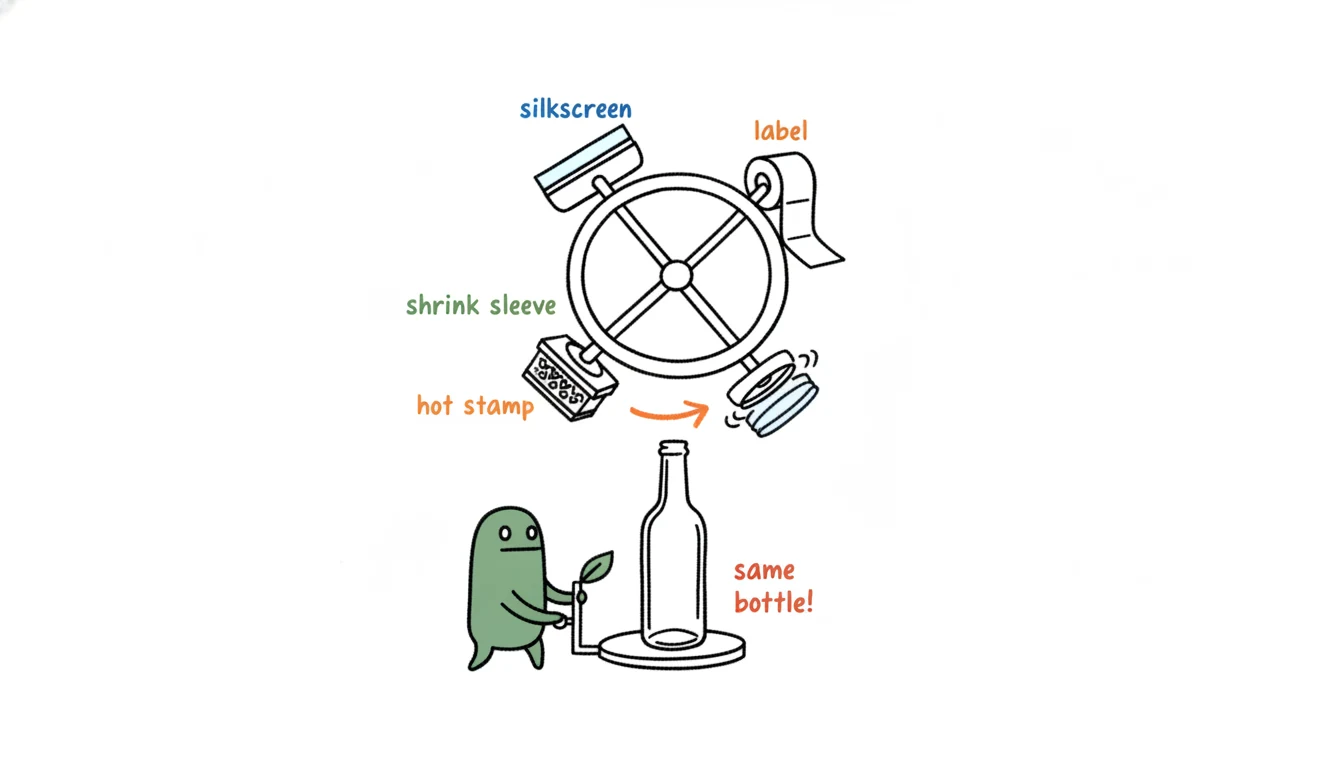
The decoration line is where most first-time buyers get blindsided. The factory quotes the bottle, the cap, and the fill — and then your artwork arrives with foil accents, a metallic logo, and a clear gloss varnish, and the per-unit cost jumps $0.20–$0.40. Here is how the four standard decoration methods stack up.
| Method | Cost adder (per unit, 1k MOQ) | Color range | Best on | Lead time impact |
|---|---|---|---|---|
| Paper / BOPP label | $0.08 – $0.20 | Full CMYK + spot | Any flat/curved bottle | +0 days (in-house at most factories) |
| Silkscreen (1–2 color) | $0.10 – $0.25 | 1–4 spot colors | Glass dropper, brush bottle | +3–5 days (screen setup) |
| Shrink sleeve | $0.15 – $0.35 | Full CMYK + finishes | Brush bottle, mini formats | +5–7 days |
| Hot stamping (foil) | $0.12 – $0.30 | Gold/silver/holo | Glass dropper neck, cap | +5–10 days (plate setup) |
A few practical notes from running these jobs:
- Paper labels are the only decoration that does not require tooling. If you want low MOQ flexibility, label is the right answer. Switching brands or SKUs only costs a print run.
- Silkscreen is the default for “professional grade” glass droppers because the print sits directly on the bottle and survives wet hands and acetone splashes — important for salon backbar use.
- Shrink sleeves win when artwork is busy or photographic. They let you cover 360° of the bottle with full CMYK, which silkscreen physically cannot.
- Hot stamping is the single decoration method that quietly inflates lead time the most — the plate has to be made, the foil supplier is often separate, and reorders are not as fast as paper-label reprints.
Stack two decorations (silkscreen + hot stamp, or label + shrink sleeve neck band) and you are at $0.30–$0.55 in decoration alone, which on a $1.40 ex-works base bottle is a meaningful percentage. Build the artwork brief with the cost ladder in mind.
How Packaging Drives Lead Time
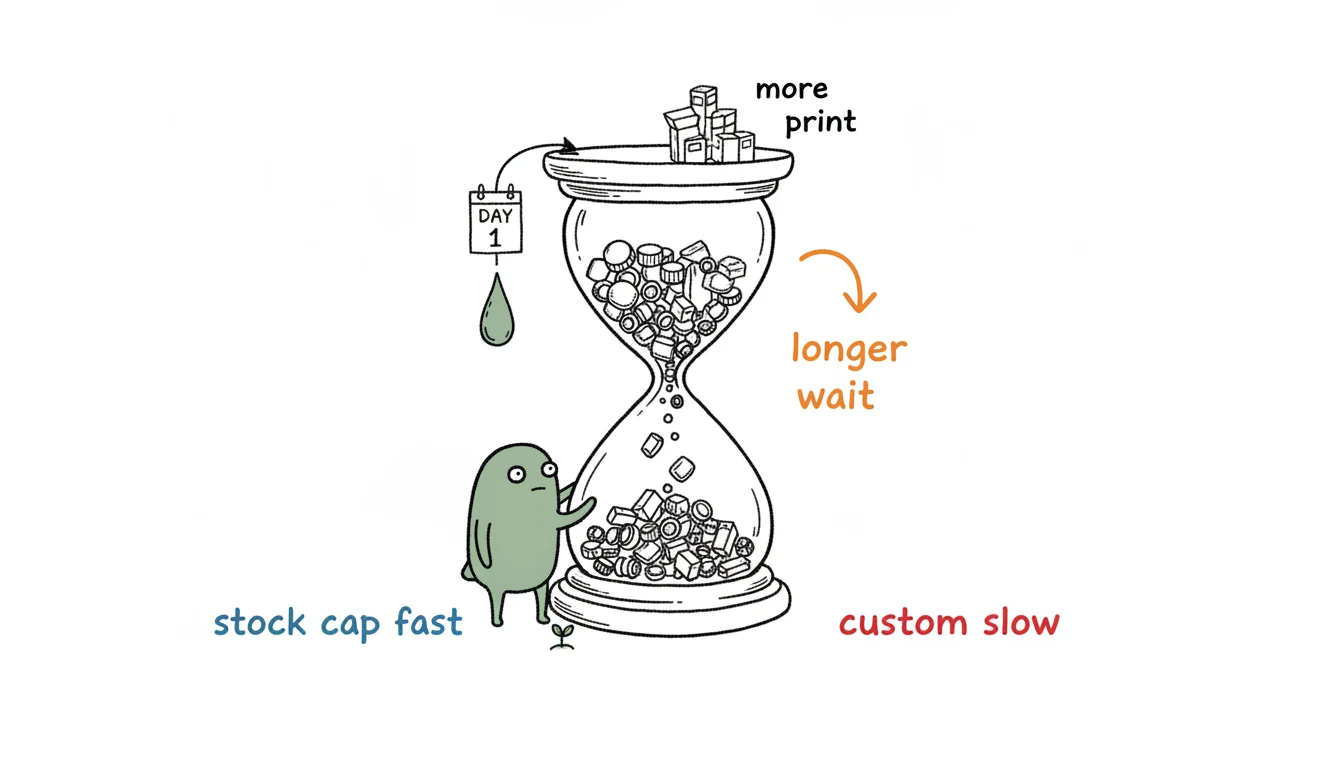
Lead time on cuticle oil is rarely a formula problem. The formula is mixed, filtered, and rested in 3–5 days. The bottle is what either ships in 30 days or 90 days. The fork in the road is stock packaging vs custom tooling.
Stock packaging — 25–40 day total lead time
Every factory that runs cuticle oil at volume keeps a stock library of 2ml–5ml twist pens, 10ml/15ml/30ml glass droppers, and 15ml brush bottles. The molds are already cut, the bottles sit in the warehouse or at a nearby trade partner, and decoration is layered on top. From PO deposit to FOB ready, expect 25–40 days on the first order including artwork approval, sample sign-off, mass production, and inspection. This is also the only path that supports the lowest MOQs — see the cuticle oil MOQ guide for the per-format minimums we hold.
Custom bottle tooling — 70–110 day total lead time + $3,000–$8,000 tooling
If your brand needs a proprietary bottle shape — a square dropper with a debossed logo, a hexagonal brush bottle, a non-standard twist pen barrel — that’s a new mold. Mold (tooling) cost for a single cosmetic bottle mold lands at $3,000–$5,000 for plastic injection and $5,000–$8,000 for glass, with multi-cavity molds and complex parting lines pushing higher. Mold cutting alone runs 30–45 days. Then you wait for first article inspection, sample bottles, fill trial, and finally mass production. Realistic end-to-end is 70–110 days from PO.
Custom tooling is the right move when your annual volume justifies amortizing the mold (a $5,000 mold spread over 50,000 units = $0.10 per unit, which is meaningful). It is the wrong move on a 1,000-unit pilot — you are paying $5 per unit just in tooling, which destroys the cost model. The private label manufacturing guide walks the full decision tree on when to amortize tooling vs stay on stock molds.
The 3 Packaging Specs You Should Lock Before Sampling
Half the clients who go to sample reopen the spec sheet during sample review and ask to change something. That’s normal — but the three decisions below are the ones that, if changed mid-sample, force a full restart of the sample process and add 2–4 weeks. Lock them before the first sample request and you will get to FOB ready a month sooner.
- Fill volume + bottle format. 5ml pen and 10ml dropper are not interchangeable — they use different fillers, different caps, and different cartons. Pick the format that matches your channel (revisit H2 1) and commit before sampling.
- Bottle material + color. Clear glass vs amber glass vs PP vs aluminum. This decision drives the bottle cost line, the freight bill, and the artwork constraints (you cannot silkscreen the same way on PP as on glass). Don’t ask for “send me both” — sample only the one you intend to ship.
- Primary decoration method. Label, silkscreen, shrink sleeve, or hot stamp. This decision sets the artwork file format your designer needs to deliver, and changing it after artwork is signed off means new files, new proofs, and new pre-production samples.
Three decisions, locked on paper, before the factory ships a sample box. If you want a pre-flight checklist for your own RFQ, the most useful starting point is the cuticle oil wholesale OEM product page — the spec sheet there lists the exact fields we need filled in to quote accurately on the first round.
FAQ
What’s the lowest MOQ for custom packaging on cuticle oil?
On stock bottles with custom decoration (your label, your silkscreen, your color), MOQ starts at 1,000 units per SKU for twist pens and brush bottles, and 1,000 units for stock glass droppers. On fully custom bottle tooling, the practical MOQ is 5,000–10,000 units per SKU because you need to amortize the $3,000–$8,000 mold across enough units to keep per-unit tooling cost under $0.15. The full MOQ breakdown covers the per-format minimums.
How long does custom bottle tooling take and what does it cost?
Plastic injection molds for twist pens and brush bottle caps run $3,000–$5,000 with a 30–45 day mold cut. Glass molds for custom dropper or brush bottles run $5,000–$8,000 with 35–50 days of mold cutting, plus first-article and trial fill before mass production starts. End-to-end from PO to FOB ready is realistically 70–110 days on a first custom-tooled order — versus 25–40 days on stock bottles.
Can I supply my own bottle and just have you fill it?
Yes — this is a standard contract filling arrangement and we run it for several clients. You ship empty bottles to the factory, we mix the oil to your formula spec, fill, cap, label, and pack to your carton spec. The catch is two-fold: (1) you take 100% of the quality risk on the bottles you supplied, so any breakage, dimensional out-of-spec, or contamination is on your account; and (2) the filling line still has setup minimums, so contract filling typically runs at a 1,500–2,000 unit minimum. Reach out via Request a Quote with your bottle spec sheet and we will confirm fit.
Which packaging format has the lowest return rate at retail?
Across our private label clients selling on Amazon and DTC, the twist pen with brush tip has the lowest customer return rate — usually under 2% — because the format is intuitive, doesn’t leak, and arrives presentation-ready. Glass droppers see slightly higher returns (3–5%) almost entirely because of in-transit breakage from the carrier’s last-mile handling, not the product itself. Brush bottles sit in between at roughly 2–3%. If retail is your primary channel and you want to minimize logistics-side complaints, the twist pen format is the safest packaging bet.
Cuticle oil packaging is one of the few decisions in private label that genuinely changes which retail channel will buy from you. The pen, the dropper, and the brush bottle are not three flavors of the same thing — they’re three different products dressed in the same oil. The brand owners who get this right pick the format first, then build the formula and the artwork to suit it. The ones who get it wrong sample three formats in parallel, lose 60 days, and ship a bottle that doesn’t match the channel they wanted.
If you want a packaging recommendation tied to your actual channel mix — Amazon, DTC, salon distributor, spa backbar, or a combination — send us your target SKU and we’ll come back with a packaging shortlist plus indicative pricing across formats. Request a Quote on cuticle oil packaging and include your target fill volume, channel, and expected first-PO quantity. For the wider sourcing context behind these decisions, the private label cuticle oil manufacturing guide remains the best single starting point.


Leave A Comment