
This deep-dive is for distributors and salon-chain buyers purchasing bulk pedicure tub liners by the case, not the retail pack. We break down film-thickness tiers (HDPE 0.4-1.0 mil), case-and-pallet logistics, three branding tiers, and the MOQ and lead-time math that decide your landed cost. Ready to compare? Request a quote.
Pedicure tub liners look like the simplest product in the salon supply closet — a folded plastic sheet, packed 200 to a case — and most distributor mistakes happen because of that. Film thickness, material grade, case configuration, branding placement, and shipping economics all change the unit cost and the failure rate in the salon, and the gap between a 0.012mm budget liner and a 0.018mm whirlpool-grade liner is the gap between repeat orders and inspection complaints. This guide is the sourcing mechanics behind the listicle — it pairs with our wholesale pedicure liner supplier comparison so you can pick the tier and then negotiate the actual quote.
Film Material & Thickness: The Spec That Drives Everything
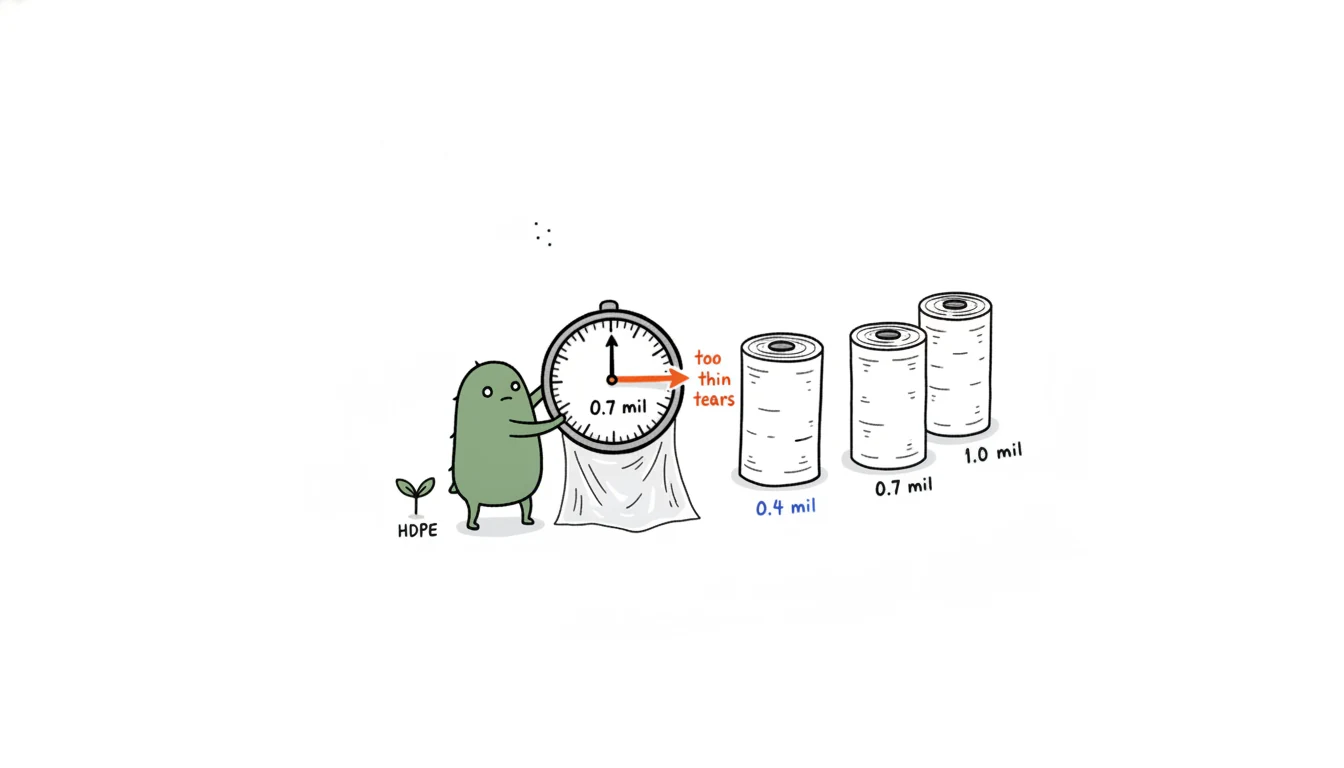
The single biggest source of liner failures and salon complaints is buying the wrong thickness for the tub type. Three real tiers in the market:
- ~0.012mm ultra-budget LDPE. Tears under normal footrest scrubbing, fails in any whirlpool jet environment, fine only for static foot-soaking basins. Distributors who lead with this thickness see the highest return rate.
- 0.015–0.018mm standard LDPE (the salon spec). Survives normal pedicure use including footrest scrubbing and moderate water movement. This is what the major distributor brands (ForPro, Universal, Spilo equivalents) ship as their volume SKU. Most pipeless tubs and gentler whirlpool tubs are fine here. This is what we recommend as the volume SKU for any new distributor lineup.
- 0.025mm+ premium LDPE / HDPE blend. Designed for whirlpool tubs where the jet circulation puts continuous stress on the film. Higher cost per unit, but eliminates mid-service rupture and protects the recirculation reservoir from contamination. Worth the premium for studios running aggressive whirlpool service.
One nuance often missed: the film grade certification. Food-grade or cosmetic-grade LDPE — typically a CFR 21 §177 or EU 10/2011 reference — matters when the salon is in a jurisdiction that audits cosmetic supplies for skin-contact material compliance. Spec the certification at quote time; some buyers don’t realize it’s a variable until an inspector asks.
Case Configuration & Packaging Standards
The industry standard case is 200 individually folded liners in a corrugated dispenser carton sized to fit standard salon backbar storage. The format has settled because it pulls cleanly from a dispenser opening and stacks efficiently. Three variants that show up at quote stage:
- Case-of-200 dispenser carton (standard). What the major distributors ship. Volume SKU.
- Case-of-100 mini for trial / boutique salons. Lower per-case cost, friendlier first-order MOQ. Useful for distributors selling into boutique salon channels.
- Bulk-pack-of-500 / 1000 for chain accounts. Skips the dispenser carton in favor of a bagged bulk pack for back-of-house storage at chain salons that rebag into their own dispensers.
Case dimensions also drive pallet economics: 40 cases per pallet at the 0.015–0.018mm standard thickness is roughly the sweet spot for ocean freight. Going thicker (0.025mm) drops the pallet count slightly because of folded volume. Distributors selling into FCL chain accounts should spec the case dim early because it changes the per-pallet math by a meaningful margin.
Branding Placement: Three Tiers of Customization
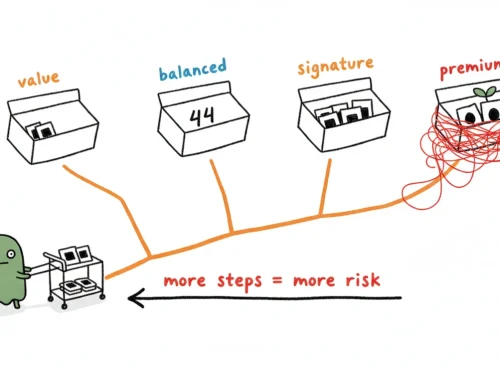
Pedicure liners are easier to brand than most disposable nail supply because the case carries plenty of real estate and the film itself can take simple per-unit print. Three branding tiers at increasing cost and lead time:
Tier 1: Case-Level Branding (fastest, lowest cost)
Your logo and color scheme on the outer carton, dispenser hole label, and any retail display sleeve. No film tooling change. 1-week sample turnaround. This is where most distributors start because it gets a coherent private-label look on the salon’s backbar without committing to per-unit film tooling. Modest MOQ adder over stock case.
Tier 2: Per-Unit Film Print (moderate cost, fixed tooling)
Your logo printed on each individual liner. Requires a print plate to be set up per design, which fixes the tooling cost — so the MOQ jumps to absorb the tooling amortization. 1–2 week sample turnaround. Most chain operators and PL distributors graduate to this tier once the case-level lineup is established. The end-salon perception is materially different: a branded liner reinforces the salon’s identity (or the distributor’s private label) on every service.
Tier 3: Full OEM (custom film color, thickness, embossed pattern, custom packaging)
Custom film color (most liners are clear; some markets prefer light blue, white, or branded color tints), custom emboss or texture, custom packaging design beyond the standard carton (premium retail sleeves, multi-pack consumer SKUs, salon-chain branded dispensers). 2–4 week sample turnaround, largest MOQ commitment. Specialty brand builders and large chain accounts only. Our OEM vs private label vs ODM guide walks the cost frame across these tiers.
MOQ Mechanics: Why There’s No Single Number
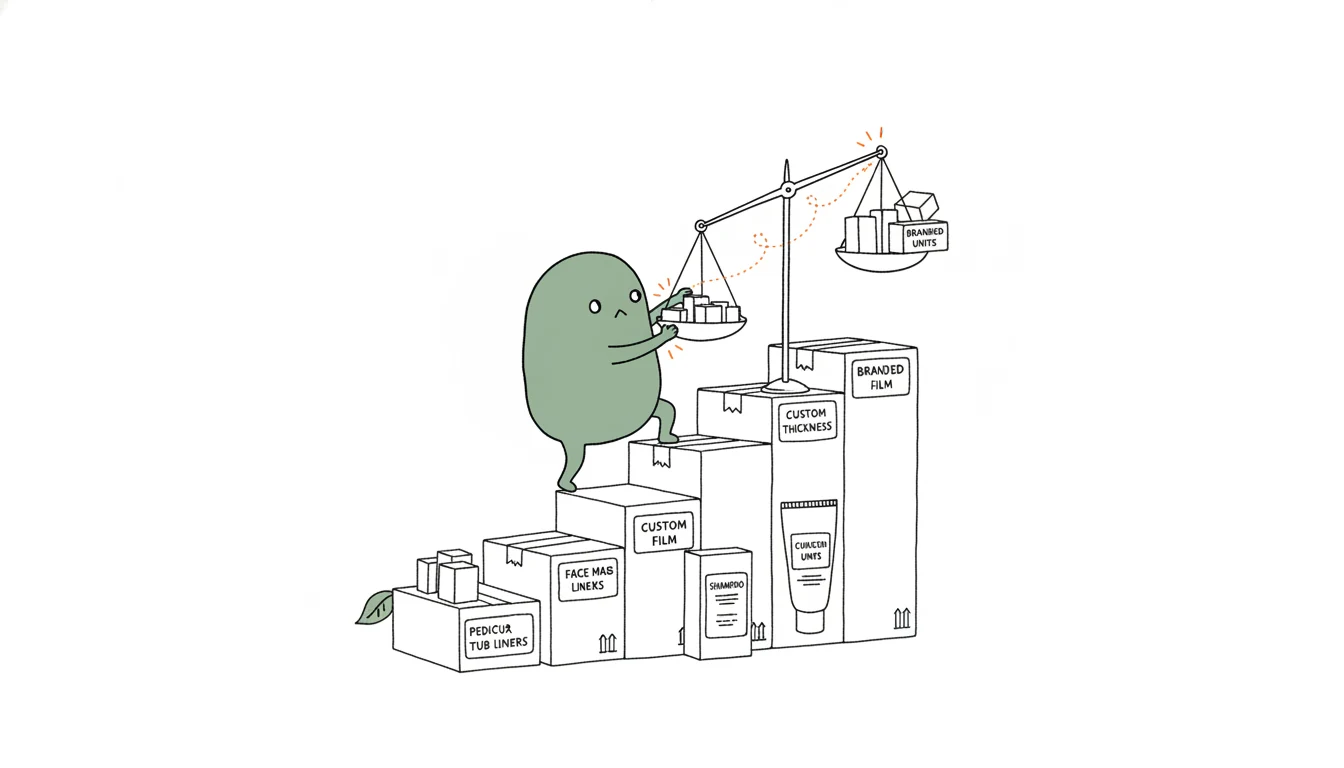
Buyers ask “what’s your MOQ?” expecting a single number. The honest answer is “set at the quote stage” because the variables interact:
- Stock case (no branding, standard 0.015mm, case-of-200) — lowest MOQ, pilot quantities available.
- Case-level branding only — modest adder.
- Per-unit film print — meaningful jump because film tooling.
- Custom film thickness or color — larger jump because film run setup.
- Full OEM with all of the above — largest commitment.
For distributor planning purposes, think in terms of scaling tiers. A pilot launch at stock or Tier-1 case branding to validate the SKU; a Tier-2 per-unit film print run once the first pallet sells through; Tier-3 full OEM only after the SKU is established as a category-volume product in your channel. Trying to start at Tier-3 is the most common over-commitment mistake on a first liner order.
Lead Time, Logistics, and Replenishment
After sign-off:
- Stock case-of-200: production 20–30 days, total to-port 20–35 days including local logistics.
- Private label (Tier 1 or 2): 25–35 days production after sample approval.
- Full OEM (Tier 3): 30–45 days after sample approval.
Shipping mode is the bigger lever:
- FCL (full container). Best economics for chain accounts at ~800+ case orders. Direct port-to-warehouse, lowest per-unit shipping cost.
- LCL (less-than-container). For mid-size distributors at 100–500 case orders. Higher per-unit shipping cost but no full-container commitment.
- Air freight. Time-critical launches and emergency replenishment only. Significantly higher cost; reserve for first-order samples and out-of-stock crises.
- Domestic warehousing (US, EU, AU). For repeat-order distributors, we operate forward-stocking in major markets so reorders ship 3-day domestic instead of 30-day ocean. Available once your relationship is established and rolling volume justifies it.
Replenishment cadence at the salon level runs roughly 4–8 weeks per location for a single-station nail salon, 2–4 weeks for a multi-chair pedicure-heavy studio. Build your reorder forecast around that turn rate; the most common distributor mistake is letting the SKU stock out at the chain account because the forecast didn’t account for service volume scaling.
The Direct-Manufacturer vs Distributor-Tier Cost Gap
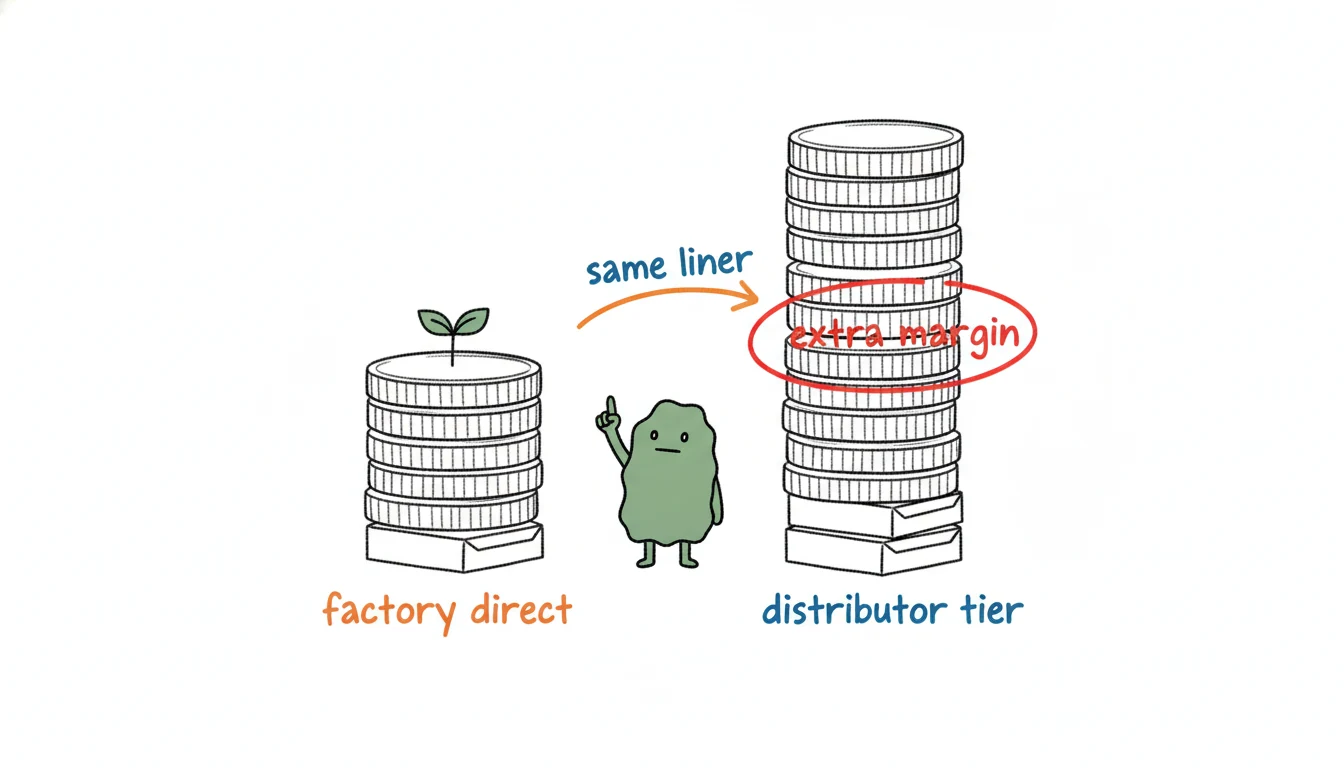
The most common ForPro / Universal / Sally-class distributor sells case-of-200 standard liners at a per-case price that’s roughly 1.6–2.0× the direct-from-manufacturer rate after duty and freight. The gap pays for warehousing, channel marketing, sales coverage, and the brand-recognition premium. For a distributor or chain operator buying at meaningful volume, that gap is the entire margin opportunity — going direct on the factory side and rebadging or private-labeling captures it.
The trade-off is order-management complexity: factory orders require longer lead time, MOQ commitments, freight management, and (for some markets) an importer-of-record arrangement. Distributors who do this well typically build forward-stock in domestic warehouses to absorb the lead-time gap. Distributors who can’t manage the logistics tier are better off staying with the distributor-tier supply.
The supplier tier comparison listicle walks the five real tiers — large beauty distributor, spa-channel wholesaler, regional salon supply chain, direct OEM, and marketplace direct factory — and which buyer profile fits each.
Beyond the Liner: The Disposable Line Bundle
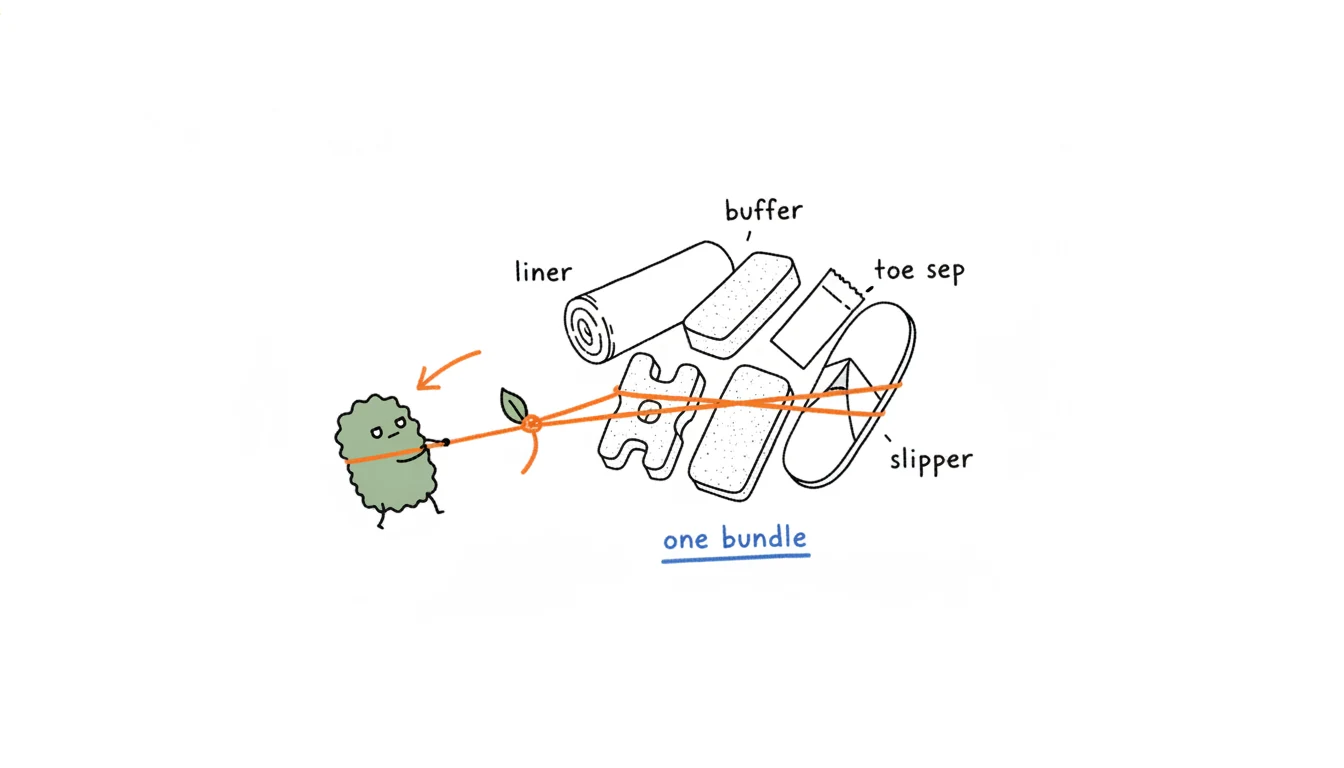
Pedicure tub liners alone are a thin SKU to organize a private-label program around. The strong move is to bundle them with the rest of the salon disposable line: single-use files and buffers, orangewood sticks, table and roll covers, manicure/pedicure kit sets, gloves, and the rest of the consumables. A unified private-label run across the disposable category gives:
- Higher margin on the recurring-SKU bundle (consumables drive 60–70% of long-term salon supply revenue).
- A coherent brand presence in the salon backbar — when the liner, file, orangewood stick, and table cover all carry the same label, the salon sees a real brand, not an assortment.
- Logistics consolidation — one PO, one container, one warehouse SKU group instead of five.
The full disposable nail supplies wholesale range is structured for this kind of bundled private-label sourcing. Combined with the broader salon equipment range (nail drills, UV sterilizers, wax heaters, lamps) and the matching nail drill buyer guide, distributors and chain operators get a complete supply package from a single source.
Common Mistakes Distributors Make on Pedicure Liner Orders
- Buying the cheapest film grade. A 0.012mm liner sold into a whirlpool studio returns at high rates and damages the channel relationship. Match thickness to tub type.
- Skipping certification documentation. Food-grade / cosmetic-grade LDPE certification matters in audited jurisdictions. Get it on file at quote time.
- Committing to Tier-3 OEM on a first order. Start at stock or Tier-1 case branding, scale up. Tier-3 first orders create dead inventory if the SKU doesn’t validate.
- Ignoring case dimensions for pallet math. The same per-case price can deliver materially different landed cost depending on pallet count. Spec dim early.
- Selling on unit price alone. The salon math is time-saved + risk-eliminated. A liner that saves two minutes between clients and eliminates whirlpool jet biofilm is a high-value SKU, not a commodity sheet of plastic.
- Stocking liners without the rest of the disposable line. Liners alone are thin margin; bundled with the full disposable supply they become a high-recurring-revenue category.
Where This Fits the Hygiene SOP
A pedicure liner is a workflow tool, not a compliance shortcut. The salon still runs the full between-client tub cleaning protocol, the disinfection cycle on the jets and footrest, and the dated dispensing of fresh disinfectant solution. Where the liner earns its keep: removing residual-water biofilm (the highest-risk reservoir in pedicure equipment) and cutting between-client tub-cleaning time enough to add 2–3 paid services per technician per day. See our salon cleaning and disinfection SOP for where liners sit in the broader hygiene protocol, and the sterilization compliance guide for the underlying rules.
Frequently Asked Questions
What’s the real MOQ on bulk pedicure tub liners from a manufacturer?
Set at the quote stage by film thickness, branding level, and case configuration. As a guide: stock case-of-200 unbranded units start at the lowest MOQ for pilot orders (typically a few cases for first orders); private-label runs (your logo printed on the case and the per-unit film, or just the case) sit in the middle; full-OEM with custom film color, thickness, embossed pattern, or custom dispenser packaging needs the largest commitment. There’s no single number — the variables matter that much. Pilot quantities are available so you can validate fit before scaling.
What film material is used and what thickness should I order?
Most disposable pedicure spa liners use food-grade or cosmetic-grade LDPE (low-density polyethylene), with HDPE blends for higher-tear-resistance versions. Thickness runs from ~0.012mm (ultra-budget, tears easily, not for whirlpool jets) through 0.015–0.018mm (the standard salon spec — survives normal pedicure with footrest scrubbing) to 0.025mm+ (premium, for whirlpool tubs where jet circulation stresses the film). Spec the thickness to the tub type your salon customers run — sending a 0.012mm liner to a whirlpool studio guarantees returns and complaints.
Why are the ForPro liners considered the benchmark, and what’s the alternative?
ForPro Pedicure Spa Liners (the ‘PediStyle’ line and equivalents) became the de-facto US salon standard through years of beauty-distributor channel presence, consistent thickness specs, and the case-of-200 dispenser packaging that fits standard salon backbar storage. They’re also priced well above bulk-direct-from-factory rates because the distribution channel adds layers. The alternative is direct manufacturer sourcing — same film spec, same case format, same dispenser-style packaging, at 30–50% lower landed cost for a salon chain that can absorb the MOQ. Our liner product is the manufacturer-direct equivalent; see our hygienic pedicure spa liner for the spec sheet.
Can I get my logo printed on the liners?
Yes, two placement options. Case-level branding (logo on the outer carton and any retail display sleeve) is the lowest-cost and fastest path — small tooling change, 1-week sample turnaround. Per-unit film branding (your logo printed on each individual liner) requires film tooling change and a meaningful MOQ commitment because the print plate is set up per design. Most distributors and chain operators start with case-level branding and graduate to per-unit film print once the line is established. We support both.
How are pedicure liners shipped — case, pallet, or container?
Standard format is case-of-200 individually folded liners in a corrugated dispenser carton. Carton dimensions are sized to fit standard salon backbar storage and to palletize efficiently — typically ~40 cases per pallet for the 0.015–0.018mm standard thickness. For chain accounts and distributors, full-container loads (FCL) make sense at the ~800-case mark and above; less than that, LCL or air-freight expedite for time-critical launches. Lead time after sign-off: 20–35 days for stock or private-label cases, 30–45 days for full-OEM film runs. Domestic warehousing in the US, EU, and AU is available for repeat-order distributors.
What’s the cost-per-pedicure economics distributors should pitch to salons?
A 0.015mm standard liner at distributor pricing lands at roughly the cost of two minutes of technician time. That’s the frame for salon customers: ‘the liner pays for itself if it saves you two minutes of between-client tub cleaning, and you almost always save more than that.’ The real economics are even better when the salon factors in the jet biofilm risk on whirlpool tubs that liners eliminate — a single complaint avoided is worth thousands of liner units in reputational protection. Build the salon pitch around time-saved + risk-eliminated, not unit price.
Do liners replace tub disinfection, or just supplement it?
Supplement, not replace. Even with a single-use liner in place, the tub itself, footrest, drain, and any non-disposable jet components still need cleaning and disinfection between clients per state and national rules. The liner’s big advantage is taking residual-water biofilm off the table (the highest-risk reservoir, especially in older whirlpool jets) and dramatically cutting between-client turnaround time. It’s a workflow upgrade and a risk-reduction tool, not a compliance shortcut. Our salon cleaning & disinfection SOP covers where liners fit in the broader between-client protocol, and the sterilization compliance guide walks the underlying state-level rules.
Can I private-label pedicure liners as part of a broader disposable line?
Yes — and most distributors do. Pedicure liners ship and brand well as part of a unified disposable supply line that includes single-use files, buffers, orangewood sticks, table covers, and pedicure kit sets. A coherent private-label run across the whole line gives the end salon a single-brand backbar that looks professional and gives the distributor a higher-margin reorder profile. See the full disposable nail supplies wholesale range for what fits the same private-label umbrella, and our OEM vs private label vs ODM guide for which sourcing model fits your scale.
Ready to source? See our hygienic pedicure spa liner spec sheet, the full disposable nail supplies wholesale range, the supplier-tier comparison to pick your buying channel, or contact our OEM team for a bulk-case or private-label quote.
Related: Building out a pedicure line? Pair your consumables with a branded private label spa & pedicure gift set — read the spa gift set buyer’s guide.



Leave A Comment