
TL;DR. If you import private label cuticle oil into the United States, the Modernization of Cosmetics Regulation Act (MoCRA, 2022) now requires facility registration and product listing with FDA — enforcement began on July 1, 2024, and your label must show a domestic contact for adverse-event reporting. If you sell into the European Union, Regulation (EC) No 1223/2009 requires an EU-based Responsible Person (RP), a complete Product Information File (PIF), and notification through the CPNP portal before the first unit moves. The single fastest way to lose a market is a wrong claim: words like treats, heals, repairs damaged nail, or antifungal push cuticle oil out of cosmetic territory and into drug regulation. Your China factory can supply MSDS, CoA, Allergen Declaration, Ingredient Statement, and stability data, but it cannot register your brand for you, cannot be your EU RP, and cannot substantiate your marketing claims. Verify all four documents before you place a PO.
Cuticle oil looks like the simplest 10ml SKU on a nail-care line sheet — base oil, a few actives, a dropper, a label. The compliance file behind it is the part most first-time B2B buyers underestimate. A US private label founder typically asks us about MOQ and unit cost before asking about FDA facility registration. An EU distributor typically asks about lead time before asking who their Responsible Person is. Both questions are urgent, and both are non-negotiable: post-2024, you cannot legally place a non-compliant cuticle oil on either market, even if your formula is identical to a product already on the shelf next to it.
This guide walks through what a B2B buyer actually has to verify before shipping a private label cuticle oil into the US or EU in 2026. It separates what your factory in China can do for you, what only you (the brand owner) can do, and which four documents you should always pull from the factory before signing off on a PO. The compliance framework here pairs with our complete private label cuticle oil manufacturing guide and our supplier vetting checklist — together they cover the technical, commercial, and regulatory side of one finished SKU.
FDA’s Cosmetic-vs-Drug Line: What Claims Move Cuticle Oil Into Drug Territory
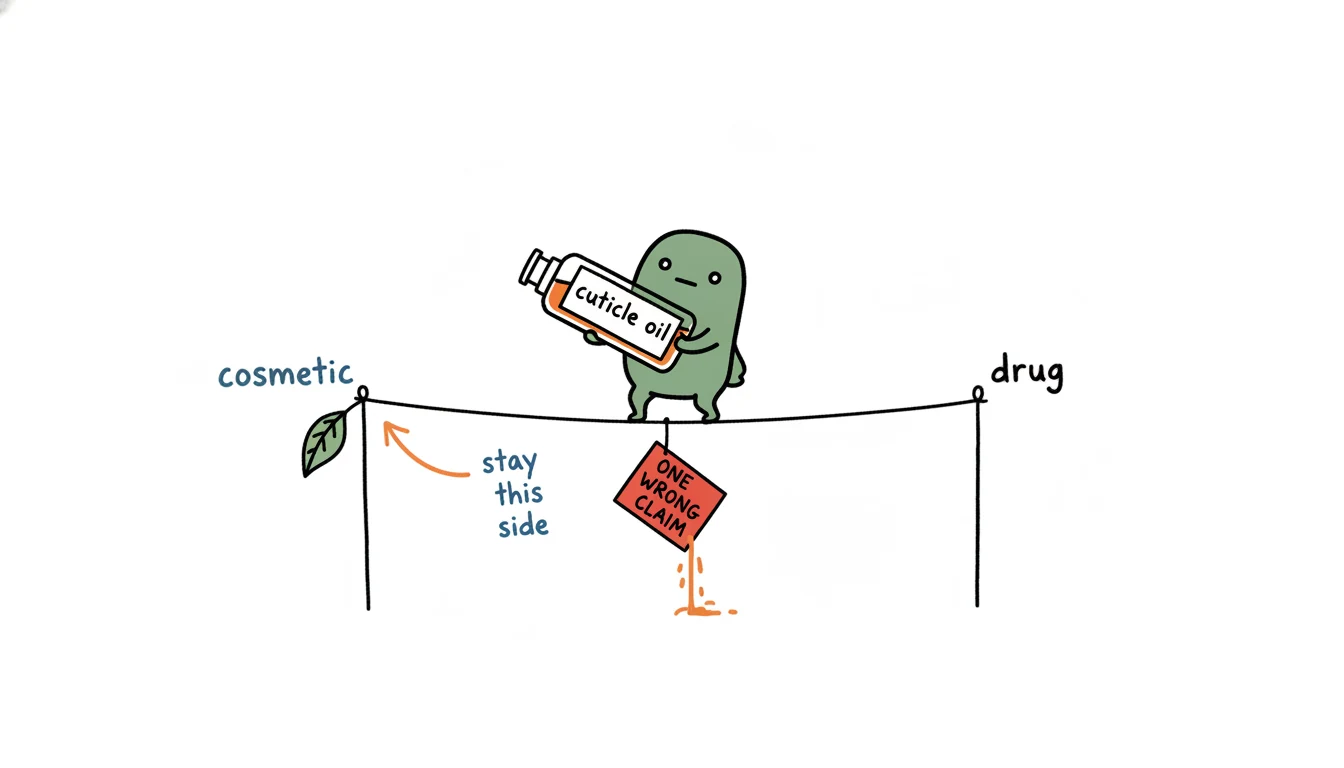
Under the US Federal Food, Drug, and Cosmetic Act (FD&C Act), a product is regulated by its intended use, and intended use is read primarily from the claims you make on the label, on your website, on Amazon copy, and in your social posts. A “cosmetic” is intended to cleanse, beautify, promote attractiveness, or alter appearance. A “drug” is intended to diagnose, cure, mitigate, treat, or prevent disease, or to affect the structure or function of the body. The same 10ml bottle of jojoba oil with vitamin E can sit on either side of that line depending on the words around it.
For cuticle oil specifically, the words that put you across the line are the ones that promise a physiological effect. Drug-territory claims include “treats brittle nails,” “heals damaged nails,” “repairs nail damage,” “antifungal,” “anti-bacterial,” “stops nail infection,” “restores nail growth,” “thickens the nail plate,” and “cures.” These are not marketing nuance; they are the exact phrases FDA warning letters cite when reclassifying a cosmetic as an unapproved drug.
Cosmetic-safe phrasing keeps the benefit at the surface, sensory, and appearance level: “conditions the cuticle,” “hydrates the skin around the nail,” “softens dry cuticles,” “adds shine,” “improves the appearance of brittle-looking nails,” “for the look of healthy nails.” Words like nourishing and moisturizing are generally tolerated for cosmetics; words like treating and healing are not.
| Drug-territory (avoid) | Cosmetic-safe alternative |
|---|---|
| Treats brittle nails | Improves the look of brittle-looking nails |
| Heals damaged cuticles | Softens and conditions dry cuticles |
| Repairs the nail plate | Adds shine to dull-looking nails |
| Antifungal protection | (no cosmetic alternative — remove the claim) |
| Restores nail growth | (no cosmetic alternative — remove the claim) |
| Strengthens the nail | For the appearance of stronger-looking nails |
If your brand strategy genuinely requires a structure/function claim — for example, you are launching an antifungal nail product — the answer is not a creative rewrite. The answer is to develop the product as an OTC drug with the corresponding active monograph, drug facts panel, and FDA pathway. That is a different SKU, a different budget, and a different factory profile from a cosmetic cuticle oil.
FDA Mandatory Label Elements for Cosmetic Cuticle Oil
Cosmetic labeling in the US is governed by the FD&C Act, the Fair Packaging and Labeling Act (FPLA), and 21 CFR Part 701, with MoCRA (2022) layering additional requirements on top. The product label of a cuticle oil sold at retail in the US must, at minimum, include:
- Identity of the product — the common or usual name (e.g., “Cuticle Oil”) on the principal display panel.
- Net quantity of contents — declared in both metric and US customary units on the principal display panel (e.g., “Net Wt 0.34 fl oz (10 ml)”).
- Name and place of business of the manufacturer, packer, or distributor — typically your brand’s legal entity and a US address.
- Ingredient declaration — listed in descending order of predominance, using INCI (International Nomenclature of Cosmetic Ingredients) names. Colorants may be listed at the end after “may contain” / “+/-“.
- Domestic contact for adverse event reporting — a US address, US phone number, or US-based email through which adverse events can be reported. This became enforceable under MoCRA on December 29, 2024.
- Warning statements where the product contains an ingredient that requires one, and any caution that is necessary for safe use.
- Lot or batch code — not strictly required by the FD&C Act for cosmetics, but required in practice for traceability under MoCRA’s adverse-event recordkeeping rules and required by virtually every serious retailer.
Beyond the label itself, MoCRA introduced two brand-level obligations that take effect once the product is on the US market. The responsible person (the brand owner, packer, or distributor named on the label) must list each marketed cosmetic product with FDA, and the manufacturing facility must be registered with FDA and renewed every two years. Enforcement of facility registration and product listing began on July 1, 2024. There is a small-business exemption for companies whose average annual US cosmetic gross sales over the previous three years are below USD 1 million — but the exemption does not apply to products in contact with the eye mucosa, injected products, products for internal use, or products intended to alter appearance for more than 24 hours. Cuticle oil at typical formulation falls outside those carve-outs, so most small brands can use the exemption for facility registration and product listing, but they are still subject to labeling, safety substantiation, adverse-event reporting, and recordkeeping requirements.
One financial note worth flagging: the cost of compliance — testing, RP fees, registration, document collection — does not sit inside the per-unit ex-works price your factory quotes you. Treat it as a separate line in your model, the way our cuticle oil cost breakdown separates landed cost from brand overhead.
EU Regulation 1223/2009 and CPNP Registration: Who Is the Responsible Person
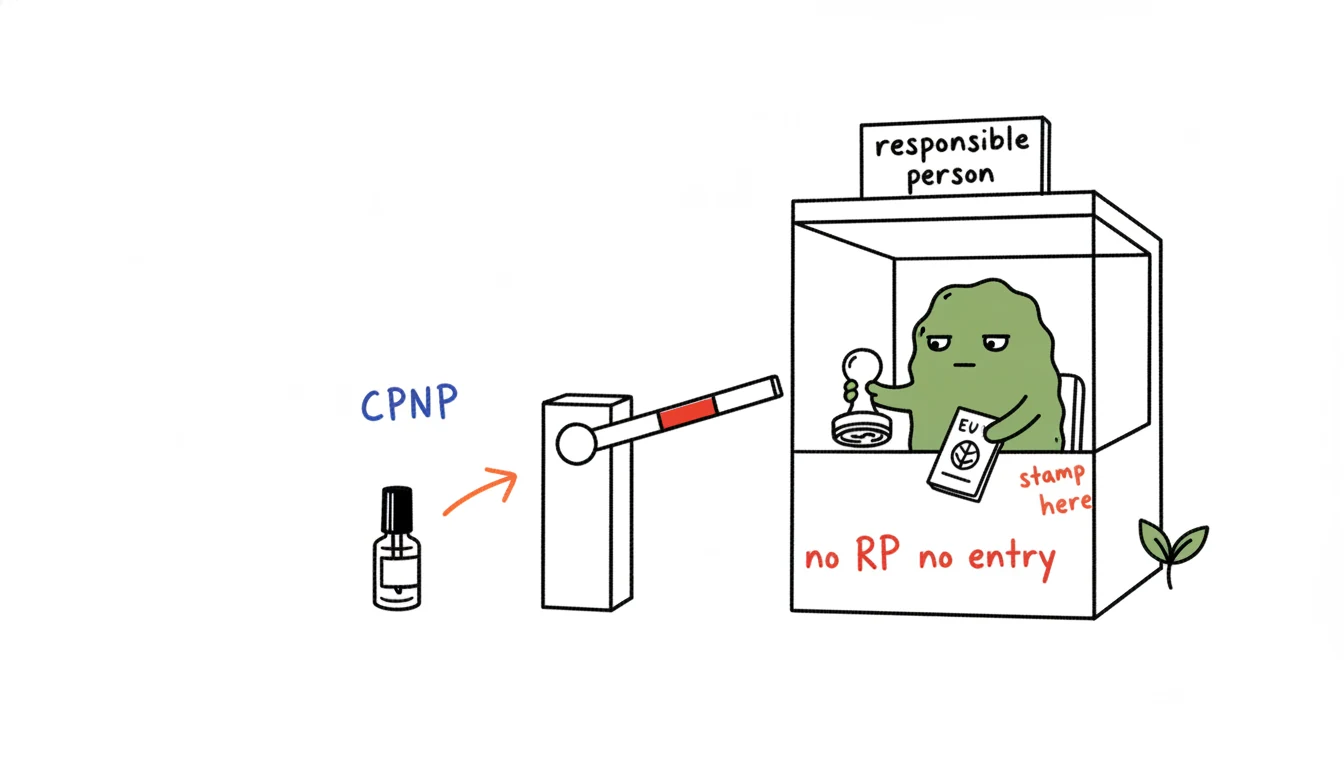
For the EU market, the foundational text is Regulation (EC) No 1223/2009 on cosmetic products. Three concepts inside that regulation matter the most for a B2B buyer placing a private label cuticle oil on the EU market: the Responsible Person, the Product Information File, and CPNP notification.
The Responsible Person (RP) is the legal or natural person established within the EU who is accountable for compliance of each cosmetic product placed on the EU market. The RP must be EU-based. A US brand, a UK brand, or a Chinese manufacturer cannot be the RP for EU sales; you must appoint an EU entity. In practice this is either (a) your EU distributor designated by written mandate, (b) an EU-based subsidiary of your brand, or (c) a specialist third-party RP service. The RP’s name and EU address must appear on the product label.
The Product Information File (PIF) must be kept by the RP for ten years after the last batch of the product is placed on the market and must be available, in a language easily understandable to the competent authority, at the RP’s EU address. A complete PIF for a cuticle oil typically contains:
- Product description and intended use
- Cosmetic Product Safety Report (CPSR), Parts A and B, signed by a qualified safety assessor
- Description of the manufacturing method and a statement of compliance with Good Manufacturing Practice (commonly demonstrated by reference to the ISO 22716 standard)
- Proof of the effect claimed for the product (claim substantiation, covered in H2 4)
- Data on any animal testing relevant to the development or safety evaluation
The CPNP (Cosmetic Product Notification Portal) is the centralized EU portal through which the RP electronically notifies each cosmetic product before placing it on the EU market. The notification covers product name and category, RP identity and address, country of origin for imports, frame formulation for poison control, presence of nanomaterials, and presence of CMR substances where relevant. CPNP notification is a one-time act per product version, not a license — there is no “approval” you receive back; the RP is responsible for ensuring compliance and remains liable.
The European Commission has announced a full evaluation of Regulation 1223/2009 running from mid-2025 to mid-2026, reviewing the regulation’s effectiveness, alignment with other EU laws, and adaptation to digital and green-claim trends. The framework above remains in force during that review; any structural change would follow a separate legislative process.
Claim Substantiation Under EU Regulation 655/2013

Commission Regulation (EU) No 655/2013 lays down the common criteria for the justification of claims used in relation to cosmetic products. It applies to every claim — on the label, on your website, in your trade catalog, in your Amazon EU listings, in influencer briefs. The regulation sets out six common criteria:
- Legal compliance — claims must not imply that the product has a specific benefit when that benefit consists only of compliance with minimum legal requirements.
- Truthfulness — claims must not attribute characteristics or functions to the product that it does not possess.
- Evidential support — claims must be supported by adequate and verifiable evidence, regardless of the type of evidential support used to substantiate them.
- Honesty — presentation of the product’s performance must not go beyond the available supporting evidence.
- Fairness — claims must be objective and not denigrate competitors or ingredients legally used.
- Informed decision-making — claims must be clear and understandable to the average end user and must allow them to make an informed choice.
Two claim categories trip up cuticle oil brands the most. “Natural” has no harmonized legal definition under EU law. A product can be presented as natural only when the natural content is meaningful and dominant — labeling a 95% synthetic emollient blend as “natural cuticle oil” because it contains 2% jojoba is the textbook misleading claim under 655/2013. “Vegan” also has no statutory EU definition; claims like “100% vegan” require robust substantiation across the entire supply chain (no animal-derived ingredients, no animal-derived processing aids, no animal testing where avoidable under the regulation’s framework). Manufacturers commonly use the softer formulation “suitable for vegans” with a documented ingredient declaration.
Other claims that need explicit substantiation in your PIF: nourishing, long-lasting, hypoallergenic, dermatologically tested, fragrance-free, and any percentage figure (“24-hour hydration,” “90% of users reported smoother cuticles”). Each of those requires either an in-vitro study, a consumer panel test, an ingredient-level dossier, or a recognized methodology — held in your PIF and producible on request.
What a China-Based Cuticle Oil Manufacturer Can and Cannot Do for Compliance

This is the question we get asked most often by first-time B2B buyers, so it deserves a clear, neutral answer.
A competent Shenzhen-based cuticle oil manufacturer can typically provide, on request:
- Material Safety Data Sheet (MSDS / SDS) for the finished formula and for each raw material, used both for freight booking and for downstream safety files.
- Certificate of Analysis (CoA) per production batch, showing the actual measured values against the formula’s release specification.
- Allergen Declaration covering the 26 (now expanded under recent EU amendments) listed fragrance allergens and any botanical-origin allergens — including sweet almond oil and other tree-nut-derived base oils that require explicit allergen labeling in many jurisdictions.
- Ingredient Statement in INCI nomenclature, formatted in descending order of predominance, ready to drop into your label artwork.
- Stability and compatibility data — typically 3-month accelerated and 12-month real-time stability in the specified packaging, sufficient to support a shelf-life claim in your PIF or your US safety file.
- Microbial / preservative efficacy testing where the formula is water-containing or where the buyer’s market requires it.
- Statement of GMP-aligned manufacturing describing the facility’s quality system. A factory may operate to ISO 22716-aligned practices without claiming to hold a current third-party ISO 22716 certificate; ask for whatever documentation actually exists rather than assuming a label.
A China-based manufacturer cannot do these things for you:
- Be your EU Responsible Person. The RP must be EU-established. The factory is outside the EU and is legally ineligible.
- Register your brand for product listing under MoCRA. The factory can register itself as a cosmetic product facility with FDA (and many do), but the product listing under MoCRA is the responsible person’s obligation — i.e., yours, as the brand owner.
- Substantiate your marketing claims. The factory can supply ingredient-level data and stability data; the burden of proof for finished-product claims (“24-hour hydration,” “clinically proven,” “reduces appearance of brittle nails by X%”) sits with the brand owner and is typically generated by an independent CRO or consumer-panel lab.
- Approve your label artwork as legally compliant. A factory can review for INCI correctness and net-weight statement format; it cannot review for FDA drug-claim risk, EU 655/2013 compliance, or your domestic-contact and RP designation. That review belongs to a regulatory consultant or qualified counsel in the destination market.
- Hold your PIF for you. The PIF must be available at the RP’s EU address; the factory can supply the technical inputs (formula card, raw material data, stability) but is not the PIF custodian.
The clean mental model: the factory owns the chemistry and the production record; you own the brand, the claims, and the regulatory posture. Vetting whether a factory can credibly deliver the documents above is one of the practical filters in our supplier vetting checklist.
The 4 Documents Every B2B Buyer Should Request from the Factory
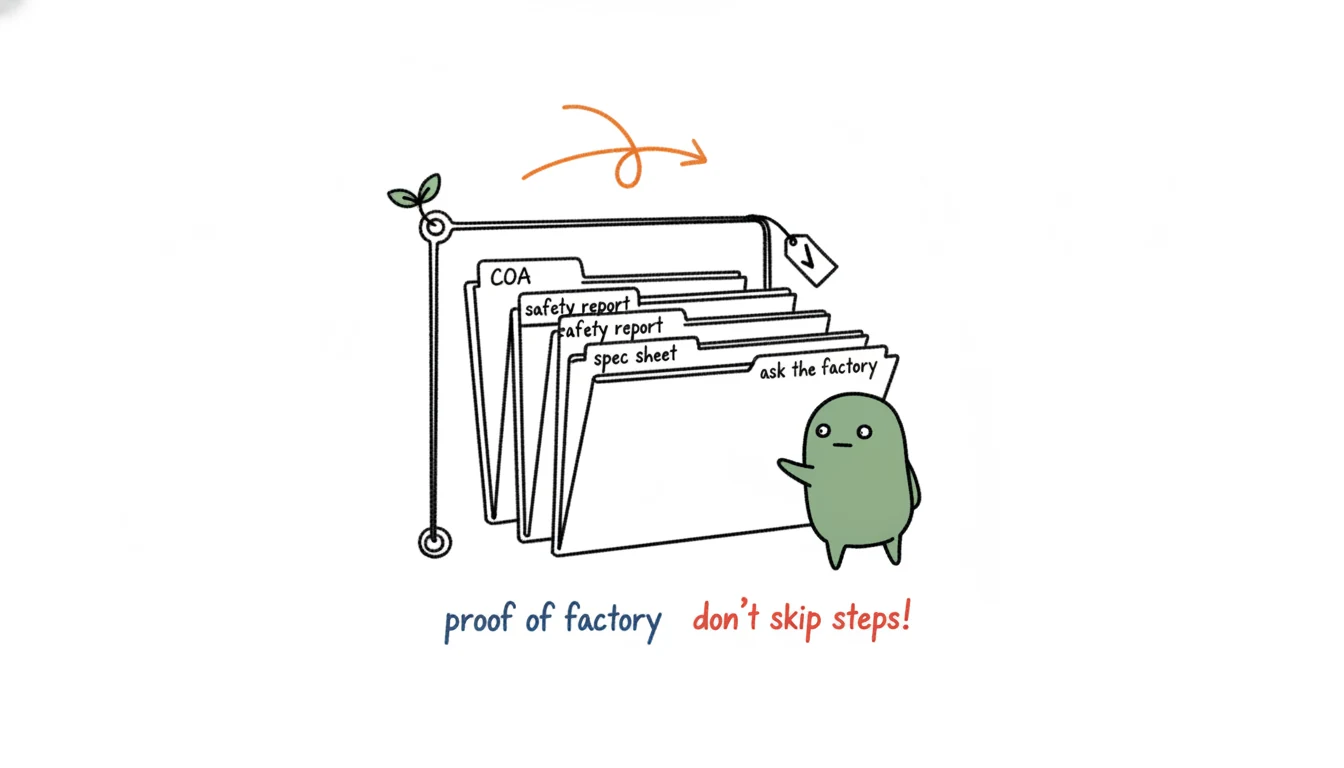
If you remember nothing else from this guide, remember these four. They are the minimum technical package you should have in hand before you sign off on a production order, regardless of whether you are selling 500 units on Shopify or 50,000 units to a regional distributor. Browse our current cuticle oil catalog for reference SKUs before sending an RFQ.
1. Full Ingredient Statement in INCI
What it is: a complete ingredient list in INCI nomenclature, descending order of predominance, with percentages disclosed at least at the bracketed/qualitative level required for safety assessment. What you use it for: generating your label artwork, populating your CPNP notification, and giving your safety assessor the input they need to write the CPSR. Without this, your label cannot be finalized and your PIF cannot be opened.
2. Certificate of Analysis (CoA) Per Batch
What it is: a per-batch document showing the formula’s release specification (appearance, color, odor, viscosity, pH where applicable, microbial counts where applicable, and any active-content assay) and the actual measured values for that specific batch, signed by the factory’s QC. What you use it for: goods-inwards inspection at your 3PL, traceability under MoCRA’s adverse-event recordkeeping, and dispute resolution if a shipment behaves differently from the approved sample. Request CoAs as a standing requirement on every PO, not just the first one.
3. MSDS / SDS for the Finished Product
What it is: a 16-section safety data sheet covering hazard identification, first-aid measures, handling and storage, transport classification, and ecological data, prepared per GHS conventions. What you use it for: ocean freight booking, customs clearance in many jurisdictions, warehouse safety files at your 3PL, and as supporting input into your CPSR safety assessment. Most cuticle oils are non-hazardous under GHS, but the SDS is still required for documented handling and is often requested by Amazon and other marketplaces.
4. Allergen Declaration and Stability Statement
What it is: two short documents, often combined in one PDF. The allergen declaration identifies presence/absence of the listed fragrance allergens above the labeling threshold (0.001% in leave-on cosmetics per current EU rules) and any other ingredient-level allergens such as tree-nut-derived oils. The stability statement summarizes the accelerated and real-time stability data supporting the labeled shelf life and the recommended storage conditions. What you use it for: finalizing your label warnings, supporting your shelf-life claim, and answering retailer and marketplace technical questionnaires.
When you send the RFQ, ask for these four documents by name. A factory that can produce them within a few business days is operating at the level required to ship into the US or EU. A factory that needs to “check with the lab” for two weeks before producing an INCI list is telling you something important about its document maturity. Request a quote and the four compliance documents in one email — we will send the technical pack alongside the price quote.
Frequently Asked Questions
Do I need to register my cuticle oil with the FDA?
Under MoCRA (in force since 2022, with facility registration and product listing enforcement beginning July 1, 2024), the responsible person — typically the brand owner — must list each marketed cosmetic product with FDA, and the manufacturing facility must be registered and renewed every two years. A small-business exemption applies to companies whose average annual US cosmetic gross sales over the previous three years are below USD 1 million, but does not extend to eye-mucosa, injected, internal-use, or long-duration appearance-altering products. Standard cuticle oil typically qualifies for the small-business exemption if your sales are below the threshold, but you remain subject to labeling, safety substantiation, adverse-event reporting (the December 29, 2024 domestic-contact requirement), and recordkeeping rules regardless of size.
Who can be the Responsible Person for EU sales if I’m a US brand?
The Responsible Person under Regulation (EC) No 1223/2009 must be a legal or natural person established within the EU. A US-based brand cannot serve as its own RP. The three practical options are: (1) appoint your EU distributor as RP through a written mandate, (2) establish an EU subsidiary or local entity, or (3) contract a specialist third-party RP service. The RP’s EU name and address must appear on every product label, and the RP keeps the Product Information File at that EU address for ten years after the last batch is placed on the market.
What’s the difference between the INCI list and the ingredients list on the label?
“INCI” (International Nomenclature of Cosmetic Ingredients) is the standardized naming system used for cosmetic ingredients globally — for example, sweet almond oil appears as Prunus Amygdalus Dulcis Oil. The “ingredients list” on the label is the legal disclosure of all ingredients in descending order of predominance, and in both the US and the EU it must use INCI names. Functionally they are the same list; “INCI list” refers to the naming convention, while “ingredients list” refers to the labeled disclosure that uses that convention. Ingredients below 1% may be listed in any order after the 1%-and-above ingredients, and colorants are typically listed at the end.
Can my Chinese manufacturer be the FDA-registered facility for my product?
Yes. Under MoCRA, the manufacturing facility — whether located in the US or abroad — registers itself directly with FDA as a cosmetic product facility, and many established Chinese factories already hold an active facility registration. However, facility registration is separate from product listing. The product listing obligation belongs to the responsible person named on the label (the brand owner, packer, or distributor), and that is not something the factory can do on your behalf. In short: the factory handles its own facility registration; you handle your brand’s product listing.
If I use sweet almond as a base, do I need a tree-nut allergen warning?
Cosmetic allergen labeling rules differ from food allergen rules, but in practice you should disclose tree-nut-derived ingredients clearly. Sweet almond oil (Prunus Amygdalus Dulcis Oil) is derived from a tree nut and is a recognized contact allergen for sensitized individuals. Best practice for a cuticle oil with a sweet almond base is to (a) list the INCI name accurately in the ingredients list, (b) include a “contains tree nut–derived ingredient” or equivalent caution near the warnings panel for the US market, and (c) ensure your EU allergen declaration accurately reflects the ingredient. Your safety assessor should address sensitization risk in the CPSR. Our base oil comparison guide covers the allergen profile of sweet almond, jojoba, argan, and grapeseed in more detail.
Ready to Vet a Cuticle Oil Supplier on Compliance, Not Just Price?
If you are scoping a private label cuticle oil launch into the US or EU in 2026, the cleanest first step is to request the four compliance documents alongside the price quote. We will send a sample-pack quotation, an INCI ingredient statement, an allergen declaration, an SDS, and a per-batch CoA template in a single reply — so your regulatory consultant and your buying team can review the technical and commercial side together. Start with our complete private label cuticle oil manufacturing guide for the broader sourcing framework, then request a quote and the compliance document pack here.
This guide provides general information and does not constitute legal or regulatory advice; verify current requirements with qualified counsel in your target market.



Leave A Comment