
Note: We’ve folded this into our complete guide — see the full, up-to-date picture here: Paraffin Wax Warmer Capacity & Sourcing Guide.
Manufacturer selection is the single biggest source of B2B sourcing pain in the paraffin warmer category — bigger than capacity sizing, bigger than certification scope, bigger than MOQ negotiation. Get the supplier wrong and you inherit two years of warranty headaches, parts shortages, and customer complaints that you cannot fix from your end. Get it right and the same SKU set you bought once continues producing margin year after year. This is the 7-signal vetting framework we recommend to every distributor evaluating a new paraffin warmer manufacturer.
For the broader sourcing context, see our Paraffin Wax Warmer Wholesale Buyer Guide. For capacity sizing, see Salon vs Personal Paraffin Wax Warmer Capacity Guide.
Why Manufacturer Selection Matters More for Equipment than Cosmetics
For private-label cosmetics, a bad manufacturer means one batch of off-spec product. For private-label equipment, a bad manufacturer means a multi-year reliability problem. Three differences matter:
- Equipment has a service life. A cosmetic SKU is consumed and replaced every 30–90 days. A paraffin warmer is in service for 24–60 months. Quality issues compound across that horizon — every warranty claim from the field traces back to the manufacturing decisions made before the unit shipped.
- Equipment depends on parts pipeline. If the thermostat fails on Day 400, you need a replacement thermostat — 24 months after your initial PO. Cosmetic suppliers do not need to maintain parts catalogs. Equipment manufacturers do, and most do badly.
- Equipment crosses regulatory boundaries. Customs, marketplaces, and major retailers all enforce certification compliance. A cosmetic SKU that fails a label review is a relabel job; an equipment SKU that fails certification is a destroyed shipment.
The 7 Vetting Signals
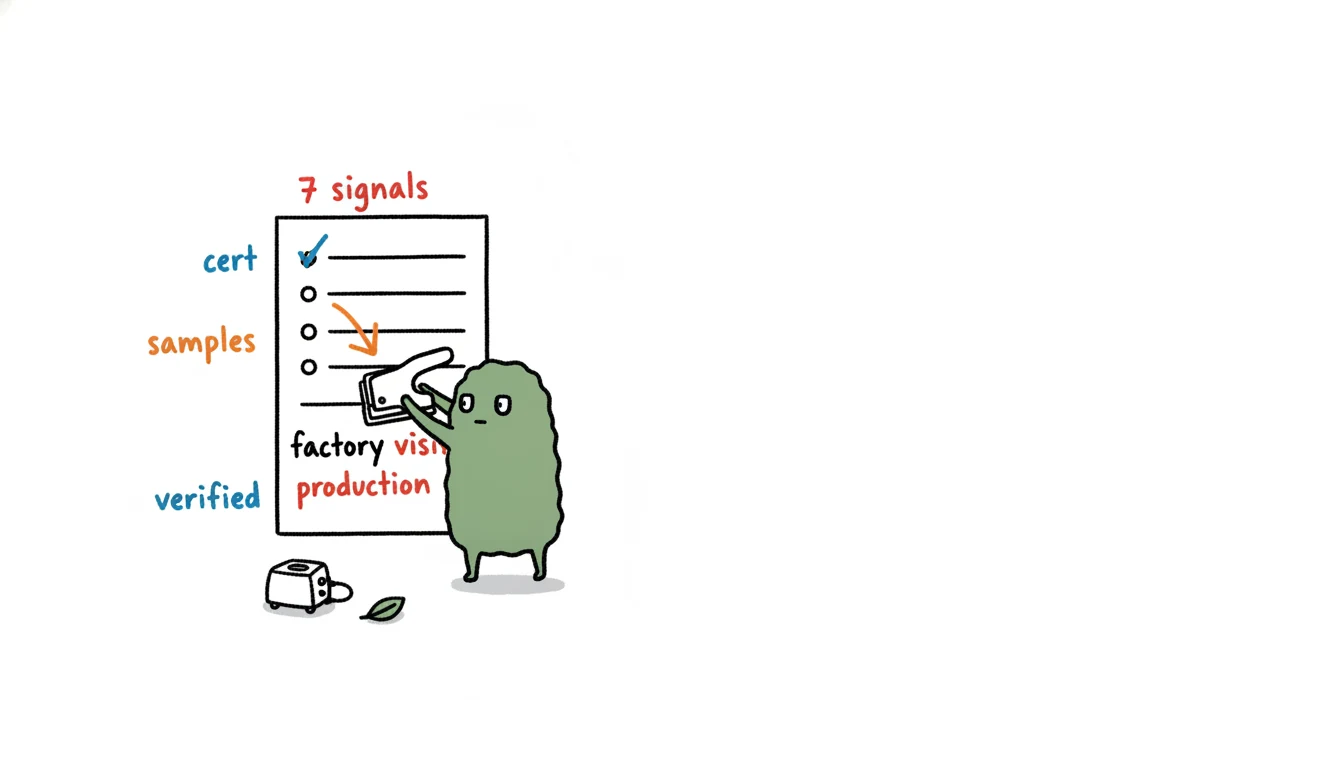
Run every prospective manufacturer through these seven signals. A vendor that scores well on at least 6 of 7 is worth advancing to sample stage; below 5, walk away.
- Signal 1: Certification documentation in writing. Ask for the actual certificate file (UL listing PDF, CE Declaration of Conformity, RoHS test report) — not photos of stickers, not screenshots of summary pages. Verify UL listings on the UL online database using the file number. CE certificates should reference the underlying LVD and EMC test reports.
- Signal 2: QC protocol documented. Per-unit electrical safety test (hi-pot test, ground continuity), temperature curve validation against spec, 24-hour burn-in. Ask the manufacturer to describe the QC protocol on a sample order before you commit. AQL 1.0 on functional defects, 0.65 on safety-critical defects is a reasonable standard.
- Signal 3: Lead time honesty with PO milestones. A manufacturer who quotes “30 days from PO” without breaking down the milestones (deposit confirmation, raw material procurement, tooling start, assembly, QC, pre-shipment inspection, shipment) is hiding production risk. Ask for the milestone breakdown. Compare against your own PO calendar.
- Signal 4: Warranty claim process and parts shipment SLA. Written warranty terms, defective-unit claim process documented, replacement parts shipment timeline (we commit to 5 business days from approved claim). Ask “what happens on Day 400 when a thermostat fails?” — if the answer is vague, the parts pipeline does not exist.
- Signal 5: Spare parts availability for 2–3 years. Heating elements, thermostats, digital controller boards, power supplies, fuses — these are the 5 components that fail in service. A manufacturer that holds 60-day component stock and commits to 2-year parts availability is operating at a higher tier than one that produces and forgets.
- Signal 6: Voltage and plug spec validation at sample stage. Sample units should arrive with the destination voltage and plug type specified at order — not “110V will work everywhere.” A manufacturer that ships a sample with the wrong plug is signaling future production-run errors.
- Signal 7: Communication responsiveness. Time-to-first-quote (we commit to 24 hours), time-to-sample-shipment (we commit to 14–21 days), time-to-complaint-response (we commit to 24 hours written response, 5 business days resolution). A manufacturer that takes a week to respond to a sourcing inquiry will take a month to respond to a quality complaint.
Red Flags to Walk Away From
- “All our products are CE certified.” Certifications are per-model, not per-supplier. A blanket claim usually means no actual certificates exist on the specific SKU you are buying.
- “We can ship 110V or 220V — same unit, just change the plug.” A unit certified for 110V at 50/60Hz is not automatically certified for 220V. Voltage and certification scope are coupled.
- Sample lead time over 30 days. A manufacturer that needs 30+ days to ship a sample of a stock SKU is producing to order, not stocking. Volume production lead times will be even worse.
- No physical address or factory tour offered. Trading companies brochure as factories. A real manufacturer can host a video factory tour or in-person visit; a trader will dodge.
- Pricing that beats the market by 20%+. Component shortages do not allow real factories to undercut the market by 20%. A 20% discount usually means missing certification, lower-grade components, or both.
The Sample Order Test
Once a manufacturer passes the 7-signal screen, run a sample order before committing to production. Inspect the sample on arrival for:
- Power-on test: unit reaches set-point temperature within spec’d pre-heat window
- Temperature accuracy: thermometer reading vs digital display, ±5°C for mechanical, ±2°C for digital
- Voltage and plug type matches order spec, printed on housing and box
- Safety cutoffs: simulate over-temperature condition, verify thermostat trips
- Build quality: housing fit-and-finish, lid seal, cord strain relief, label legibility
- Documentation: user manual in target language, certification certificates included or available
📚 Related pillar: see our full Paraffin Warmer private label & OEM sourcing guide for the broader sourcing frame, MOQ tiers, lead times, and decision framework.



Leave A Comment