
Note: We’ve folded this into our complete private label body butter guide — see the full picture (formulation, MOQ, packaging, vetting, compliance) here: Body Butter Private Label Manufacturing Guide.
“What’s your MOQ for body butter?” is the first question almost every buyer asks a private-label factory. It is also the question where the most assumptions hide. The headline number on a supplier’s website (“MOQ from 100 units!”) rarely survives contact with a real PO — it usually applies to a single base, a single scent, a single packaging spec, and a particular cash-up-front payment term. Cross any one of those boundaries and the number changes. This piece is the framework we use with new B2B buyers to land on a realistic MOQ for their specific spec — and the negotiation levers that move price without raising your committed quantity.
If you arrived here researching body butter sourcing for the first time, our Body Butter Private Label Manufacturer guide covers the upstream decisions (formulation models, scent strategy, packaging). For the supplier-vetting checklist that pairs with this MOQ framework, see How to Vet a Body Butter Manufacturer.
The Three Real MOQ Tiers
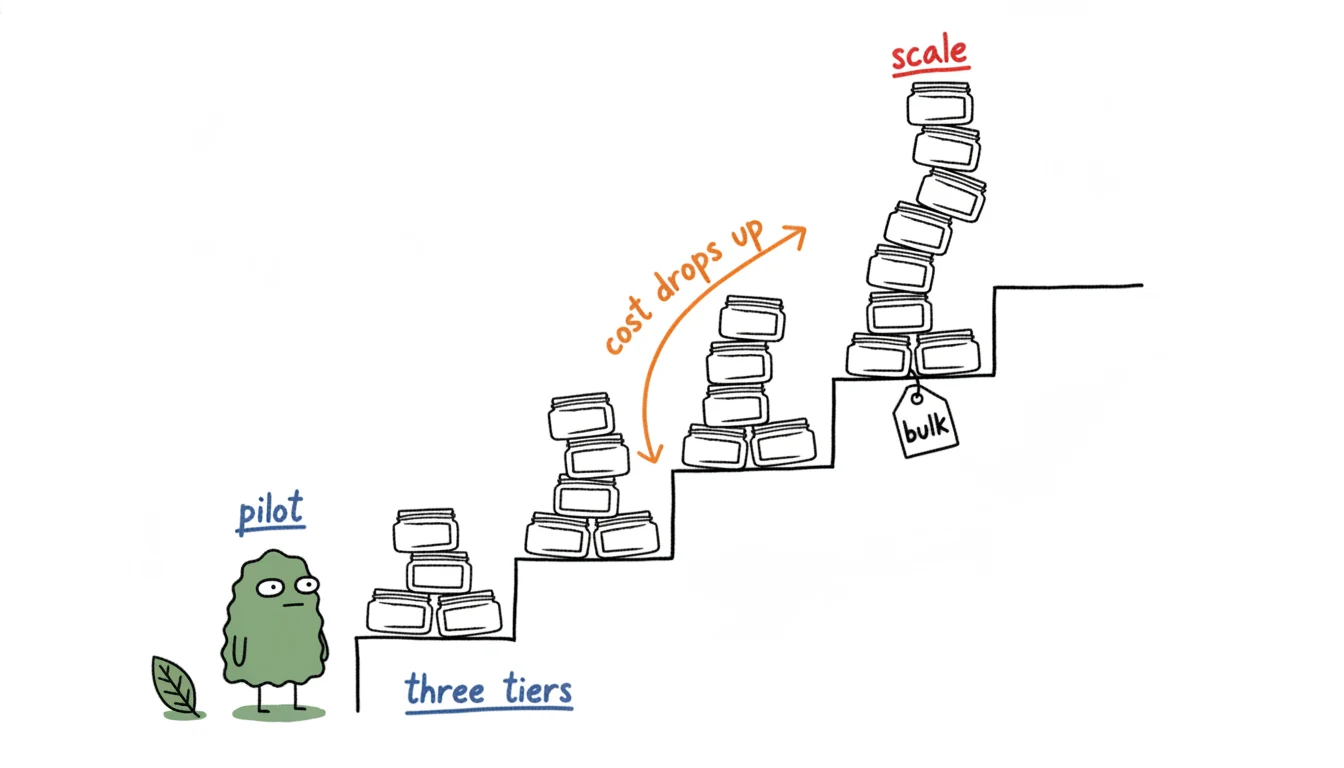
Strip away the marketing-page numbers and you find three real tiers in the body butter category. Each tier has a different per-unit cost, a different relationship dynamic with the factory, and a different expected reorder cadence.
Tier 1 — Trial (300–500 units per scent)
This is the entry tier and the one most first-PO buyers should target. It uses the factory’s stock base, stock packaging molds, and library scent profiles. Lead time is the fastest in the category — 25–30 days. Per-unit cost is the highest of the three tiers, typically $2.20–$4.80 for an 8oz tub depending on scent complexity, packaging spec, and label complexity. The factory accepts this MOQ because the production setup cost is low — they are running your batch on equipment that’s already configured.
The right way to think about Tier 1 is as a market-validation cost, not a margin run. You’re paying $1,000–$2,500 (300 units × cost) to learn whether your label, scent, and pricing land with your target customer. If the answer is yes, your second PO jumps to Tier 2 and your per-unit cost drops 20–30%.
Tier 2 — Standard production (500–2,000 units per scent)
This is where most established private-label brands operate. The factory configures a dedicated production batch for your SKU, runs it efficiently, and per-unit cost drops noticeably. Expect $1.40–$3.20 per 8oz tub at this tier, depending on the same variables. Lead time is similar to Tier 1 (25–35 days) because the bottleneck is component procurement and mixing time, not setup. This is also the tier where modified-stock formulations become economically rational — the formulation modification fee is amortized over a meaningful order size.
Tier 3 — Bulk & scaling (3,000+ units per scent)
The bulk tier is where the per-unit cost curve flattens. From 3,000 units up, you typically see another 15–25% reduction over Tier 2, landing at $0.95–$2.20 per 8oz tub. The factory runs this as a dedicated batch, often with continuous production over 5–10 days, and ingredient procurement shifts to volume-pricing terms with their raw-material suppliers. This is also the tier where full custom formulations become economically rational — a $3,000 development fee amortized across 5,000 units is $0.60 per unit, which a strong product can absorb easily.
Brands sourcing 5–10K units typically also negotiate shared inventory programs — the factory holds a portion of finished goods at their warehouse and ships in waves over 3–6 months, smoothing your cash cycle without raising your MOQ commitment. This is one of the most underused negotiation levers in the category.
What Drives Per-Unit Cost (Beyond Quantity)
Quantity is the single biggest cost driver, but four other variables move per-unit cost more than first-time buyers expect:
- Packaging format. A 12oz PET tub costs roughly $0.30–$0.55 per unit at quantity. The same 12oz in glass costs $0.95–$1.80 per unit. Aluminum tins land between $0.60–$1.20. Pump bottles for salon back-bar are $0.80–$1.40 because of the pump assembly.
- Scent complexity. Single-note scents (rose, vanilla) draw from inexpensive fragrance oils. Layered scents (a “morning citrus with rosemary, ginger, and bergamot” type brief) typically cost 8–18% more per unit because the fragrance house charges more for the compound.
- Hero ingredient cost. Hyaluronic acid at 1% adds roughly $0.10–$0.20 per unit. Vitamin C (stable forms) adds $0.20–$0.40. Niacinamide is cheap (~$0.05). Ceramide is expensive ($0.35–$0.80). Premium “exotic butter” upgrades (mango, kokum, shea nilotica) add 5–12% to the base.
- Label complexity. A standard front-label-and-back-label PET tub is included in the base price. Add wraparound labels, embossed labels, hot-stamped foil, or shrink-sleeve labeling and per-unit cost rises $0.15–$0.60 depending on the technique. Custom carton printing adds $0.10–$0.30 per unit.
The cost spread between a “minimum spec” 8oz PET tub at Tier 3 ($0.95) and a “premium spec” glass jar with vitamin C, ceramide, and embossed label at Tier 1 ($6.50+) is roughly 7×. Most B2B buyers do not need either extreme — the sweet spot for first-PO buyers is usually a mid-spec PET tub at Tier 1 or 2, around $2.40–$3.60 per unit.
Hidden Costs That Inflate the True Per-Unit Number
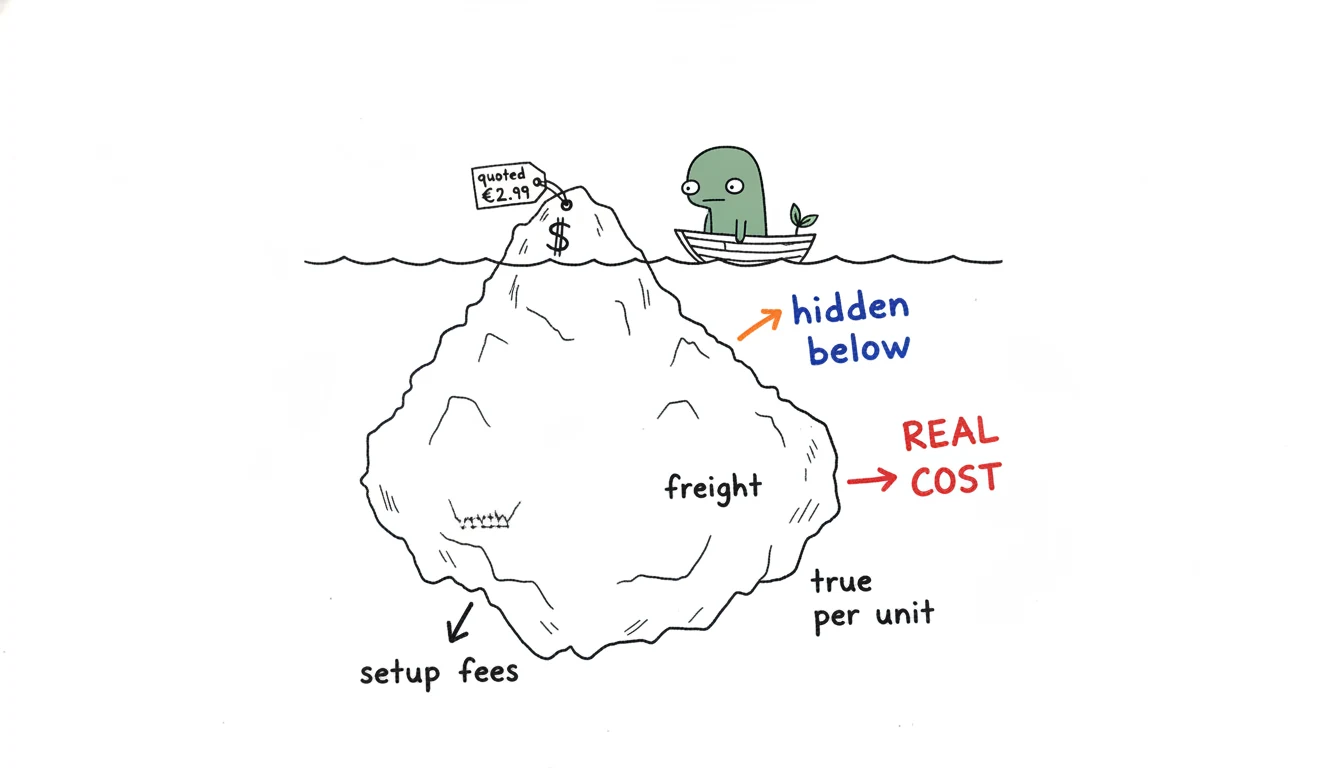
The headline per-unit price is rarely the true landed cost. Five categories of hidden cost commonly catch first-time buyers:
- Tooling fees. Custom packaging molds run $4,000–$12,000 and are not refundable if you switch factories. Always ask “what’s the tooling cost and who owns the mold after?” before signing.
- Formulation development fees. Modified-stock fees are typically $400–$1,200 one-time. Full custom is $1,500–$5,000. Sample-only POs (no production commitment) often carry a $200–$500 sample fee that’s credited against your first production order.
- Compliance documentation fees. A 90-day accelerated stability test costs $300–$800 per SKU if not already on file for that formulation. Microbiological safety panels run $200–$500. Allergen declarations are usually free if requested upfront, $150–$300 if requested after production.
- Freight & duty. Body butter ships well — viscous, non-flammable, no special HazMat handling. Ocean freight from Asia to US West Coast is currently $8–$14 per cbm at FCL rates. Add 5–10% duty rate depending on HS code classification (3304.99 for body lotions/creams in most jurisdictions).
- Payment terms cost. Most factories offer 30/70 (30% deposit, 70% on B/L) at standard pricing. Net 30 or Net 60 terms typically add 1.5–3% per month to per-unit cost via the factory’s working capital pricing. If your cash flow is tight, the math is sometimes still in favor of paying the premium — but always run it explicitly.
Negotiation Levers That Move Price Without Raising MOQ
If your MOQ commitment is fixed (cash flow, warehouse space, or a clean validation budget), there are still six levers that meaningfully move per-unit pricing in your favor:
- Bundle multiple scents in one PO. A single PO with 4 × 300-unit scent variants is cheaper per unit than four separate POs of 300 units each, because procurement and setup overhead is amortized once.
- Bundle multiple categories in one PO. Buyers who source body butter alongside cuticle oil, sugar scrub, or massage lotion typically get a 5–12% bundle discount because freight, customs, and inspection cost amortize across the combined shipment.
- Pre-buy 12 months of forecasted demand. Even at Tier 1 quantity, committing to a 12-month forecast (with quarterly call-offs) often unlocks Tier 2 pricing. The factory locks production capacity, you lock pricing.
- Pay 50% deposit instead of 30%. Worth 1–2% per unit in working-capital savings to the factory, often passed back as a discount.
- Use stock packaging. Anything that uses the factory’s existing molds avoids tooling cost and trims 8–15% off per-unit landed cost compared with custom packaging.
- Allow flexible scent fill. If you give the factory the option to fill ±10% on individual scent variants (within the same PO total), they can balance their production line and typically discount 3–5%.
Practical Numbers for Three Common Scenarios
To make this concrete, three real scenarios with indicative numbers (US-bound, EXW factory pricing, FY 2026):
- DTC brand launch, 1 SKU, validating demand. 500 units × 8oz PET, custom label, single-note scent, hyaluronic acid. Per-unit landed: $3.10–$3.60. Total invoice: $1,550–$1,800. Lead time: 28–32 days. Best path: Tier 1, modified-stock formula with HA addition.
- Salon distributor, 4 SKUs, retail line. 1,000 units each × 4 scents × 12oz PET, branded label, library scents. Per-unit landed: $2.20–$2.70. Total invoice: $8,800–$10,800. Lead time: 35–40 days. Best path: Tier 2, stock formula with bundle discount.
- Hospitality amenity buyer, 1 SKU, single hotel chain. 5,000 units × 2oz aluminum tin, simple label, signature scent (custom). Per-unit landed: $1.50–$1.80. Total invoice: $7,500–$9,000. Lead time: 50–60 days (custom scent + tooling). Best path: Tier 3 with custom scent development.
If you are at the planning stage and want a tailored quote for your spec, you can request a quote here — we typically respond inside 24 hours with MOQ scenarios, indicative per-unit pricing, and lead time for your specific PO shape. Representative SKUs we ship at the three tiers above include our 12oz custom-scented base, the 1 Gallon salon format, and the 5 Gallons bulk refill format.
Companion Reading: Formulation Deep-Dive
For the ingredient and formulation-mechanics decisions, see two new spokes: body butter base butters compared (shea vs cocoa vs mango vs murumuru vs kokum — cost, melt point, feel, brand-story, blends, SRP positioning) and body butter formulation guide (anhydrous vs water-containing, whipped vs unwhipped, preservation, melt-point targeting by shipping lane, packaging compatibility).
📚 Related pillar: see our full Body Butter private label & OEM sourcing guide for the broader sourcing frame, MOQ tiers, lead times, and decision framework.


Leave A Comment