
Vetting a wax heater manufacturer is not the same as vetting a cosmetic supplier. Small electricals fail differently: they do not go off-spec on a test strip, they catch fire in a salon at 2 AM. The reputational and liability downside of choosing the wrong factory is asymmetric, which is why we wrote this checklist. Eight signals, each actionable, each grounded in what actually distinguishes factories that survive a decade from those that disappear after two seasons.
For the broader sourcing context, see our 2026 B2B buyer guide. For MOQ and pricing math, see Wax Heater MOQ & Wholesale Pricing. This piece is the supplier-side diligence layer.
Signal 1 — Safety Certification Verification
Certifications are the single most-faked element in the wax heater supplier universe. A CE sticker is not a CE certification; a screenshot of a UL listing page is not a UL listing. What to ask for and how to verify:
- Request the full Declaration of Conformity (CE) or UL File Number — not a logo image.
- Verify UL file numbers on the UL Product iQ database directly. Takes 90 seconds per model.
- Ask whether the cert is per-model or per-family. A family listing covering one specific SKU does not extend to a cosmetically similar one.
- Check the cert issue date. Certifications older than five years are often in renewal limbo — confirm they are current.
- Ask for the test-lab name and location. Legitimate cert bodies are accredited and traceable; vague “third-party lab” language is a red flag.
Signal 2 — Factory Audit Records
Third-party factory audits (BSCI, Sedex SMETA, WCA) exist because retail buyers demand them before shelf placement. Factories that pass these audits maintain documented processes, which correlates strongly with production consistency. Factories that refuse audits are not automatically bad, but the absence removes a data point you want.
- Ask for the audit report summary, not just “yes we are audited.”
- Check the audit date. Reports older than 24 months need renewal for most retail buyers.
- Look at the non-conformities section if shared. A zero-non-conformity audit is statistically unlikely; honest reports with minor NCs that were closed are more credible than suspiciously perfect ones.
- Ask whether your brand can be listed on the factory’s audited SKU manifest — useful if you plan to distribute through major retailers who request this chain of custody.
Signal 3 — Sample Testing Protocol
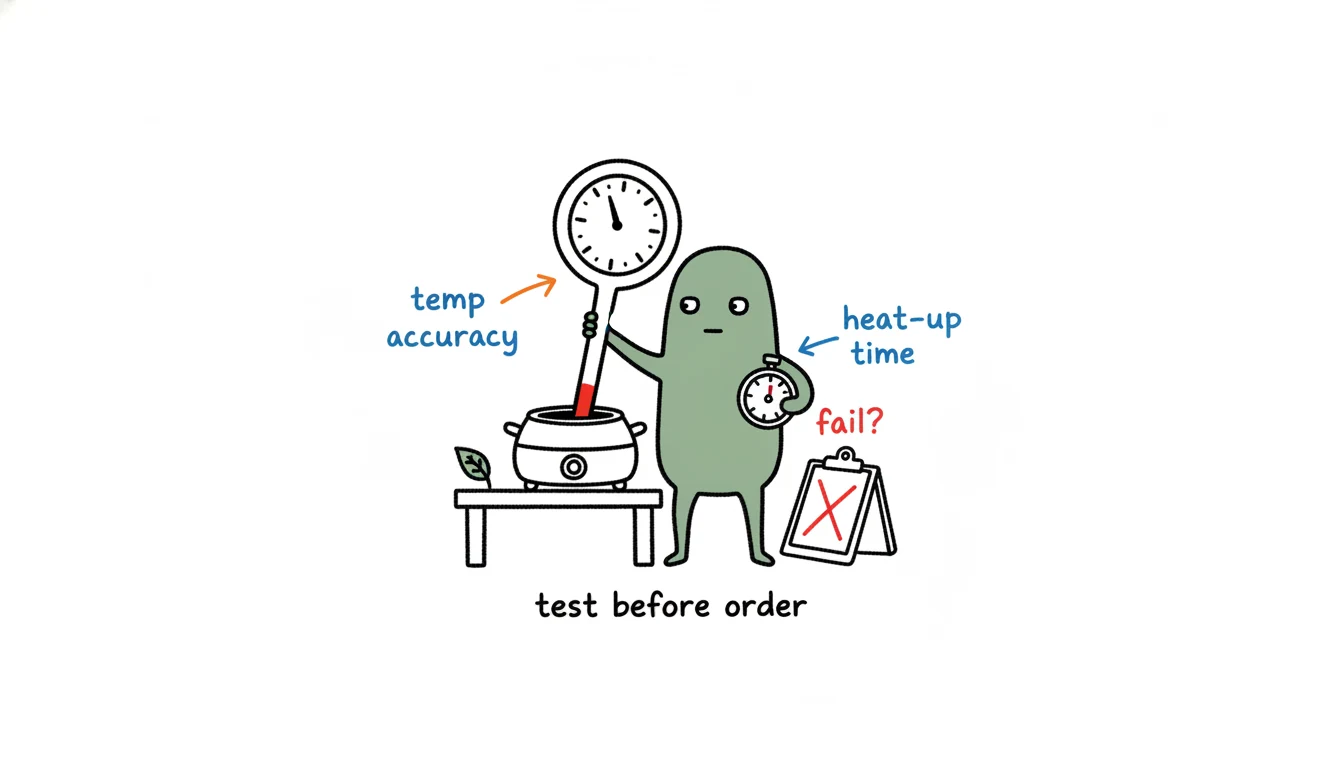
Before committing to a production order, the sample is the only real data you have about what you are buying. Run it properly:
- Duty-cycle test. Power the unit on for 8 hours continuously, measure temperature drift every 30 minutes with an external thermocouple. More than 10°C drift is a hard fail.
- Thermal recovery test. Scoop out 50% of the wax at temperature, time how long the unit takes to return to set point. Under 4 minutes is excellent, 4–8 minutes is acceptable, over 8 minutes fails professional service.
- Plug inspection. The plug should carry the appropriate regional certification mark molded in (CE, BS, UL), not as a printed sticker.
- Cord strain relief. Pull the cord out at the housing junction with reasonable force. A quality cord resists without play; a failed strain relief exposes wires and becomes a safety failure in 6 months of use.
- Documentation review. The unit should ship with a user manual in at least English plus your target market’s language, a warranty card, and a carton with clear country-of-origin marking.
Signal 4 — QC Sampling Rate (AQL)
AQL (Acceptable Quality Limit) is the statistical framework factories use to decide how many units to inspect from each batch. Ask directly:
- What AQL level is used for cosmetic defects? (Industry norm: AQL 2.5)
- What AQL level is used for functional defects? (Industry norm: AQL 1.0)
- What AQL level is used for safety-critical defects? (Industry norm: AQL 0.65 or tighter)
- Is there a pre-shipment inspection gate, and can the buyer send a third-party inspector?
A factory that cannot articulate its AQL rates either does not use them or does not want you to know the numbers. Both are warning signs.
Signal 5 — Lead Time Track Record
Promised lead times are easy; delivered lead times are the signal. Ask:
- What percentage of orders in the last 12 months shipped on time?
- What is the typical delay when orders slip — a week, a month, a quarter?
- How is the buyer notified when slippage is likely? (Proactive 10-day-ahead notice is good; “we will let you know when ready” is bad.)
- Can the factory provide contact references from existing B2B buyers for lead-time verification?
Factories hitting 90%+ on-time delivery over a 12-month window are rare and worth paying a small premium for. Supply-chain reliability compounds; a cheap unit that arrives six weeks late costs more than a market-priced unit that arrives when promised.
Signal 6 — After-Sales Parts and Warranty
Wax heaters fail eventually. The question is whether the unit can be repaired or must be replaced. Parts availability is a B2B decision criterion, not a nice-to-have:
- What is the parts-availability window? Three years minimum post-production is our minimum bar; five years is professional-grade.
- Which parts are stocked? Thermostats, heating elements, inner pots, and indicator LEDs should all be routinely available.
- What is the warranty policy, and who bears the cost of return shipping? Silence on return shipping usually means the buyer pays.
- Does the factory maintain a parts pricing sheet you can reference, or is pricing “case by case”? Published pricing correlates with operational maturity.
Signal 7 — Custom Engineering Capacity
If your private-label plan will evolve into OEM in 18–24 months, vet engineering capacity now. Some factories are pure assembly shops; others have in-house PCB design, mold engineering, and certification filing capacity. The difference shows up when you want a digital display, a custom dial, or a region-specific certification filed under your entity.
- Is PCB design in-house, or outsourced to a third party?
- Does the factory maintain mold tooling on-site, or coordinate with external mold shops? Both are workable; on-site is faster for iterations.
- What is the shortest path from “idea” to “sample” for a small mechanical change? A good factory answers in days; a pure assembly shop answers in weeks.
- Has the factory filed new-model certifications in the last 24 months (UL, ETL, PSE)? This is strong evidence of live engineering capacity.
Signal 8 — Red Flags Checklist
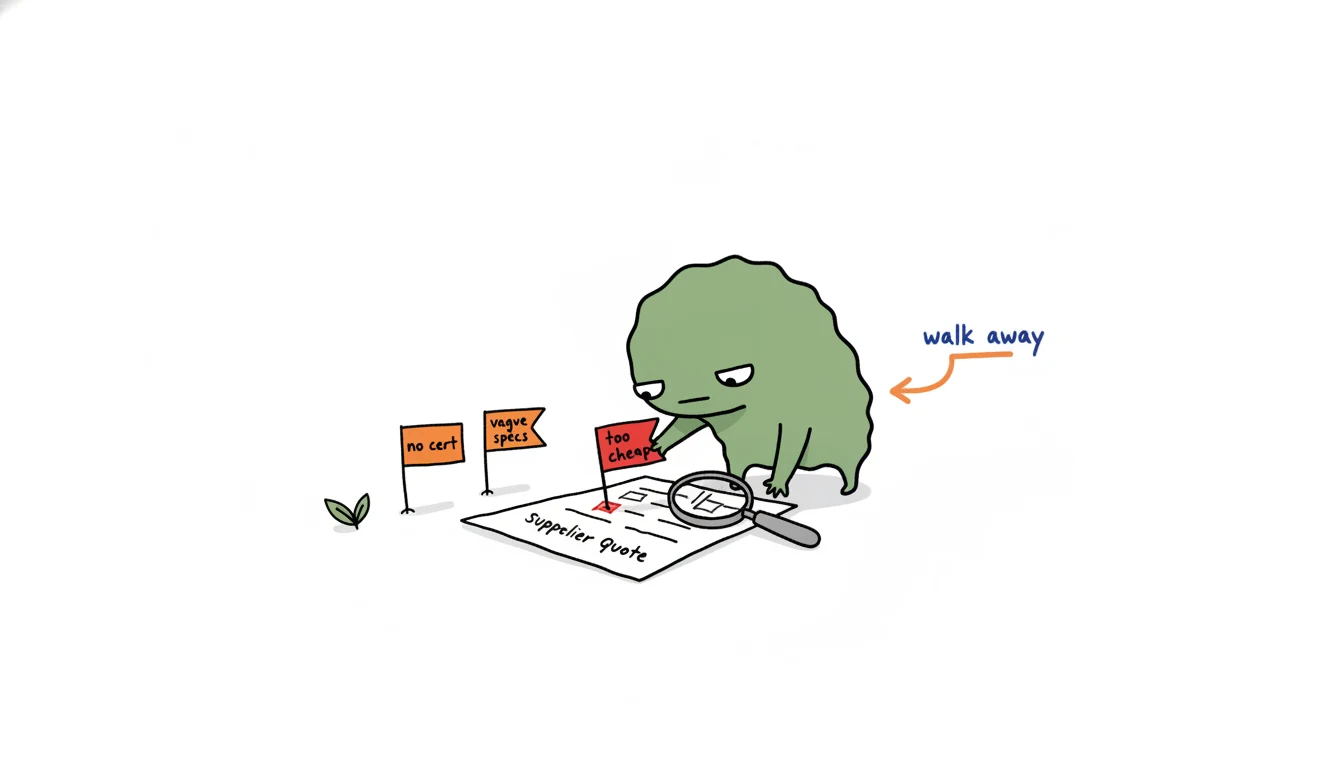
Patterns that should end the conversation, in rough order of severity:
- Certification documents that cannot be verified on the issuing body’s database.
- MOQ numbers that do not match across the quote, the spec sheet, and the Alibaba listing.
- Pricing that is significantly below the market floor. The floor exists for a reason — material and labor cost. Below-floor pricing implies corners are being cut somewhere you cannot see.
- Unwillingness to share AQL rates, lead-time statistics, or parts-availability windows in writing.
- “Universal voltage with adapter in the box” — a regulatory shortcut that fails at customs in any market that enforces plug standards.
- Claims to hold certifications that the factory cannot produce documentation for within one working day. Legitimate certs are organized; opaque certs are usually fiction.
- Reluctance to identify a named contact for post-order support. If the sales rep disappears after the order is placed, you have a problem.
Applying the Checklist
Use this as a pre-RFQ filter and again as a pre-PO final gate. Most suppliers clear the first four signals easily; the last four separate transactional factories from strategic partners. Your selection criteria should scale with your commitment: a 120-piece first order can run on signals 1–4 alone; a 1,000-piece OEM commitment needs all eight.
If you want to run this framework against our operation, start with the depilatory wax heater range for spec and certification visibility, then request a quote with your target market, MOQ, and certification requirements. We will hand you the documents the checklist asks for, up front, without the three-email back-and-forth that usually precedes due diligence.
Frequently Asked Questions
How long does full supplier vetting take before placing a first order?
A thorough vetting run takes 2–4 weeks: one week for certification document review and verification, one week for sample order and testing, and 1–2 weeks for audit report review and reference calls. Compressed timelines are possible but trade diligence for speed.
What AQL levels should I require for wax heaters?
Industry-standard AQL for wax heaters: 2.5 for cosmetic defects (scratches, minor housing blemishes), 1.0 for functional defects (thermostat drift, button malfunction), and 0.65 or tighter for safety-critical defects (wiring exposure, grounding faults). A factory that cannot produce these numbers in writing probably does not track them.
Can I send a third-party inspector to check my production batch?
Yes — this is standard practice for B2B buyers above a certain order size, and a factory that refuses third-party inspection is a serious red flag. Typical third-party inspection services (SGS, Bureau Veritas, Intertek, TUV) perform pre-shipment inspection at the factory for a fixed fee, reporting back on AQL compliance, packaging, and documentation.
What do I do if the supplier fails one or two of the 8 signals?
Failing one signal merits a clarifying conversation; failing two puts the supplier below bar. Some signals are recoverable — for example, lacking a recent BSCI audit is fine if the factory is scheduled for one in the next quarter. Others are not — falsified certifications, for example, should end the relationship immediately.
📚 Related pillar: see our full Wax Heater private label & OEM sourcing guide for the broader sourcing frame, MOQ tiers, lead times, and decision framework.


Leave A Comment