
Note: We’ve folded this into our complete guide — see the full, up-to-date picture here: Depilatory Wax Heater Wholesale Buyer Guide.
MOQ is the first number every wax heater buyer asks about, and the number most often misquoted on supplier websites. “MOQ 1 piece” on an Alibaba listing is a retail-stock fiction; “MOQ 5,000 pieces” on a spec sheet is usually a copy-paste from a different product. The real numbers live in the middle, and they shape every downstream sourcing decision — how much capital you need, whether you can afford a pilot run, and how fast per-unit cost falls as you scale. This guide lays out the actual tiers we quote and the math behind each one.
If you are new to the wax heater category, start with our 2026 B2B buyer guide for the full sourcing overview. This piece zooms into MOQ tiers, pricing components, and negotiation levers.
Why Wax Heater MOQ Is Different From Consumables
Consumables like wax beads run at MOQ 50–100 cartons because the production line runs continuously and the only variable is packaging. Wax heaters are different — every order triggers a mini production cycle: plastic injection batch, PCB pick-and-place, heating element and thermostat sourcing, assembly line setup, aging test, QC. Each step has fixed setup cost, and that cost is amortized across the order. Below a threshold, the per-unit economics stop making sense for both sides.
That threshold is where our 120-piece entry MOQ comes from. Below 120 units per model, the setup cost per heater pushes pricing into the retail zone, which defeats the point of wholesale sourcing. Above 120, the math becomes progressively more attractive.
The Four MOQ Tiers That Matter
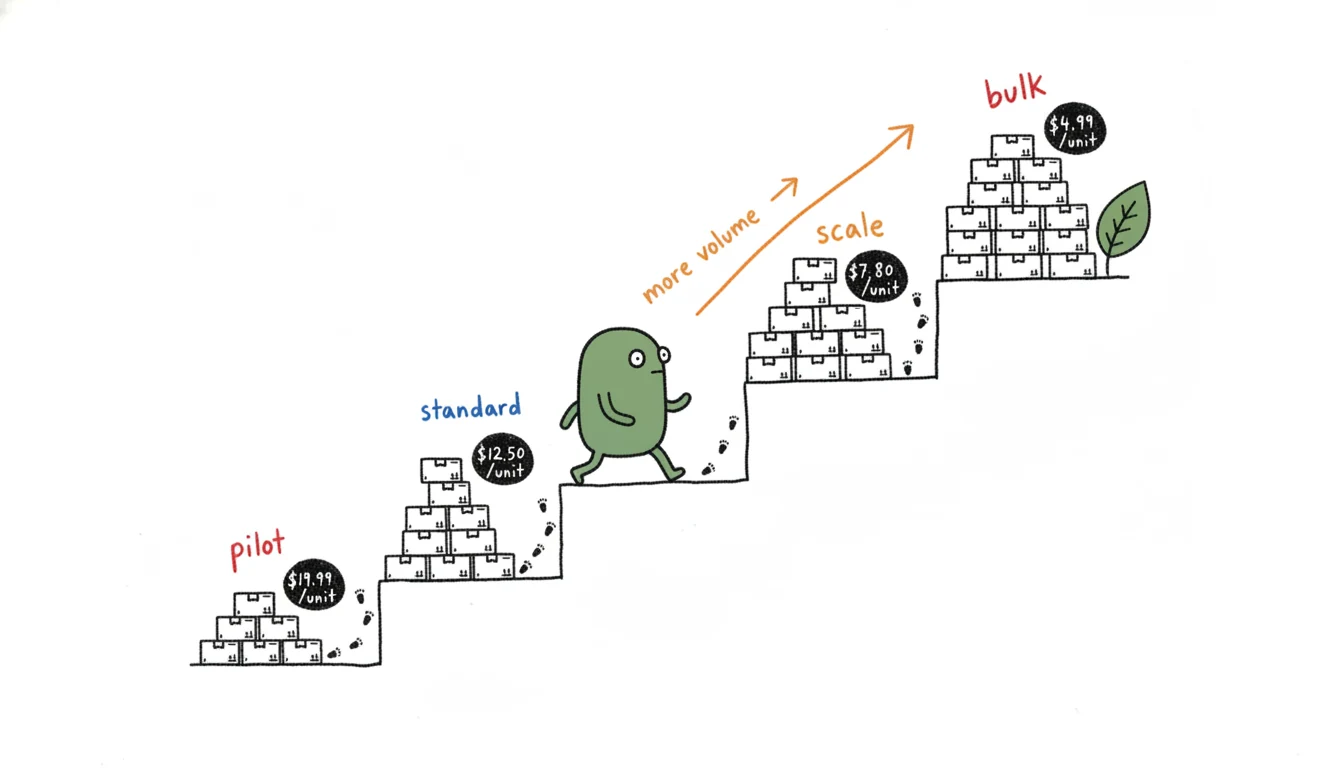
- Entry tier (120–299 pcs). Standard private-label with logo silk-screen, stock housing color, stock carton with your artwork. Representative lead time 30–40 days. Best fit for first-order buyers, regional distributors testing a new SKU, or Amazon sellers launching a pilot.
- Growth tier (300–499 pcs). Unlocks meaningful per-unit discount (usually 8–12% below entry). Custom housing color from the Pantone library becomes viable. Lead time similar to entry.
- Scale tier (500–999 pcs). Per-unit cost typically lands 15–20% below entry. Custom molded accessories (removable pot design, custom dial) become realistic. Certification filings (UL, ETL) under your own entity start to make economic sense at this volume.
- Bulk tier (1,000+ pcs). Full OEM flexibility: custom housing mold, custom PCB with digital display or memory function, bundled kit SKUs with wax consumables. Per-unit cost usually 25–35% below entry. Lead times extend 10–20 days for the tooling cycle but per-unit economics change the business model.
Per-Unit Cost: An Illustrative Math Table
Exact numbers vary by model, certification bundle, and plug region, but the curve looks predictable. Here is an illustrative example for a mid-range 800 ml single-pot heater with CE certification and EU plug:
- 120 pcs: per-unit $22 (index 100)
- 300 pcs: per-unit $19.50 (index 89)
- 500 pcs: per-unit $18 (index 82)
- 1,000 pcs: per-unit $15.80 (index 72)
- 3,000 pcs: per-unit $13.90 (index 63) — full OEM tooling amortized
The steepest per-unit savings are between 120 and 500 pieces — roughly 18% off entry pricing. Buyers who can afford to size up from 120 to 300–500 get most of the scale economics without the capital commitment of a full OEM run.
Sample Orders and Pilot Runs
Before a production order, most serious buyers want to see the unit. Our sample policy:
- Paid samples. Retail-equivalent pricing plus shipping; sample cost credited against your first production order above MOQ. Typical sample turnaround: 3–5 days from stock inventory.
- Branded sample. 5–10 pieces with your logo on a stock housing, useful for trade shows, investor demos, or retailer pitch meetings. Tooling-free — silk-screen on an existing unit. Lead time 7–10 days.
- Pilot run. Not the same as a sample. A pilot is a real production batch at 60–80 pieces with abbreviated QC, useful only when the main barrier is formal MOQ and you have a confirmed path to a full order within 60 days. Pilots are case-by-case, not a standing policy.
What Drives the Price: Pricing Components
When a wax heater price quote lands in your inbox, here is how the stack actually decomposes (illustrative):
- BOM (raw materials). 40–55% of ex-works price — plastic housing, heating element, thermostat, PCB, wiring, plug, indicator LED, retail carton.
- Labor and assembly. 8–15% — assembly line time, QC labor, packaging labor.
- Tooling amortization. 0–10% — zero on stock housing, meaningful on custom mold at bulk tier.
- Certification amortization. 2–8% — CE is low-cost on established models; UL/ETL filings for a new model can add $1–3 per unit if amortized over 500 pieces.
- Factory margin. 8–15% — healthy factories need margin to reinvest in QC and tooling; below-market margins usually mean cut corners somewhere.
- Packaging and carton. 3–6% — retail carton artwork, inner protective foam, user manual print.
Buyers who understand this stack negotiate better. “Can you match $18.50?” is a weaker ask than “What if we standardize on stock housing color to cut tooling — can you match $18.50 at that tier?”
Negotiation Levers That Actually Work
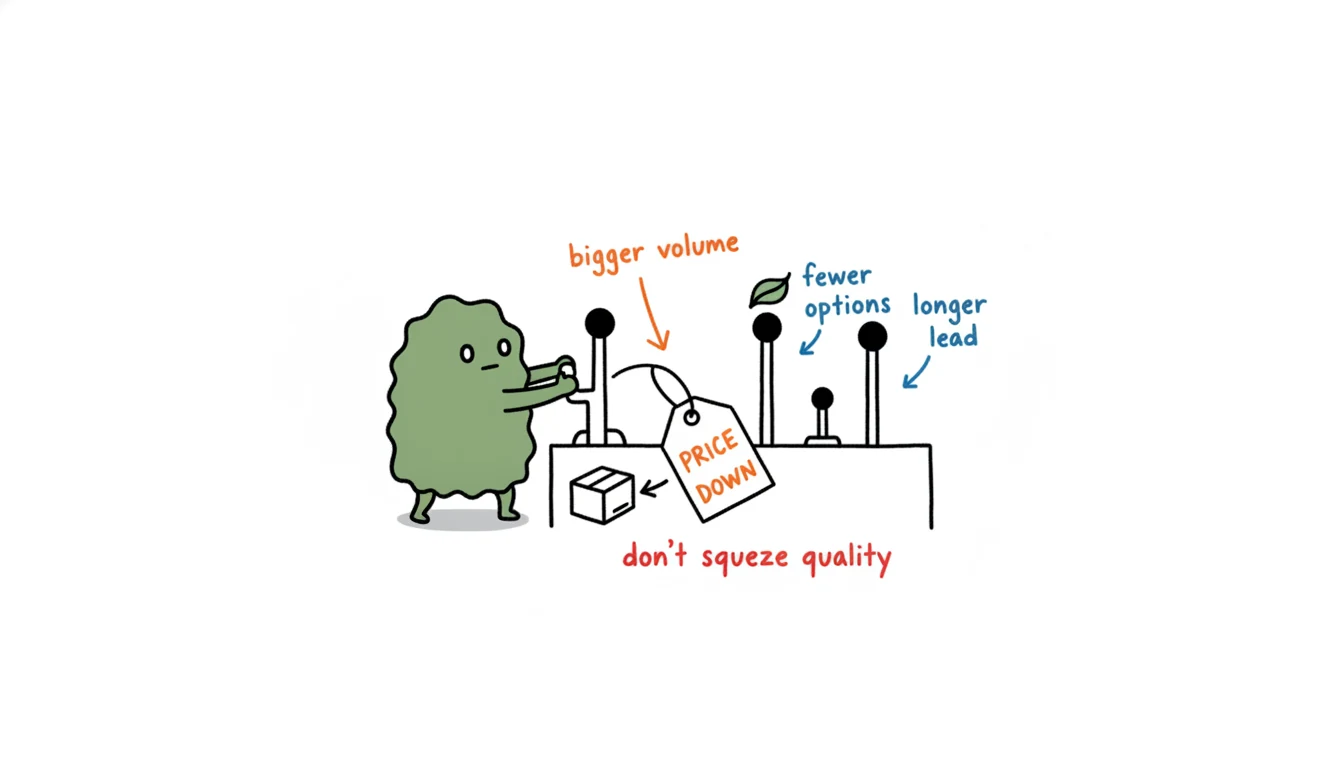
- Bundle SKUs under one PO. Combining a roll-on model + a single-pot model in the same shipment unlocks shared shipping and documentation cost. Per-unit discounts of 3–5% are realistic if total volume hits scale tier.
- Commit to a forward quarter. A PO that covers Q3 + Q4 with a phased shipment schedule lets the factory plan material procurement against known demand. Factories discount this meaningfully (4–7%) because it de-risks their side.
- Lock in plug region and color early. Variant explosion is expensive. If your European distribution plan is stable, order 500 pieces EU plug / black housing; do not ask for 125 pieces each across four plug regions and two colors — that is a retail order, not a wholesale one.
- Bring the spec lock. If you know thermostat hysteresis, heating element material, and QC AQL at the first quote, the factory quotes its real number instead of padding for unknown risk.
Red Flags in Low-MOQ Offers
If a supplier quotes you private-label pricing at MOQ 20 pieces, something is wrong. Usually one of these:
- The unit is a retail-stock rebrand — you get an existing product with a sticker slapped on it, not a manufactured batch. Quality is whatever was on the shelf, which is usually near end-of-life stock.
- The quoted price is a loss-leader to win the first order; real production pricing shows up on order two and you lose your negotiating leverage.
- Certifications on the spec sheet belong to a different model, and the one you bought has none. This is the sourcing mistake that costs the most downstream.
Before committing to a supplier at any MOQ tier, run the full vetting checklist: How to Vet a Wax Heater Manufacturer — 8 B2B Signals.
Sizing Your First Order
Our practical advice for first-order buyers:
- If you have no prior sell-through data: 120–150 pcs of one anchor model in one plug region. Use it to validate packaging, certify regional demand, and set up reordering cadence.
- If you have existing distribution and know your attach rate: 300 pcs across one or two models, sized to 6 months of sell-through. Unlocks the 8–12% per-unit discount.
- If you have 12+ months of demand signal and multi-region distribution: 500–1,000 pcs with custom housing color, tiered by plug region. The pricing unlock justifies the capital commitment.
Want quote-level numbers for your specific model, plug region, and size? Request a free quote with your target market, order size, and certification requirements. We will send tier pricing for your exact scenario within 24 hours.
Frequently Asked Questions
What is the absolute minimum order you accept for private-label wax heaters?
Standard entry MOQ is 120 pieces per model with logo silk-screen and stock housing color. We occasionally run case-by-case pilot batches at 60–80 pieces for buyers with a documented path to a full order within 60 days, but pilots are not a standing option.
How much does per-unit cost drop between 120 and 1,000 pieces?
For a representative mid-range single-pot heater, per-unit cost drops roughly 28% from the 120-piece tier to the 1,000-piece tier — most of it between 120 and 500. The 500-piece tier captures about 80% of the total scale savings available before full OEM tooling.
Do you offer sample units before a production order?
Yes. Paid samples ship at retail-equivalent pricing plus shipping, turnaround 3–5 days from stock. The sample cost is credited against your first production order at or above MOQ. Branded samples with your logo on stock housing are available at 5–10 pieces with 7–10 day lead time.
Can I mix different wax heater models in one order to hit MOQ?
Yes, but pricing reflects per-model setup rather than blended scale. A mixed order of 60 single-pot + 60 roll-on units hits our 120-unit MOQ threshold for scheduling purposes but does not unlock the 300-piece discount on either model. Single-model runs at higher volume are more cost-efficient when your demand supports it.
📚 Related pillar: see our full Wax Heater private label & OEM sourcing guide for the broader sourcing frame, MOQ tiers, lead times, and decision framework.



Leave A Comment